Notifications
Clear all
Digital Life — Payments, Phone & Internet
1
Posts
1
Users
0
Reactions
340
Views

Topic starter
Updated 27/09/2026
With Apple’s iPhone Duo now eSIM-only in mainland China, anyone considering buying one needs to understand how Chinese carrier eSIM works before making the switch. The process is straightforward, but device compatibility, in-store activation and the differences between domestic and travel eSIMs are worth knowing in advance.
Smartphone eSIM is now available from China Mobile, China Unicom and China Telecom across mainland China. The service is still officially described as being in commercial trial, but device support has expanded significantly since the three operators launched smartphone eSIM services in October 2025.
For foreign residents in Hainan, the practical process is similar to getting a conventional Chinese SIM: check that your phone supports mainland-China eSIM, go to a carrier-owned service hall and complete the identity verification in person.
For iPhone users, Apple's current mainland-China eSIM instructions specifically tell customers to bring an identity card or passport.
The bigger issue is device compatibility. An overseas phone may support eSIM elsewhere but still be unable to use an eSIM issued by a mainland Chinese carrier.
At a glance
Carriers: China Mobile, China Unicom and China Telecom
Current status: Commercial trial
Foreign nationals: A foreign passport is accepted for Chinese mobile real-name registration. Apple specifically instructs iPhone eSIM customers to bring an identity card or passport.
Activation: In person at a carrier-owned service hall
Physical SIM to eSIM: Supported, subject to carrier requirements
eSIM back to physical SIM: Supported, subject to carrier requirements
Move eSIM to another phone: Supported, subject to carrier requirements
Hainan: Use your carrier's app or customer-service hotline to find a carrier-owned hall that handles smartphone eSIM
China Mobile: 10086
China Unicom: 10010
China Telecom: 10000
Main limitation: Your exact phone model must support mainland-China carrier eSIM
What is eSIM?
An eSIM performs the same basic job as the physical SIM card traditionally inserted into a phone, but the subscriber information is stored electronically on hardware built into the device.
For everyday use, a domestic Chinese eSIM can provide voice calls, SMS and mobile data in much the same way as a conventional SIM.
The main difference is that there is no removable card to insert or replace.
Can foreigners use eSIM in China?
Foreign nationals can use a passport for Chinese mobile-service real-name registration.
China's telephone-user real-name registration rules expressly recognise a foreign citizen's passport as an accepted identity document.
For iPhone eSIM activation, Apple's current mainland-China instructions tell customers to take an identity card or passport to the carrier service hall.
If you already have a Chinese physical SIM registered using your passport, the identity-verification side of the process should therefore be familiar.
Which Chinese carriers support smartphone eSIM?
All three major mainland operators provide smartphone eSIM:
- China Mobile
- China Unicom
- China Telecom
Current guidance from Apple, Huawei and Samsung confirms support from all three operators.
The service is still described as being in commercial trial, and it is not yet available as a fully remote service.
Huawei's current smartphone eSIM guidance says smartphone eSIM business is currently handled through carrier-owned service halls.
How to activate eSIM in Hainan
1. Check your phone first
Before going to a carrier, make sure your exact phone model supports mainland-China eSIM.
For iPhone, check Apple's official mainland-China eSIM page.
Huawei users should check the specifications for the exact handset. For example, the HUAWEI Pura 90 Pro Max supports eSIM from China Mobile, China Telecom and China Unicom.
Samsung's Galaxy S26 series also supports domestic carrier eSIM.
Do not assume that because a phone supports eSIM internationally it will automatically work with a mainland Chinese carrier.
2. Find a carrier-owned service hall
Huawei's current eSIM guidance gives routes through the three carrier apps for finding service locations.
For China Mobile, open the China Mobile app and search for eSIM. The eSIM service section allows you to select a processing location.
For China Unicom, open the China Unicom app and go to:
Services → eSIM Zone → eSIM Mobile Number Card
For China Telecom, open the China Telecom app, search for eSIM, enter the reservation section and select a service hall.
The important point is to use a carrier-owned or self-operated service hall rather than assuming every small agent or franchised shop can process smartphone eSIM.
If in doubt, call the carrier first:
China Mobile: 10086
China Unicom: 10010
China Telecom: 10000
Huawei's eSIM guide includes the current carrier-app routes.
3. Take your phone and identification
For iPhone, Apple says to take:
- your supported iPhone;
- an identity card or passport;
- your existing SIM where applicable.
The carrier completes the identity check and eSIM activation at the service hall.
Before leaving, check that calls, SMS and mobile data are working.
Can I convert my existing Chinese SIM to eSIM?
Huawei's current smartphone eSIM guidance lists four types of carrier transaction:
- opening a new eSIM number;
- converting a physical SIM to eSIM;
- moving an existing eSIM to another phone;
- converting an eSIM back to a physical SIM.
The exact conditions and procedure are set by the individual carrier.
This means changing to an eSIM phone does not necessarily require opening a completely new Chinese mobile number.
Which iPhones support Chinese carrier eSIM?
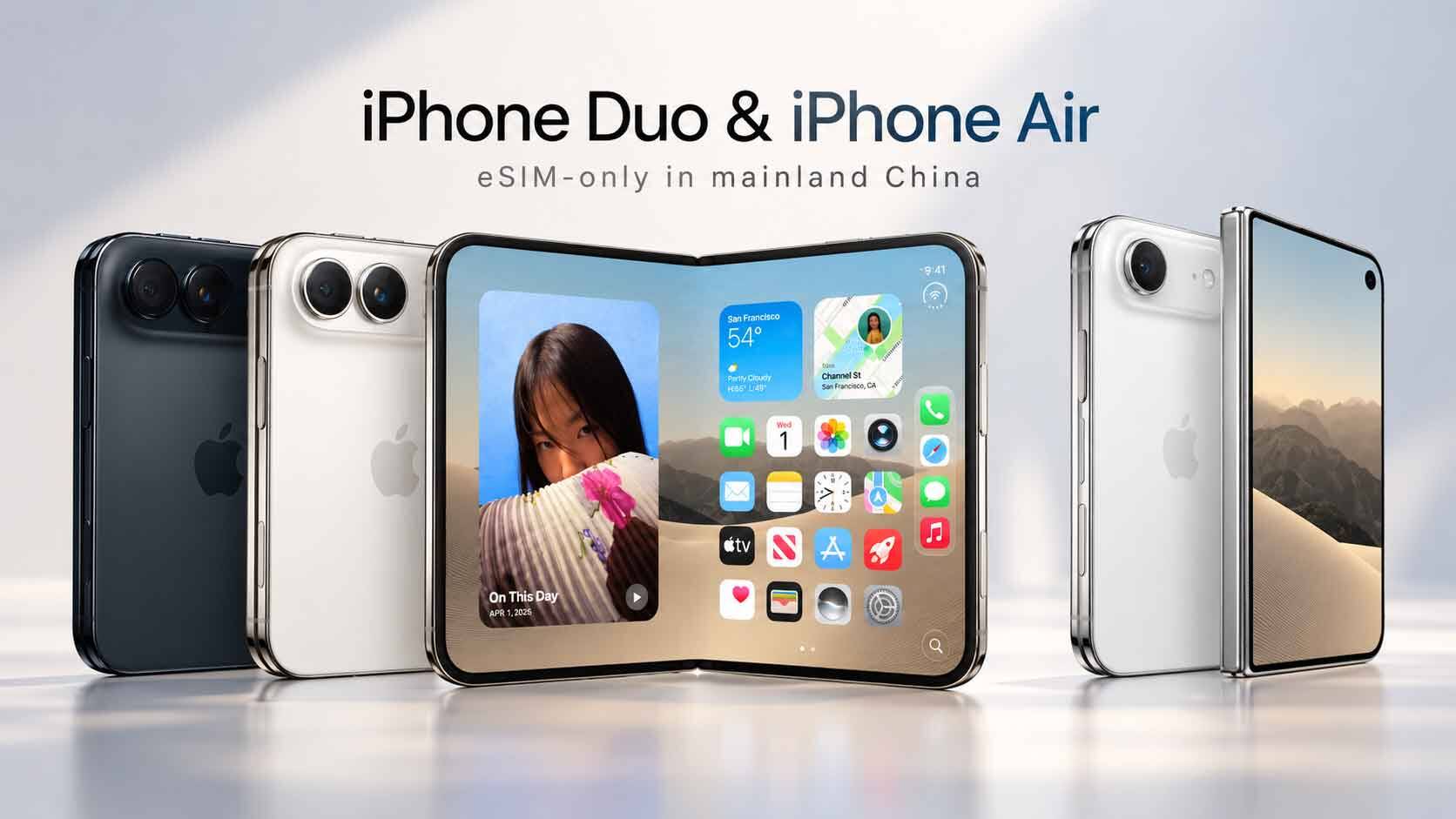
Apple's current mainland-China eSIM guide lists:
- iPhone Air — A3518
- iPhone 17e — A3635
- iPhone 18 Pro — A3715
- iPhone 18 Pro Max — A3718
- iPhone Duo — A3721
There is an important difference between the models.
The iPhone Air and iPhone Duo are eSIM-only.
The iPhone 17e, iPhone 18 Pro and iPhone 18 Pro Max can use either eSIM or a physical nano-SIM.
Apple also states that supported mainland models can store and use up to two eSIMs.
Buying an iPhone outside mainland China? Check carefully
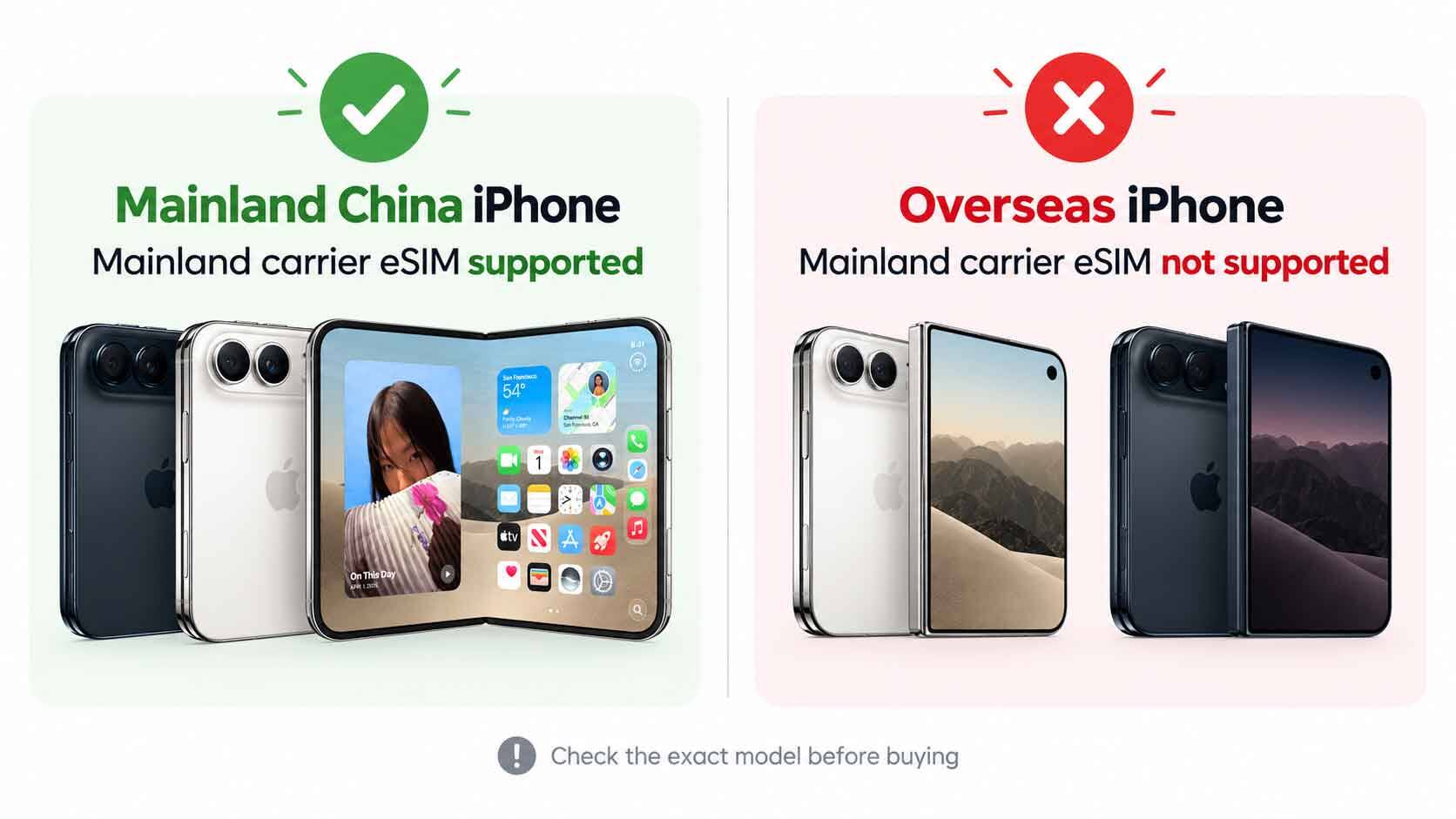
This is particularly important for foreigners.
Apple states that an iPhone bought outside mainland China cannot install an eSIM issued by a mainland Chinese carrier, even if that phone supports eSIM in another country.
In other words, having an “Add eSIM” option on your phone does not automatically mean China Mobile, China Unicom or China Telecom can activate a domestic Chinese eSIM on it.
If you are buying a phone specifically for use with a Chinese eSIM, check the exact mainland model number before buying.
Apple explains the mainland-China restrictions here.
What about Huawei phones?
Huawei now has several mainland models with domestic eSIM support.
The HUAWEI Pura 90 Pro Max, for example, lists China Mobile, China Telecom and China Unicom as supported eSIM operators.
Huawei's current eSIM guidance also covers models including the Pura series and other recent flagship devices.
Do not assume that every Huawei phone supports eSIM. Check the specifications for the exact model before buying.
What about Samsung?
Samsung has also added domestic Chinese carrier eSIM support.
The Galaxy S26, S26+ and S26 Ultra support eSIM from mainland operators.
Unlike Apple's eSIM-only iPhone Air and Duo, the Galaxy S26 family also retains physical-SIM capability.
Samsung states that eSIM service is currently handled through offline carrier service halls.
Chinese domestic eSIM versus a travel eSIM
These are different products.
A domestic eSIM from China Mobile, China Unicom or China Telecom is a Chinese mobile subscription. It can provide a mainland +86 number, ordinary calls, SMS and mobile data.
A travel eSIM sold by an international provider is usually designed primarily to give visitors mobile data while roaming in China.
Many travel eSIMs do not provide a mainland Chinese phone number.
That matters because a Chinese +86 number is commonly used for:
- bank verification;
- WeChat and Alipay;
- government services;
- delivery apps;
- account recovery;
- SMS verification codes.
A travel eSIM can be extremely useful for internet access, but it should not automatically be treated as a replacement for a domestic Chinese phone number.
Apple provides separate guidance on using eSIM while travelling internationally.
Can I use foreign eSIMs on a mainland-China iPhone?
Apple's mainland models have specific rules.
A supported mainland-China iPhone can activate a non-mainland carrier eSIM while you are outside mainland China.
Apple states that Location Services must be enabled during activation.
A non-mainland carrier eSIM cannot be installed on the relevant mainland models while the phone is physically in mainland China.
If you delete a mainland Chinese eSIM and later need to restore it, Apple instructs users to return to the carrier service hall.
Apple explains these restrictions in its mainland-China eSIM guidance.
What does eSIM cost?
There is no single nationwide smartphone-eSIM fee that can be applied to every carrier and every transaction.
Activation, conversion, replacement and mobile-plan charges should therefore be confirmed with the carrier when arranging the service.
The eSIM is simply the way your mobile subscription is stored on the phone. Your voice and data plan remains a separate service.
Does eSIM make your connection faster?
No.
Changing from a physical SIM to an eSIM does not itself improve mobile-network speed.
Performance still depends on factors such as:
- the phone;
- network coverage;
- signal strength;
- congestion;
- the carrier;
- your mobile plan.
The main practical difference is that the mobile subscription no longer requires a removable SIM card.
What has changed since 2025?
When smartphone eSIM launched nationally in October 2025, device support was much more limited and the focus was on the start of the commercial trials.
By September 2026:
- China Mobile, China Unicom and China Telecom all continue to provide smartphone eSIM;
- the service is still officially described as being in commercial trial;
- Apple now lists five mainland-China eSIM-capable iPhones;
- the iPhone Air and iPhone Duo are eSIM-only;
- Huawei has expanded its supported mainland models;
- Samsung now clearly supports domestic carrier eSIM on its Galaxy S26 range;
- physical SIM-to-eSIM conversion and eSIM migration are recognised service options, subject to carrier requirements;
- smartphone eSIM transactions are still handled through carrier-owned service halls.
For most users, the practical sequence is simple: check the exact phone model, locate a carrier-owned service hall, take the phone and required identification, and complete the activation in person.
Quick reference
Carriers: China Mobile, China Unicom, China Telecom
Status: Commercial trial
Foreign passport: Accepted for Chinese mobile real-name registration; Apple specifically instructs iPhone eSIM users to bring an identity card or passport
Activation: Carrier-owned service hall
New eSIM number: Supported, subject to carrier requirements
Physical SIM → eSIM: Supported, subject to carrier requirements
eSIM → physical SIM: Supported, subject to carrier requirements
Move eSIM to another phone: Supported, subject to carrier requirements
Imported iPhone with mainland Chinese carrier eSIM: Not supported
China Mobile: 10086
China Unicom: 10010
China Telecom: 10000
Official sources
MIIT — Telephone User Real-Name Information Registration Regulations
Apple — Using eSIM with iPhone in Mainland China
Huawei — Smartphone eSIM Guide
Huawei — Pura 90 Pro Max Specifications
Samsung China — Galaxy S26 Series
Apple — Using eSIM While Travelling Internationally
This topic was modified 2 hours ago by Patrick Quinn
Posted : 27/09/2026 11:09 am

Register Your Business

Follow Us on WeChat

Jobs in Hainan