Notifications
Clear all
Guides, Whitepapers & Market Data
3
Posts
2
Users
0
Reactions
815
Views

Topic starter
01/02/2026 12:53 pm
Overview
Based on official customs statistics, this article reviews Hainan’s foreign trade performance in 2025, focusing on changes in imports and exports, trade structure, and major partner trends.
Hainan’s 2025 foreign trade data shows overall stability with internal rebalancing.
Official statistics released by Haikou Customs in January 2026 indicate that total foreign trade value for 2025 was broadly unchanged compared with 2024. Within that headline, imports increased while exports declined, and the mix of trade modes shows meaningful movement.
All figures below are taken from the 2025 annual statistical tables published by Haikou Customs and compiled under the Guangzhou Customs system.
1. Overall Trade Performance in 2025
Total trade
- Total import and export value: 27,600,339.79 (RMB, 10,000)
- Year-on-year change: –0.68%
Exports
- Export value: 9,494,579.95 (RMB, 10,000)
- Year-on-year change: –10.62%
Imports
- Import value: 18,105,759.84 (RMB, 10,000)
- Year-on-year change: +5.48%
The headline picture is a broadly stable total for the year, with a clear divergence between imports and exports. Based on customs statistics, this indicates a change in the composition of trade flows.
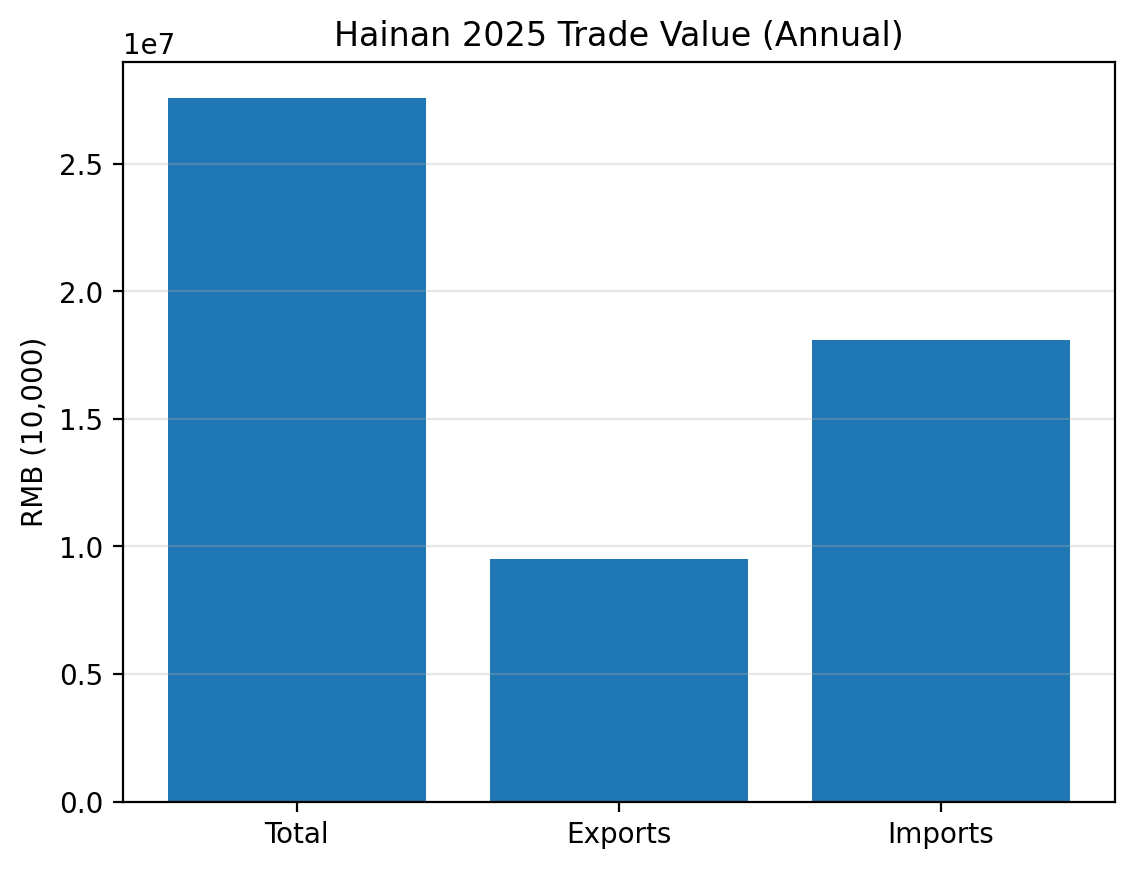
Chart 1 (annual totals)
2. Monthly Performance Pattern
Trade performance varied across the year.
Selected monthly year-on-year changes in total trade:
- March: –1.4%
- April: –15.44%
- July: –31.29%
- September: +25.53%
- October: +15.49%
- December: +32.15%
The second half of the year, and particularly the fourth quarter, showed a notable year-on-year increase compared with earlier months. This indicates that 2025 performance was uneven across the year, rather than moving in a single direction month after month.
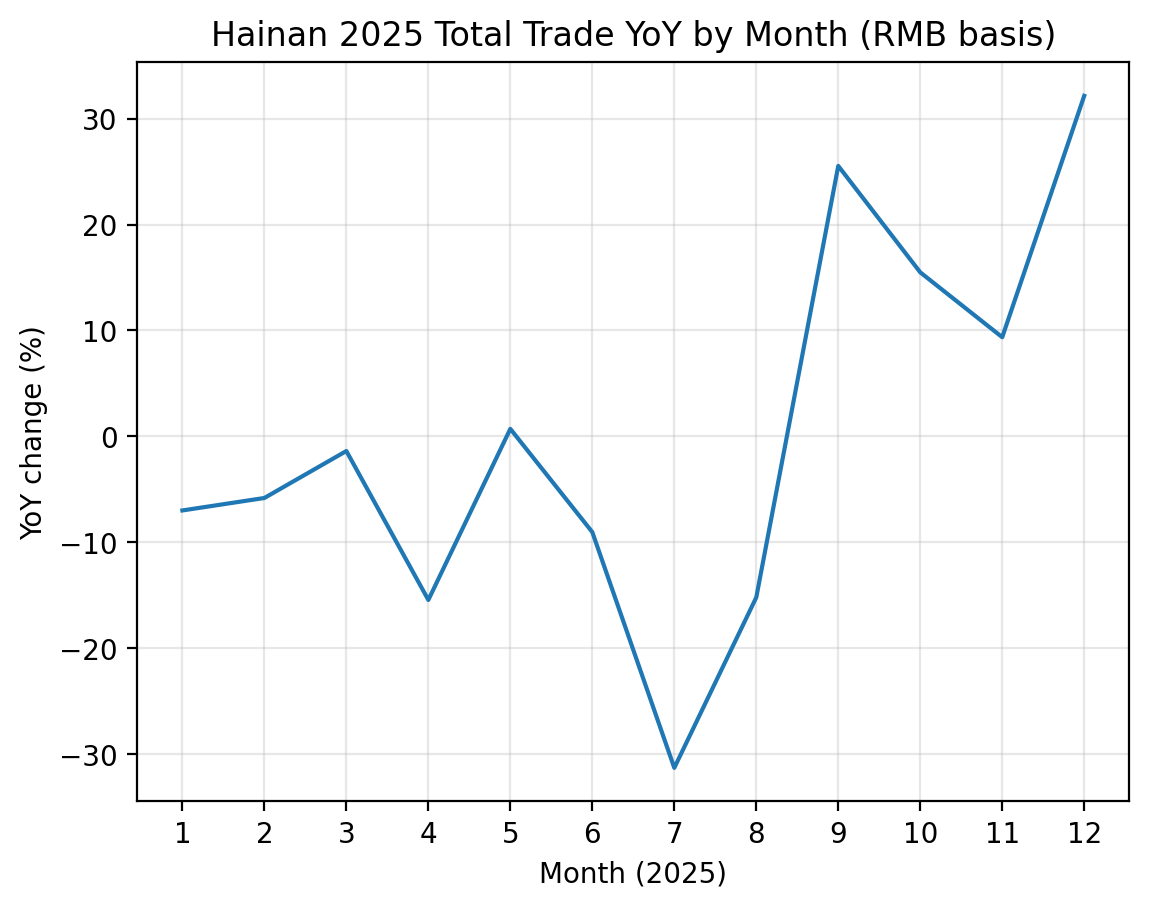
Chart 2 (monthly YoY line).
3. Enterprise Structure: Who Is Trading
Trade by enterprise type shows a strong concentration in private-sector activity.
Share of total trade by enterprise type
- Private enterprises: approximately 71.6%
- Foreign-invested enterprises: approximately 19.6%
- State-owned enterprises: approximately 8.7%
Year-on-year performance
Private enterprises
- Total trade: +11.46%
- Exports: +16.30%
- Imports: +9.18%
Foreign-invested enterprises
- Total trade: –9.62%
- Exports: –30.83%
- Imports: +32.33%
State-owned enterprises
- Total trade: –40.31%
- Exports: –86.94%
- Imports: –26.36%
These figures indicate that private enterprises account for the largest share of Hainan’s recorded trade value in the customs tables, while foreign-invested enterprises were more active on the import side than the export side in 2025.
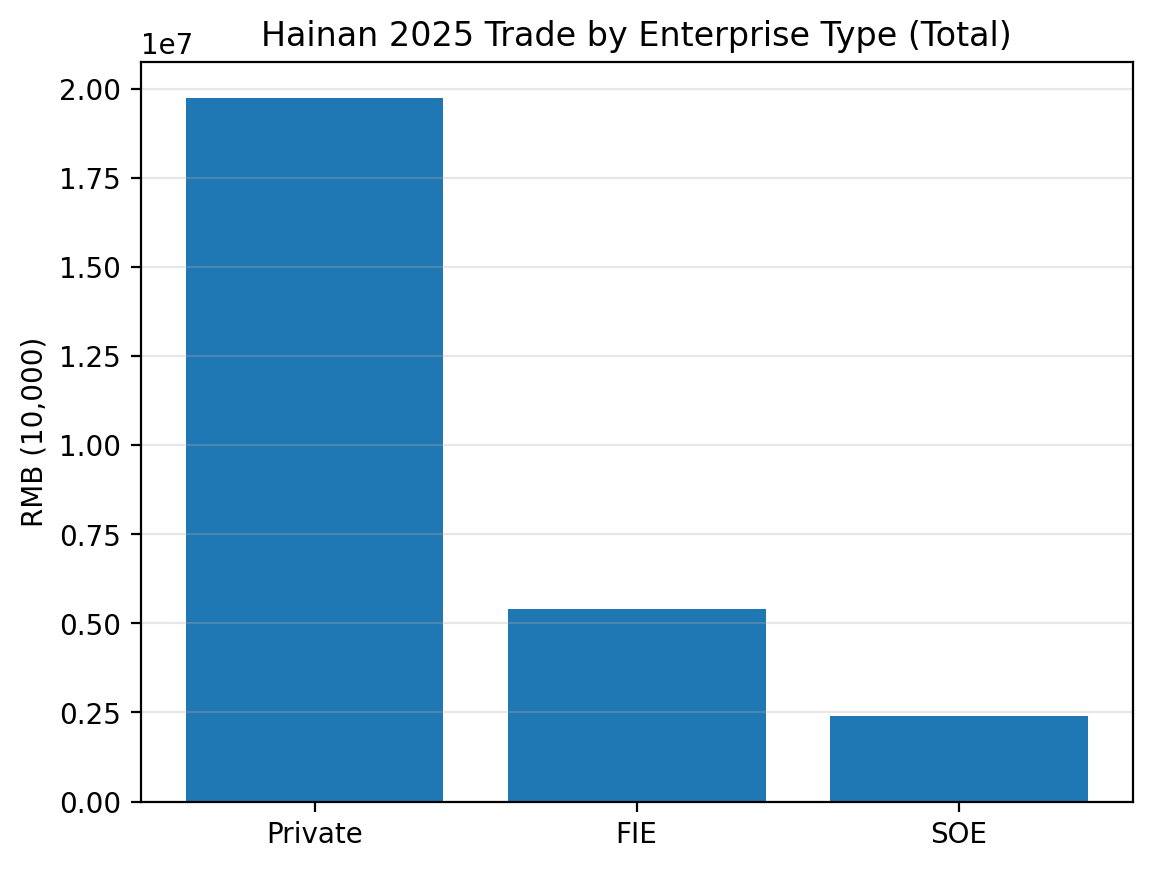
Chart 3 (enterprise totals)
4. Trade Mode: Composition Shift in the Data
Trade by mode (share of total)
- General trade: approximately 67.7%
- Bonded logistics: approximately 17.2%
- Processing trade: approximately 8.7%
- Other trade types: approximately 6.4%
Year-on-year changes
General trade
- Total: –5.70%
- Exports: –11.43%
- Imports: –1.85%
Bonded logistics
- Total: +16.33%
- Exports: –29.18%
- Imports: +45.59%
Processing trade
- Total: +13.40%
- Exports: +14.14%
- Imports: +12.77%
Bonded logistics imports increased significantly year-on-year, which is one of the clearest structural signals in the 2025 tables. This is consistent with a higher share of logistics-linked activity reflected in the trade mode breakdown.
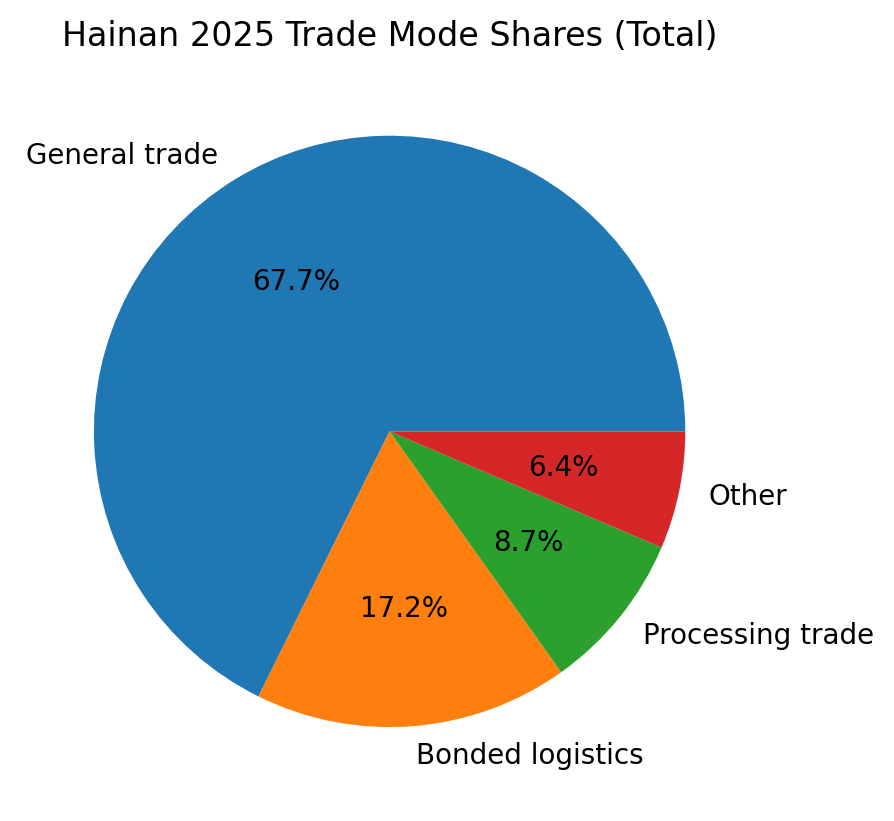
Chart 4 (trade mode shares).
5. Transport Mode: How Goods Are Moving
Share of total trade by transport mode
- Sea transport: approximately 79.1%
- Air transport: approximately 12.2%
- Road transport: approximately 5.2%
- Rail transport: approximately 1.0%
Year-on-year changes
Sea transport
- Total: +3.02%
Air transport
- Total: +1.35%
- Imports: +20.97%
- Exports: –37.99%
Rail transport
- Total: +83.47%
- Imports: +114.43%
Sea transport remains the dominant channel by value in the customs tables. Air transport growth is driven primarily by imports, and rail transport remains a small share but shows rapid year-on-year growth from a low base.
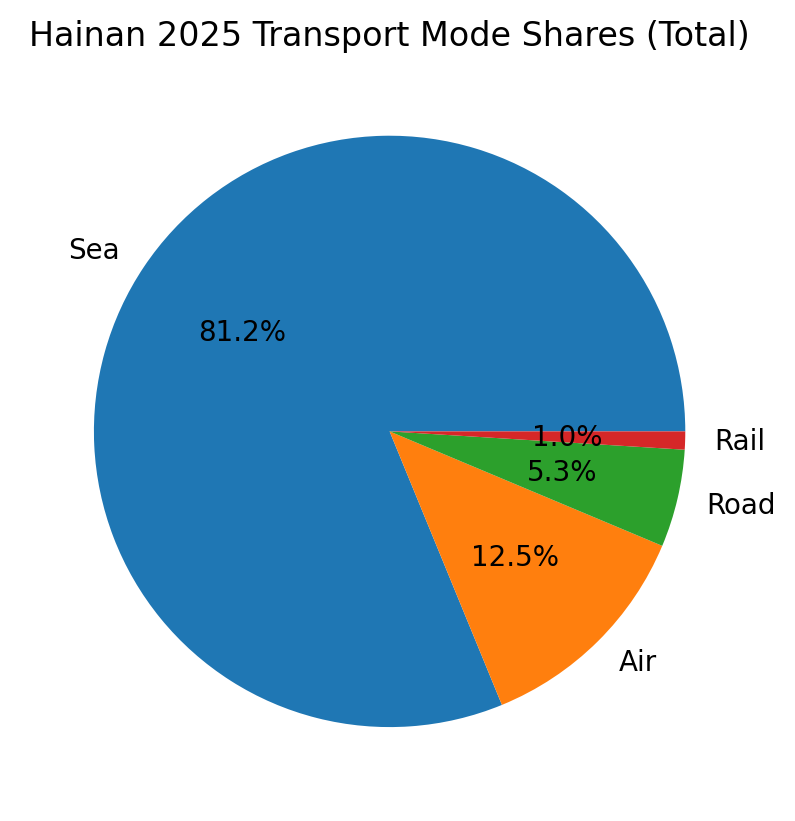
Chart 5 (transport mode shares)
6. Major Trading Partners
Top trading partners by total trade value in 2025:
- Australia: 3,508,098 million RMB, +8.32%
- United States: 1,428,381 million RMB, –2.00%
- Indonesia: 1,295,323 million RMB, –9.64%
- Russia: 1,067,741 million RMB, –36.63%
- Vietnam: 1,012,244 million RMB, –2.97%
- United Arab Emirates: 949,981 million RMB, –11.46%
- Hong Kong (China): 934,535 million RMB, –30.51%
- Oman: 859,478 million RMB, +28.79%
- Canada: 791,294 million RMB, –1.54%
- Brazil: 772,891 million RMB, –20.54%
These partner rankings reflect diversification across commodity suppliers, regional markets, and major economies, as recorded in the customs partner table. This section does not include regional aggregates that are not explicitly published in the partner table.
7. Product Structure: What Was Traded
The product tables list published category totals and their year-on-year changes. Shares below are calculated using the published annual totals and rounded.
Main export categories (selected published category totals)
- Mechanical and electrical products: 40.3% of exports, –17.82%
- High-tech products: 13.8%, –39.39%
- Refined oil products: 10.0%, –34.42%
- Agricultural products: 6.1%, +0.95%
- Steel products: 5.3%, +24.37%
- Food products: 5.3%, –4.26%
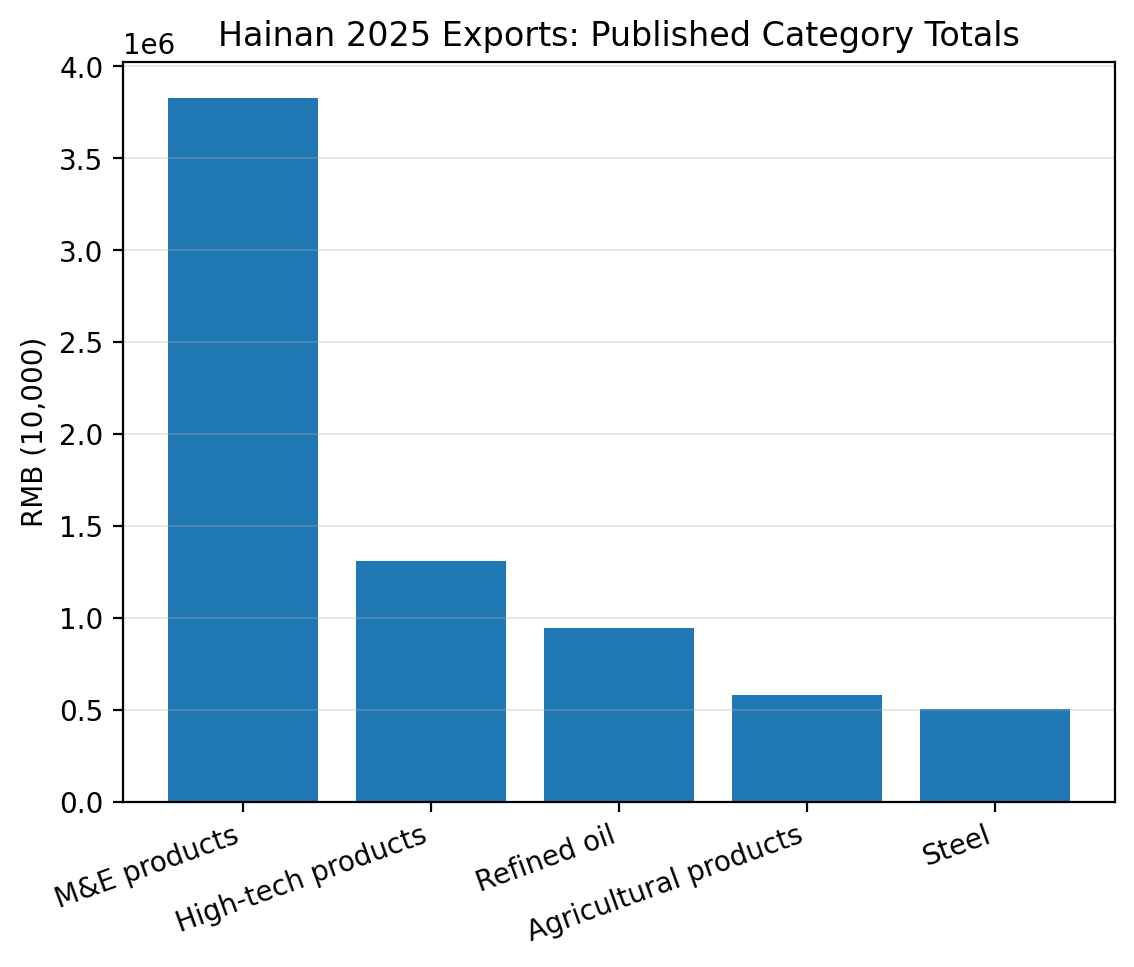
Chart 6 (exports)
Main import categories (selected published category totals)
- Metal ores and concentrates: 26.6% of total imports, +9.36%
- Organic chemicals: 10.2% of total imports, –3.06%
- Agricultural products: 9.7% of total imports, +18.74%
- Crude oil: 9.2% of total imports, up 296.40% year-on-year
- Mechanical and electrical products: 8.7% of total imports, +44.52%
- Food products: 7.4% of total imports, +12.28%
- Cosmetics and personal care products: 6.7% of total imports, +4.85%
- High-tech products: 6.3% of total imports, +64.66%
Taken together, the tables show a contrast between declining export values across several major published export categories and increasing values across multiple major import categories, particularly energy-related items, industrial inputs, and consumer-related goods.
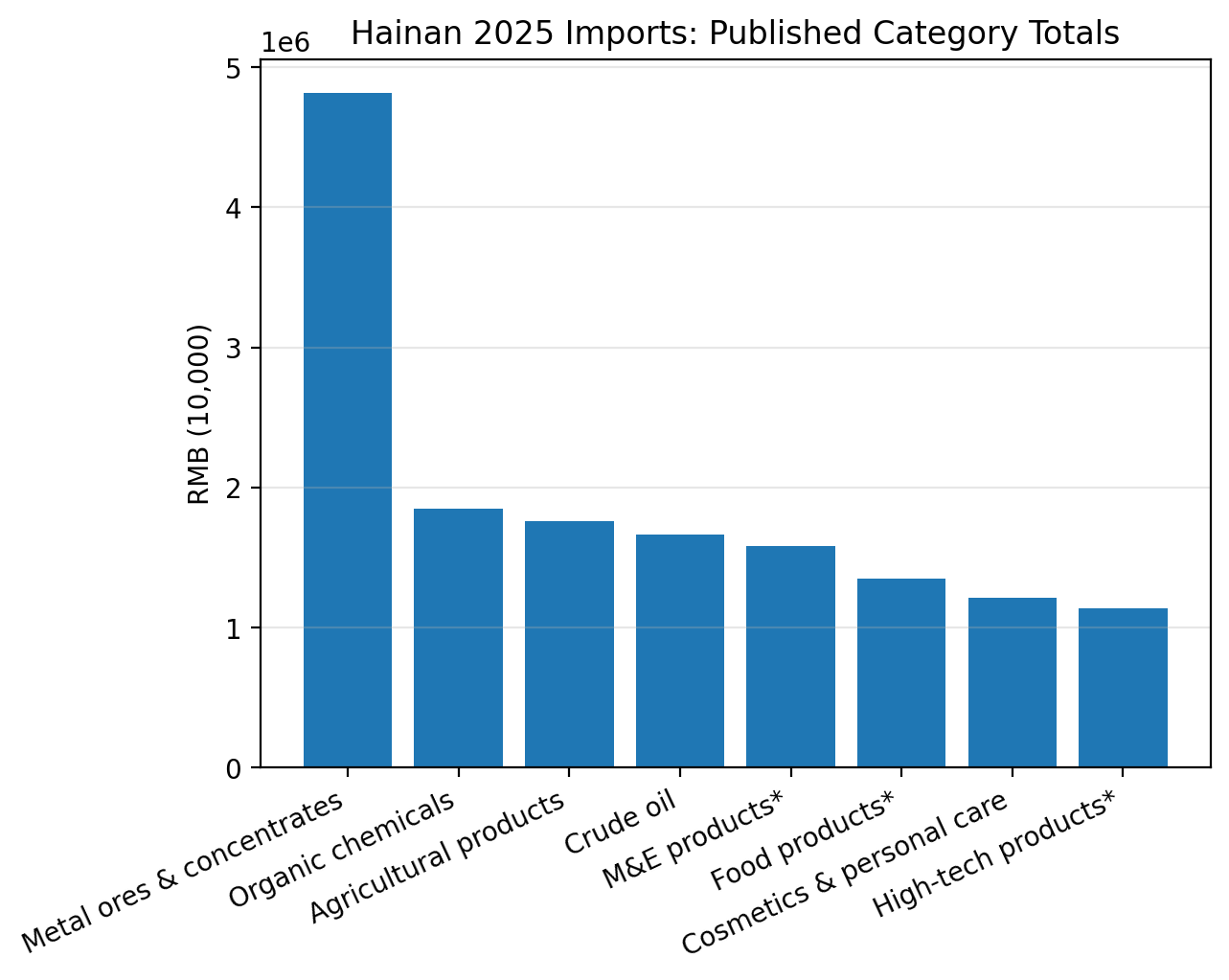
Chart 7 (imports)
8. What Changed, and What Did Not
What changed in 2025
- Imports accounted for the increase in total trade value while exports declined
- Bonded logistics trade volumes increased significantly year-on-year
- Import structure shows diversification across multiple major categories
- Export values declined across many published categories in the customs tables
What did not change
- Private enterprises remain the largest trade actors by value in the tables
- Sea transport remains the dominant channel by value
- Trade remains concentrated in a limited number of major product groups
- The trade structure reflected in the tables shows a high share of import-oriented and logistics-linked activity
9. Practical Takeaways
For businesses:
- The tables show higher growth rates in logistics-related and bonded-logistics categories
- Import categories include several segments with strong year-on-year growth in 2025
- Where operations involve bonded logistics, classification, documentation, and compliance processes remain important, and binding decisions should be made with licensed local professionals
For observers and planners:
- The customs tables show changes in trade composition rather than a uniform decline in trade values
- Trade patterns in the customs data show a high share of logistics-linked activity
- The customs tables do not show abrupt changes in the distribution of trade modes or transport shares within the year, although monthly volatility is visible
Data Notes
- Source: Haikou Customs annual statistical tables, published January 19, 2026
- Units: values in RMB (10,000) as presented in the tables; percentages rounded
- Data scope: import and export activity of Hainan-registered enterprises
- City-level data reflects enterprise registration location, not physical cargo flow
- Figures are subject to revision by customs authorities
- This analysis is descriptive and does not constitute legal, tax, accounting, or investment advice; for binding decisions, consult licensed PRC legal and professional advisors
This topic was modified 2 months ago 4 times by Patrick Quinn

10/02/2026 11:28 pm
Hi Patrick, I'm Daniel. I'm pretty new to this forum and found your post interesting. Do you know if we can send direct messages on here? Looking forward to connect.
Topic starter
11/02/2026 8:45 am
Hi Daniel, welcome to the forum, glad you found the post useful.
Yes, you can connect with members here, and there are several tools on the platform that may be useful to you:
• Member Profiles & Messaging
You can view member profiles and send direct messages as well as,
• Business Directory
You can search for registered companies, service providers, and partners here:
Members – Hainan FTP Business Forum
• Company Showcase Section
Many businesses maintain detailed showcase pages with background, services, and updates. You can connect and talk with them directly (like a FaceBook page):
Hainan Business Directory (Under Construction) – – Hainan FTP Business Forum
• Discussion Categories
The forum is organised into sections covering policy, trade, investment, relocation, compliance, and daily life in Hainan:
• Search Function
You can search past discussions, companies, and resources here:
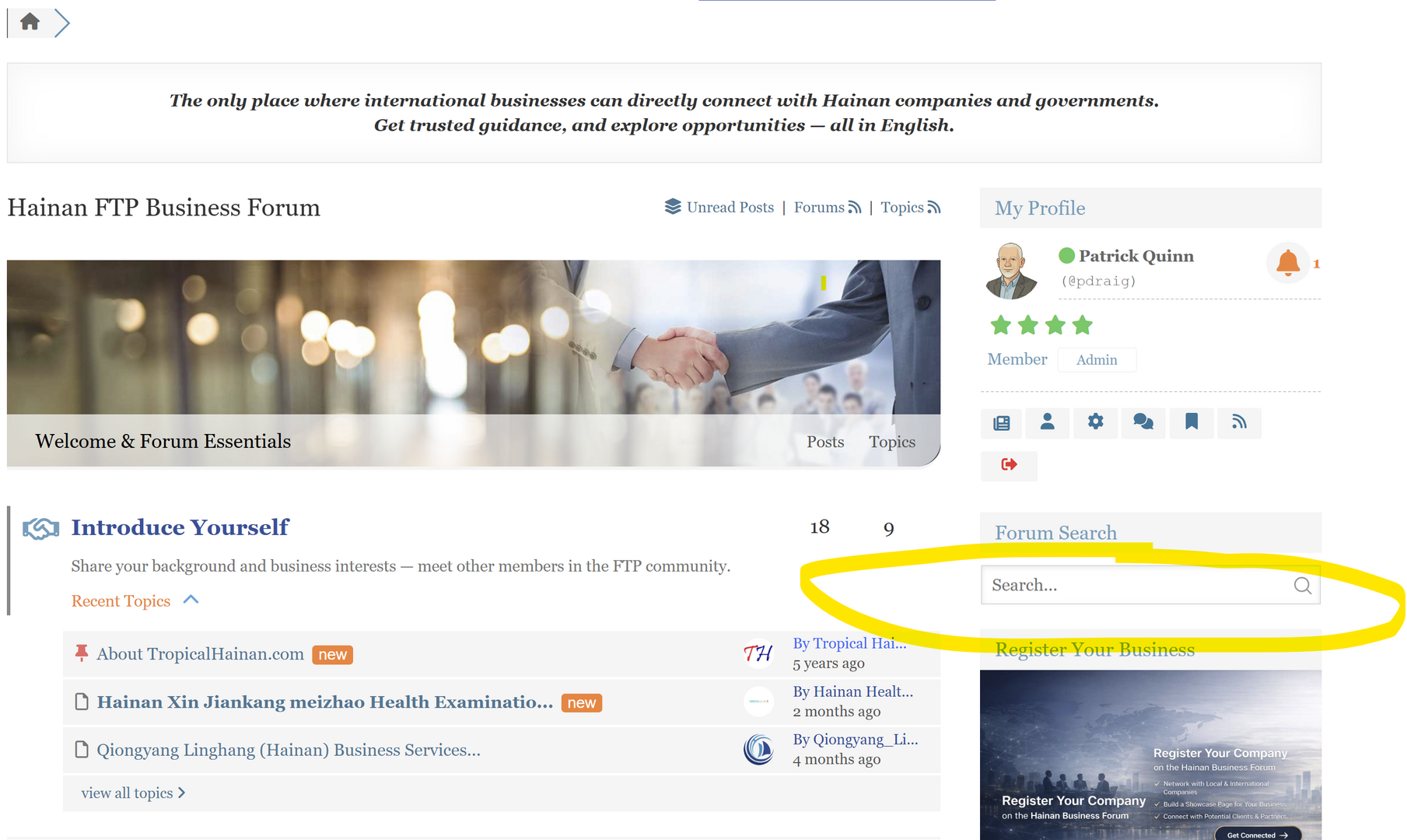
• Resource & Reference Library
We also maintain a growing collection of official documents, explainers, and practical guides:
• Connect with TropicalHainan Directly
This is TropicalHainan's showcase page ... you can connect with us directly, where we answer questions and offer advice etc, (again, think FaceBook page). You can also subscribe to Individuals or companies to keep up to date with their latest posts.
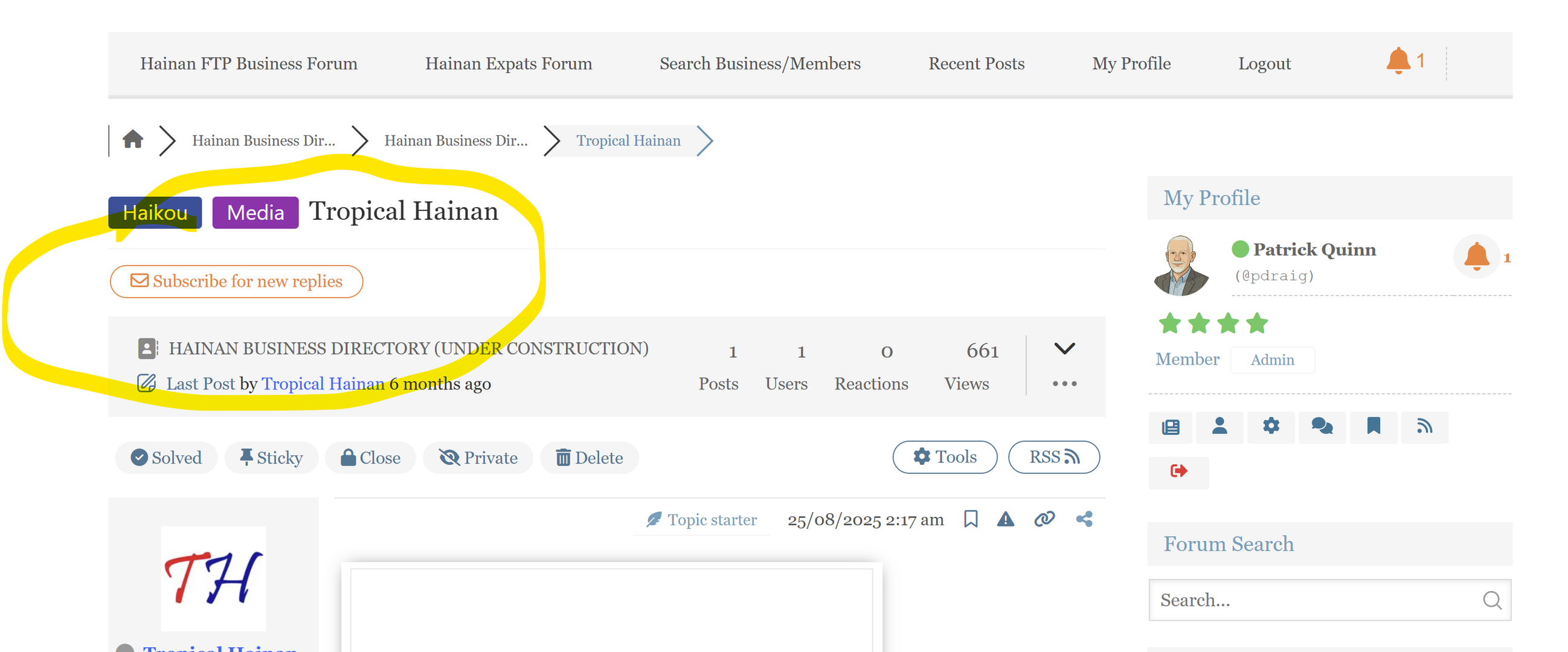
Tropical Hainan – – Hainan Business Directory (Under Construction) – Hainan FTP Business Forum
The forum is designed to help members find reliable information, connect with serious businesses, and exchange practical experience related to the Hainan Free Trade Port.
Feel free to message me directly if you have any questions, and let me know what you’re mainly looking for — business, relocation, compliance, or something else — and I’ll be happy to point you in the right direction.
Best regards,
Patrick
This post was modified 1 month ago 2 times by Patrick Quinn
Register Your Business

在自贸港论坛上注册您的企业

Jobs in Hainan