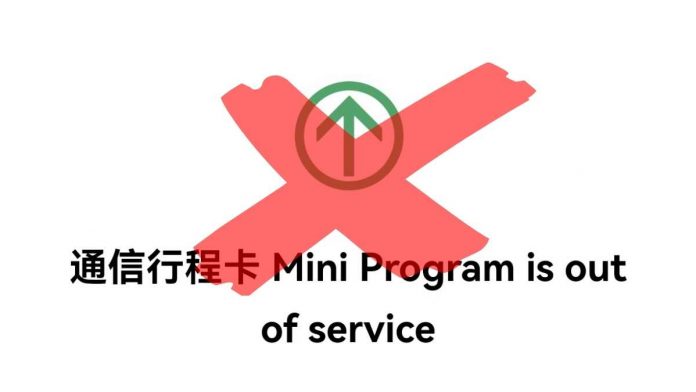
Travel Tracking System unplugged as Covid Travel Curbs Ease

The mobile itinerary tracking system that has been a constant in our lives over the last 34 months has been deleted as China dismantles restrictions and shifts away from the long-held “zero-Covid” policy.

The operator of the “mobile itinerary card” said early Monday that the system would be deactivated under an order from the State Council and all user data in the system will be deleted for privacy protection.

Launched in February 2020, the mobile itinerary tracking system required individuals to register with their real name and cellphone number

The mobile itinerary card, was co-developed by the China Academy of Information and Communications Technology and the country’s three state-owned telecom carriers, to track people’s travel history using cellphone data to identify those who had traveled to places with high infection risks. 

Launched in February 2020, the system required individuals to register with their real name and cellphone number. It started out tracking people’s travel history for the previous 14 days. The period was then shortened to seven days in July under China’s updated version of Covid control guidelines. 

As of May 26, 55.6 billion searches were made in the system, according to the Ministry of Industry and Information Technology (MIIT).

People who had been in cities listed by authorities as “high-risk” during the tracking period would have an asterisk marked in their itinerary card, which could affect their access to certain places. 

But due to technical issues, the system often failed to identify locations precisely and sometimes tagged people who only got close to risky regions. Public frustration grew as some local authorities arbitrarily expanded travel restrictions for people with asterisks in their itinerary cards.

RIP Mobile Itinerary Card, February 2020 – December 2022.

Related article: mRNA Vaccines approved for German nationals in China

mRNA Vaccines approved for German nationals in China


SourceSource

LEAVE A REPLY

Please enter your comment!
Please enter your name here

- Follow Us on WeChat -

spot_img

Related articles:

Hainan’s 2026 Investment Opportunity List Shows What the Free Trade Port Wants Built Next

Hainan’s 2026 Investment Opportunity List shows what the Free Trade Port wants built next, from ports and digital trade to medical platforms and future industries …

Explainer: Apostille vs Consular Authentication for Hainan Work Permit Documents

Apostille has replaced Chinese consular authentication for relevant documents from Convention countries, but notarisation, translation and validity rules can still apply ...

Lost Your Passport in China: The Emergency Document You Should Know About

Lost your passport in China? If your embassy, consulate, or relevant home-country institution in China cannot reissue a travel document, China has an Exit-Entry Permit for Foreigners …

Hainan’s Free Trade Port Is Moving From Incentives to Usability

Hainan’s new services plan points to a shift in how foreign operators may use the FTP: banking, permits, policy access and talent recognition …

Get weekly email updates for new articles published!

Follow Us on WeChat

spot_img

Latest Articles ...

How Hainan’s 30% rule is beginning to shape business decisions for companies using the FTP’s customs route into mainland China ...
Typhoon Season 2026 in Hainan: What residents need to know about storm forecasts, El Niño impacts, ferry suspensions, airport disruptions, warning levels, and how to prepare for typhoons from July to October ...
How international graduates can stay in China after graduation through Hainan’s startup residence route, and why it does not allow paid work ...
What spouses on S visas in China can and cannot legally do, including work, tutoring, remote work, volunteering, tax, and permit risks ...
spot_img

Why Foreigners Lose Access to Their Chinese Bank Accounts

Frozen accounts, blocked cards, restricted access. Most expats in China don't think about their bank account until they can't access it …

China’s Green Card: How Rare Is It, and What It Takes to Get One

Between 2004 and 2017, China issued just over 10,000 permanent residency permits to foreign nationals. This guide explains the four eligibility routes, the real criteria, and your honest odds of qualifying …

Why Your Passport Doesn’t Work: A Foreigner’s Guide to China’s ID-Only Systems

Your passport is legally valid for trains, hotels, SIM cards and payment accounts in China. The problem isn't the rules, it's the systems built on top of them …

China’s 2026 Work Permit Salary Rules: Who Actually Needs to Worry?

China’s work permit salary thresholds have raised concerns among foreign professionals. This explainer clarifies the 6× and 4× rules, why the figures appear high, and who is actually affected ...
spot_img

Looking for an international pre-school in Haikou?

Flora's International Preschool has three preschools in the Haikou area. Our schools follow a European curriculum

Continue Reading ...

Hainan’s 2026 Investment Opportunity List Shows What the Free Trade Port Wants Built Next

Hainan’s 2026 Investment Opportunity List shows what the Free Trade Port wants built next, from ports and digital trade to medical platforms and future industries …

Explainer: Apostille vs Consular Authentication for Hainan Work Permit Documents

Apostille has replaced Chinese consular authentication for relevant documents from Convention countries, but notarisation, translation and validity rules can still apply ...

Lost Your Passport in China: The Emergency Document You Should Know About

Lost your passport in China? If your embassy, consulate, or relevant home-country institution in China cannot reissue a travel document, China has an Exit-Entry Permit for Foreigners …

Get weekly email updates for new articles published!

Never miss another important notice or event. Be informed of what you need to know, when you need to know it.