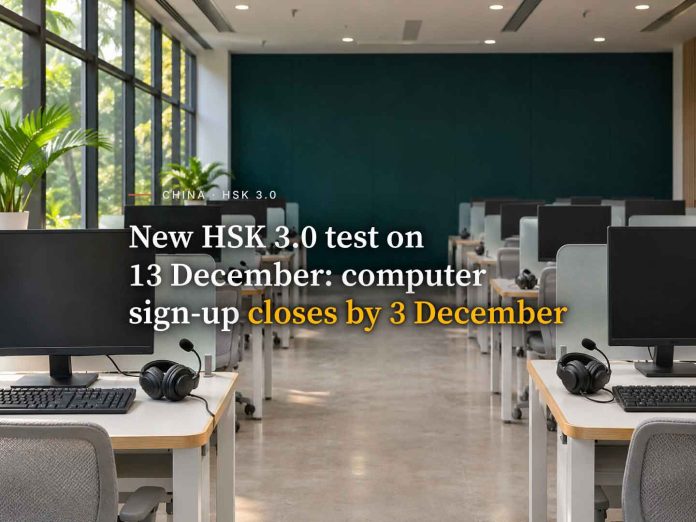
Paper registration for the upgraded Chinese proficiency test closed on 16 November. Computer-test registration stays open until 24:00 Beijing time on 3 December, but some centres close earlier.
Anyone hoping to sit the first official HSK 3.0 Chinese test on 13 December 2026 has one route left: the computer-based exam, taken at a test centre. The general registration deadline for it is 24:00 Beijing time on 3 December.
Registration for the paper-based version closed at 24:00 Beijing time on 16 November.
Some centres close earlier, and places can run out. Zhejiang University’s centre in Hangzhou offers HSK levels 4 to 6 with their speaking tests on 13 December. It stops taking registrations at 17:00 on 30 November, or sooner if its seats fill.
Chinese Testing International (CTI, 汉考国际), which sets the general deadline, describes HSK 3.0 as a comprehensive upgrade of the test. The 13 December sitting is the new version’s first official worldwide sitting.
What is changing
The HSK (汉语水平考试, Hanyu Shuiping Kaoshi) is the standardised test for people learning Chinese around the world. Version 3.0 arranges the test in nine levels, up from six.
Levels 1 to 3 test basic everyday communication. Levels 4 to 6 test Chinese for study, work and daily life. Levels 7 to 9 test specialist, professional and academic Chinese.
Levels 7 to 9 are not new. CTI’s 2026 test calendar lists levels 1 to 6 with the speaking test for 13 December, and levels 7 to 9 as a separate exam on 22 November 2026.
Who uses it
HSK 3.0 is proof of Chinese ability for foreigners applying to study or work in China. It is also used as proof for internships and jobs at Chinese companies overseas and at multinationals, the report said. The report named HSK level 4 as the basic language requirement for studying in China.
Individual universities set their own levels. China University of Petroleum (Beijing) at Karamay requires postgraduates on Chinese-taught programmes to score at least 180 in the HSK level 5 written test before it awards their degree.
The 2026 World Chinese Language Conference was held in Beijing on 13 to 15 November where it was announced that HSK candidate numbers in 2026 passed 1 million for the first time. The figure counts each sitting separately. The test is offered at more than 1,500 centres in 169 countries.
What candidates must do
Candidates register on CTI’s Chinese Test Service Website, www.chinesetest.cn, where they find the test centres in their country. Harbin Institute of Technology, which runs a computer-based centre, tells candidates to check their chosen centre’s test format before registering.
At test centres in China, candidates for HSK levels 3 to 6 must register for a speaking test at the same time. Under HSK 3.0, each speaking test carries the same number as its written level: HSK 3 goes with the level 3 speaking test, up to HSK 6 with level 6. CTI announced the rule in September 2022 and applied it from January 2023.
A registration only counts once the fee is paid. Zhejiang University’s notice says this is how CTI’s system is set up. It also tells candidates to bring their original passport and a printed admission ticket on test day.
Fees vary by level. For its sittings in the first half of 2026, Hainan University’s test centre in Haikou charged from RMB 150 for HSK 1 to RMB 650 for HSK 6. Its speaking tests cost an extra RMB 200 to RMB 400 in that period.
CTI’s calendar, published in December 2025, lists results for the computer-based HSK on 28 December 2026 and for the speaking test on 4 January 2027. Paper-based results are listed for 15 January 2027.
Related article: A Spouse on an S Visa: What They Can and Cannot Legally Do in China