
- Every month you worked in China, 8% of your salary went into a pension account in your name. Many departing expats leave without ever claiming it.
- The employer’s pension contribution finances current Chinese retirees and is not individually refundable. What you can claim is your own 8% plus interest.
- Withdrawing closes the account permanently. If you return to China to work, your contribution years reset to zero.
- Workers from countries with bilateral social security agreements with China may have little or nothing to withdraw.
- In Shanghai and Hainan, there is a second refundable balance that the application process does not surface by default. You have to ask for it.
What Happens to Your Chinese Pension When You Leave, and the Window You Cannot Miss
By the time most foreign employees start thinking about their Chinese pension, they have already missed the easiest part of the process.
The flights are booked. The apartment has been handed back. The work permit has been cancelled. Every exit step on the list has been handled, except the one nobody put on the list.
Sitting in a social insurance bureau somewhere in the city where they worked is an individual pension account in their name. For someone who spent five years earning RMB 20,000 a month, it holds approximately RMB 96,000 in contributions before interest.
Many departing expats leave without ever claiming it, not because they decided against it, but because the standard off-boarding process never mentions it.
What you can actually claim, and what you cannot
China’s pension system splits contributions into two streams.
The employee’s 8% of monthly salary goes directly into an individual personal account. That account belongs to the employee. The employer also contributes, at the national standard rate in most major cities, though rates vary in some provinces.
That employer contribution goes into the social pooling fund, which finances pension payments to current retirees.
The pooling fund is not individually refundable.
This applies regardless of nationality or bilateral agreement status. What is recoverable is the personal account: the employee’s own 8% plus interest at the government-announced notional rate. That rate is reviewed annually and has declined in recent years.
Check the current figure at mohrss.gov.cn before calculating any expected balance.
The table below shows what the personal account accumulates in contributions alone.
| Monthly salary (RMB) | Monthly contribution | 3-year total | 5-year total |
| 10,000 | 800 | 28,800 | 48,000 |
| 15,000 | 1,200 | 43,200 | 72,000 |
| 20,000 | 1,600 | 57,600 | 96,000 |
| 25,000 | 2,000 | 72,000 | 120,000 |
| 36,921 (Shanghai cap) | 2,954 | 106,344 | 177,240 |
Based on Shanghai/Beijing 2024-25 parameters. Beijing ceiling is RMB 35,283/month. Figures exclude interest. Amounts vary by city.
The decision you cannot undo
Before starting the withdrawal process, there is a prior question worth considering, because the answer is permanent.
Withdrawing the pension personal account closes the social insurance relationship. The Beijing Municipal HRSSB departure clearance notice states this explicitly: the basic endowment insurance relationship is terminated, the balance is paid out in full, and if the holder returns to work in China, the contribution period is recalculated from zero.
For the years already accumulated, this is a one-way door.
The alternative is retention. An account that is not withdrawn does not expire. There is no dormancy period, no forfeiture deadline. The account waits, interest continues to accrue, and if the account holder dies before claiming, the balance is hereditary under both the Social Insurance Law and the regulations governing foreign national accounts.
For someone certain they will not return to China, withdrawal is straightforward. For someone who might return, retention preserves the contribution years already built up and keeps open, at least in principle, the option of qualifying for a monthly Chinese pension at retirement age, though in practice qualifying requires many years of total contributions and is not a realistic outcome for most foreign postings.
Decide deliberately rather than by default.
The process, and the timing that catches people out
The application goes to the local Human Resources and Social Security Bureau or its district-level social insurance centre. Standard documents required:
- Valid passport (original and copy)
- Residence permit (original and copy — see timing note below)
- Employment termination certificate from the employer
- Bank account details
- Application form: Personal Pension Insurance Deposit Withdrawal Application Form for Insured Foreigners
On timing: Applying while your residence permit is still valid and before you leave China is the standard route and the most straightforward. If you have already left China or your permit has expired, applications can in some cases still be processed through written submission or via a representative acting on your behalf, but the process becomes more complex and city-specific. Do not assume the window has closed if your permit has lapsed. Contact the relevant bureau directly to confirm what is possible in your situation.
On bank accounts: The Big Four state banks, ICBC, CCB, Bank of China, and Agricultural Bank of China, are the most widely accepted across major cities. Some cities accept accounts from a broader range of banks. This is not stated in national regulations and varies by location. Confirm which banks are accepted with your local bureau before opening a new account specifically for this purpose.
On timing: Begin as early as possible. Two weeks before departure is an absolute minimum, but city-specific timelines mean this is rarely sufficient in practice:
- Shanghai: Processing timelines vary. Confirm the current expected timeframe directly with the Shanghai social insurance bureau before planning your departure date.
- Beijing: User reports and professional sources suggest approximately six weeks end-to-end. Online application channels exist through the Beijing HRSSB portal; confirm whether full remote processing is available for your specific case.
- Other cities: Professional advisory sources document one to three months as the typical range.
The funds arrive in a Chinese bank account. If the applicant has already left China, an international transfer will require documentation of the legal source of funds.
If you worked in more than one city
Social insurance is administered regionally. Two cities means two separate accounts, two separate bureaus, two separate applications. Many multi-city expats claim only from their final city. Before starting, obtain a full contribution history covering every city where you worked.
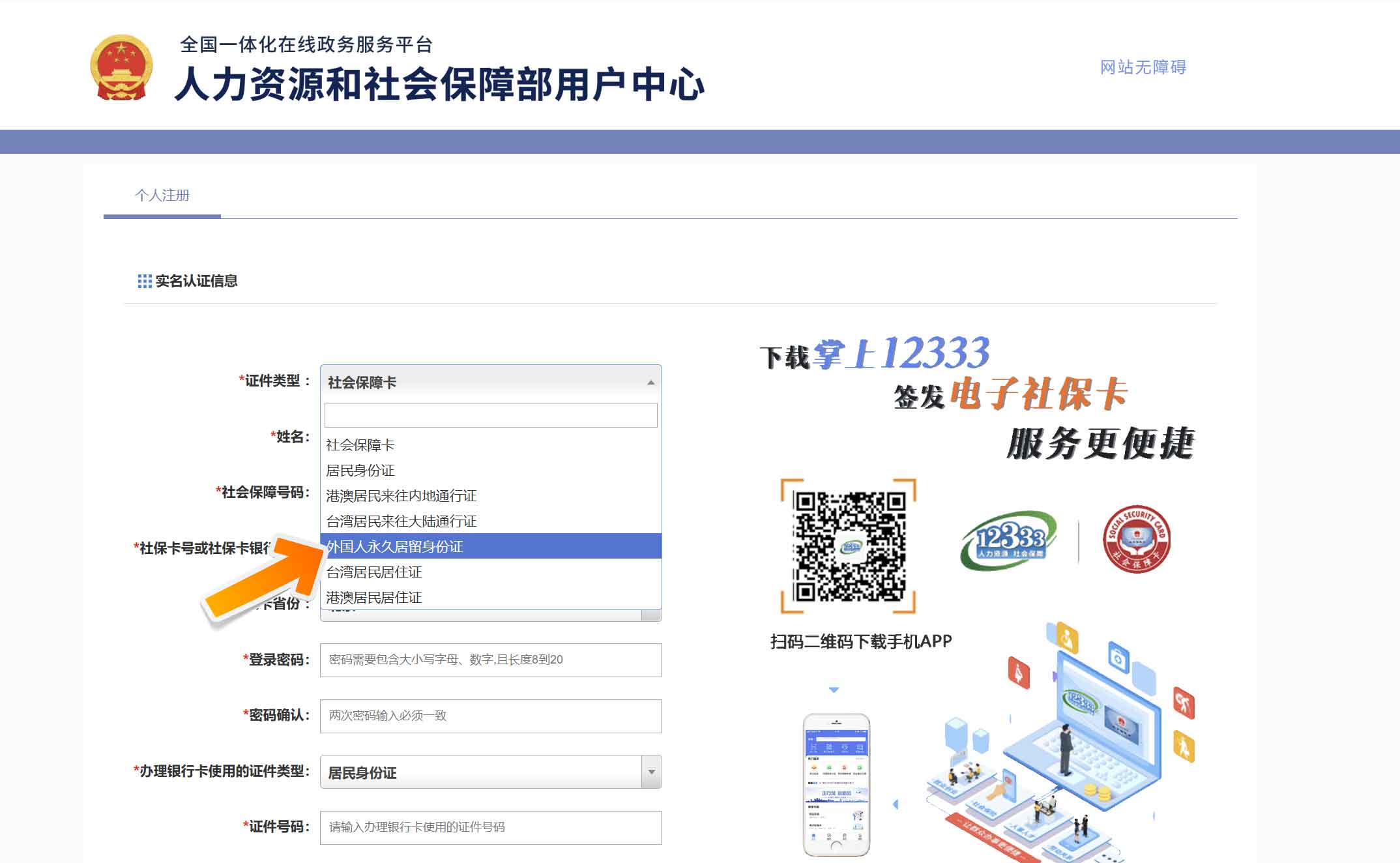
Foreign nationals holding a permanent residence card (外国人永久居留身份证, Foreigner’s Permanent Residence Identity Card) can access their records by registering at si.12333.gov.cn and selecting that document type at the authentication step.
For everyone else, neither the 掌上12333 (12333 Mobile) WeChat Mini Program nor the si.12333.gov.cn web platform currently supports authentication with a standard foreign residence permit or passport.
The practical alternatives are to ask your employer’s HR department to pull the record directly, or visit your local social insurance bureau in person and request a printed contribution certificate (参保缴费证明, Social Insurance Contribution Certificate).
Both methods cover all cities.
If your country has a bilateral agreement with China
China has signed bilateral social security agreements with 13 countries. All 13 are now in force: Germany, South Korea, Japan, Denmark, Finland, Canada, Switzerland, the Netherlands, Spain, Luxembourg, Serbia, France, and Kyrgyzstan. The Kyrgyzstan agreement entered into force in October 2025. Workers from any of these countries should confirm the specific insurances covered and the exemption conditions with their home country’s social security authority, as the scope of each agreement differs.
Workers who obtained a Certificate of Coverage exemption and applied it throughout their entire posting typically paid zero pension contributions into China’s system, and have nothing to withdraw.
This is the bilateral agreement paradox: the workers best protected from double-payment are often the ones who leave with the least to claim.
Workers from these countries who contributed during any period outside the exemption window have those contributions in their account and can claim them under standard rules.
One edge case worth noting: the Japan-China agreement covers only Basic Old-Age Insurance on the Chinese side. All other insurances remain mandatory for Japanese workers regardless of Certificate of Coverage status.
If your country is on this list, check with your home country’s social security authority before assuming you have a balance to claim, or that you do not.
One more account to ask about
In Shanghai and Hainan, the medical insurance system includes an individual personal account that is also refundable on departure. The application process does not surface this by default, it is handled by a separate agency, not the social insurance bureau, and you need to request it specifically.
Shanghai’s rules clearly allow withdrawal of the personal medical account balance on permanent departure. In Hainan the position is similar though applicants should confirm the current procedure directly with the local medical insurance bureau. Payment procedures and timelines vary by city and by the size of the balance. Ask the local medical insurance bureau for current processing arrangements when you apply.
Whether equivalent refunds are available in Beijing, Shenzhen, and Guangzhou is not uniformly documented. Ask specifically when you apply. If a refund is available and you do not ask, it is unlikely to be raised automatically.
Before you leave, five things to do
1. Obtain your full contribution history across all cities before starting. Permanent residence card holders (外国人永久居留身份证, Foreigner’s Permanent Residence Identity Card) can do this at si.12333.gov.cn. Everyone else should ask HR to pull the record directly, or visit the local social insurance bureau in person and request a printed contribution certificate (参保缴费证明, Social Insurance Contribution Certificate).
2. Confirm which bank accounts are accepted by your local bureau. The Big Four state banks are the most widely accepted, but some bureaus accept a broader range. Confirm before opening a new account specifically for this purpose.
3. If your country has a bilateral agreement with China, check whether you contributed during any period outside the exemption window, and confirm the specific insurances covered under your country’s agreement.
4. Begin the process as early as possible, at minimum two weeks before departure, and significantly earlier in Shanghai or Beijing. If you have already left China, contact the relevant bureau to confirm whether application is still possible in your situation.
5. Ask specifically about the medical insurance personal account when you apply. It is unlikely to be raised automatically.
Related article: Leaving China: The Exit Checklist Nobody Gives You