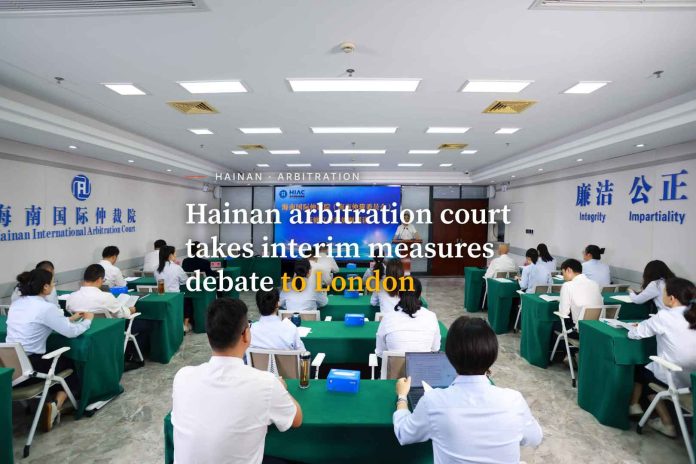
The Hainan International Arbitration Court (海南国际仲裁院, HIAC) will host a panel on interim measures in international arbitration in London on 1 December 2026 as part of London Arbitration Week. Interim measures are orders made while a dispute is being decided to protect assets or evidence, or require a party to do or stop doing something.
The panel comes 17 days before HIAC’s new arbitration rules, which also cover interim measures, take effect on 18 December 2026. The date marks the first anniversary of island-wide special customs operations in the Hainan Free Trade Port.
HIAC describes itself as Hainan’s only civil and commercial arbitration institution established by the provincial government. Its main office is in Haikou, with a branch in Sanya.
The London session
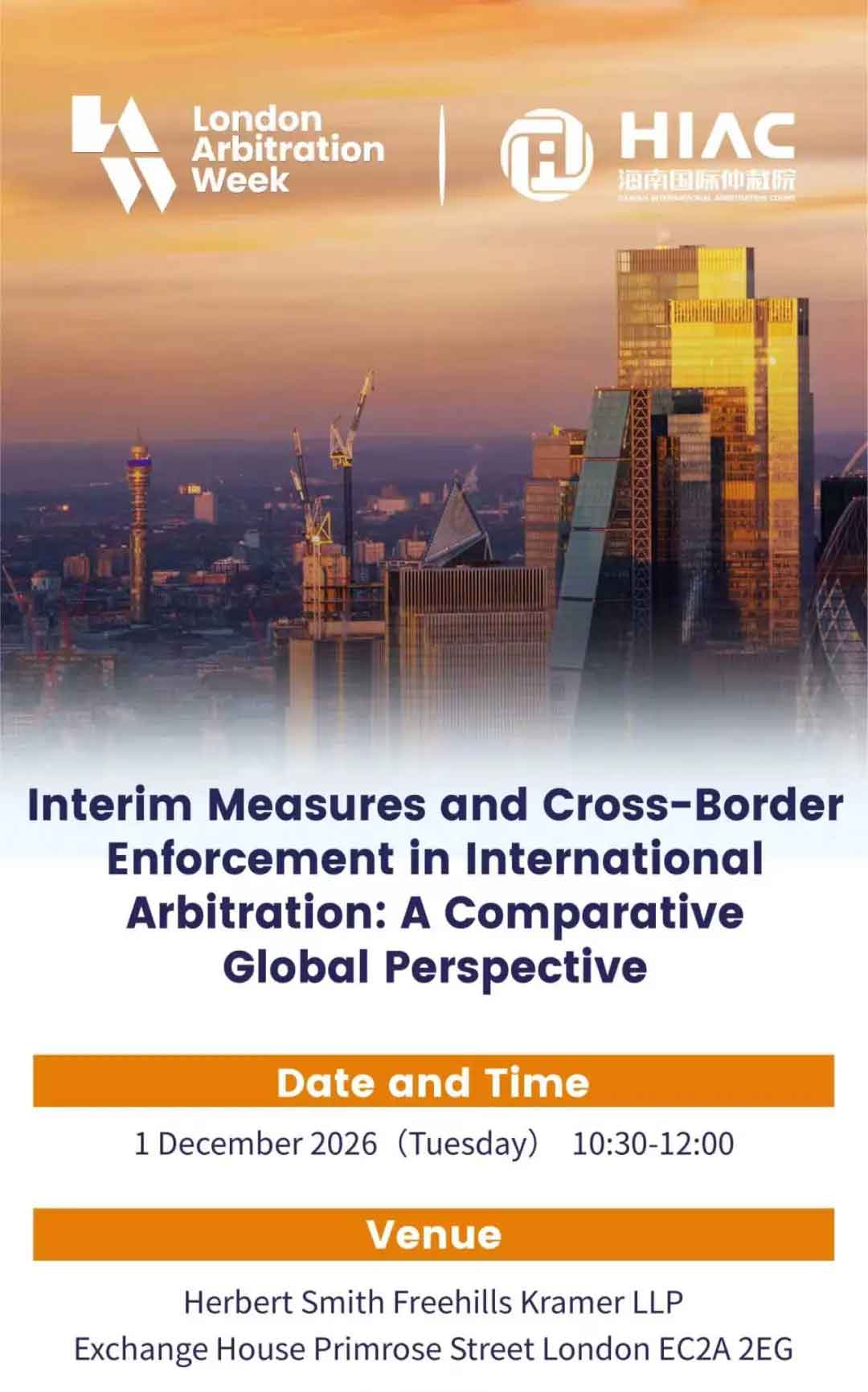
The session, titled Interim Measures and Cross-Border Enforcement in International Arbitration: A Comparative Global Perspective, runs from 10:30 to 12:00 at the London office of Herbert Smith Freehills Kramer, at Exchange House, Primrose Street. The law firm is the venue sponsor.
HIAC board member David Samuels will give the welcome remarks. Jingzhou Tao, another HIAC board member and an independent arbitrator, will moderate the panel and close the session.
The four speakers and their topics are:
- Hussein Haeri KC, partner and co-head of international arbitration at Withers: interim measures in investor-state arbitration;
- Hilary Heilbron KC of Brick Court Chambers: interim measures in England and Wales;
- Mike McClure KC, partner at Herbert Smith Freehills Kramer: South Korean and Singaporean perspectives;
- Philip Dunham, partner at Signature Litigation: the French perspective.
HIAC’s event poster asks attendees to scan a QR code to register and reserve a place. It does not mention a fee.
What changes in Hainan on 18 December
HIAC’s board adopted the new rules on 27 October 2026. According to its explanatory note, the revision follows the revised national Arbitration Law.
The new rules set out two separate procedures: preservation through the courts in domestic cases and tribunal-ordered interim measures in international commercial cases. They use different Chinese terms for each: 保全 (preservation) for the court procedure and 临时措施 (interim measures) for tribunal orders.
In domestic cases, a party may apply to protect property or evidence, or to require the other party to act or stop acting. HIAC must forward the application to the competent people’s court within five days of receiving it.
In emergencies, where a delay would cause irreparable harm or evidence could be lost, a party may apply directly to the court before filing for arbitration.
This court procedure follows the revised Arbitration Law, which took effect on 1 March 2026. Article 39 covers property preservation and orders requiring a party to act or stop acting, while Article 58 covers evidence preservation. In both cases, if a party applies through arbitration, the arbitration institution must forward the application to the court.
In international commercial cases, the tribunal may order interim measures it considers appropriate at a party’s request. It must follow the applicable procedural law or the parties’ agreement and act within the limits of the law of the place of arbitration.
The tribunal may require the applicant to provide appropriate security where necessary. Parties may also apply directly to a competent court under the relevant law.
Unless the parties agree otherwise, the international chapter applies to international commercial cases. Under the new rules, a case may qualify as international if, for example:
- A party is a foreign national or foreign company;
- A party’s habitual residence is outside the People’s Republic of China;
- The subject matter is located outside the People’s Republic of China.
The chapter also applies by reference to cases involving the Hong Kong, Macao and Taiwan regions.
Before a tribunal is formed, a party in an international case needing urgent relief may apply to HIAC for an emergency arbitrator under the applicable law or the parties’ agreement.
If HIAC approves the application, its board chair must appoint an emergency arbitrator within two days of the applicant paying the fee. The arbitrator must make a decision within 15 days of appointment, unless HIAC grants an extension in special circumstances.
The tribunal, once formed, is not bound by the emergency arbitrator’s decision and may change, suspend or revoke it.
The decision also ceases to have effect if the tribunal is not formed within 90 days of the decision. The parties may agree to extend that period, or HIAC’s board chair may extend it where appropriate.
What is not new
Tribunal-ordered interim measures and emergency arbitrators are not new at HIAC. Its explanatory note says both were already included in its 2020 rules.
The change is that the court preservation and tribunal-ordered interim measures procedures are now set out separately. HIAC says this is to avoid confusion between the terms, which could lead to different interpretations and difficulties with cross-border enforcement.
The new rules do not automatically apply to existing cases. Cases HIAC accepts before 18 December remain subject to the rules in force when they were accepted, unless both parties agree to use the new rules. A company with a pending HIAC case therefore needs the other party’s agreement to switch.
HIAC trained its case secretaries and other staff on the new rules on 24 November. It says its next step is a series of briefings for arbitrators, lawyers and businesses.
The new rules take effect on 18 December 2026.
Related article: Five Danzhou firms added as Hainan nears 2027 advanced smart factory goal