Notifications
Clear all
Work Permits & Residence
1
Posts
1
Users
0
Reactions
361
Views

Topic starter
18/09/2026 10:03 am
Permanent Residence in Hainan: Who Can Apply and How the Haikou Process Works
For foreigners who have spent years building a career, business or family life in Hainan, permanent residence marks a clear break with the cycle of work permits and residence-permit renewals. Chinese regulations define it as the right of a foreign national to reside in China without a fixed limit on the period of residence. Successful applicants receive a Foreign Permanent Resident ID Card.
Hainan has also added routes linked to the Free Trade Port’s talent and investment policies. These sit alongside the national pathways for employment, investment, family reunion and people considered to have made major contributions to China. In Haikou, the process begins with the municipal public-security authorities and, where the case passes the local stages, moves through provincial review to central approval.
This guide sets out the principal routes available in Hainan, how the Haikou process works, what applicants should expect to prepare and where the published rules still require confirmation before filing.
Permanent residence versus a residence permit
Permanent residence is not the next stage of a work permit or residence permit. It is a separate immigration status with its own eligibility tests and approval process.
It becomes relevant once a foreign national qualifies through employment, investment, family circumstances, high-level talent status or another recognised route and intends to make China a long-term base. The national system also provides routes for qualifying spouses, children and dependent relatives.
Who can apply?
National rules set out seven main grounds for permanent residence. On the Hainan Government Services portal, Haikou publishes six category-specific initial-review services covering investment, employment or appointed-position applicants, special applicants, spouse reunion, parent-child reunion and dependent relatives, plus a separate service for the spouses and children of investment, employment and special-category applicants.
The main national routes are:
- Investment: foreigners who have invested directly in China, maintained stable investment for three consecutive years and have a good tax record. The national route also carries a prescribed paid-in capital requirement, which varies according to the circumstances of the investment. Applicants should confirm the threshold currently being applied before relying on this route.
- Employment or appointed position: foreigners serving at deputy general manager, deputy factory director or an equivalent senior level, or holding an associate-senior professional title such as associate professor or associate researcher or above, at a qualifying organisation or enterprise. They must have held the relevant position continuously for four years, lived in China for at least three cumulative years during that period and have a good tax record.
- Special applicants: foreigners who have made major or outstanding contributions to China or are particularly needed by the state.
- Spouses and children of investment, employment and special-category applicants: the foreign spouse and unmarried children under 18 of a person qualifying through one of those three routes.
- Spouse reunion: the foreign spouse of a Chinese citizen or foreign permanent resident where the marriage has lasted at least five years, the applicant has lived continuously in China for five years, has spent at least nine months in China in each of those years, and has stable means of support and accommodation.
- Parent-child reunion: an unmarried foreign child under 18 joining a parent in China who is a Chinese citizen or a foreign permanent resident.
- Dependent relatives: applicants aged 60 or above with no direct relatives overseas who are joining a direct relative in China who is a Chinese citizen or a foreign permanent resident, subject to the prescribed five-year residence, nine-month annual presence, financial-support and accommodation requirements.
Additional Hainan routes
Hainan’s Free Trade Port policies widen the picture for some international talent and investors.
Foreign high-level technical and management personnel introduced into Hainan’s priority sectors, urgently needed specialists and members of science and technology innovation teams may apply for permanent residence following recommendation by the Hainan provincial talent authority. Their foreign spouses and minor children may also apply.
Foreign nationals of Chinese origin have a separate Hainan route. Those working in Hainan who hold a doctoral degree, or who have worked continuously in Hainan for four years and actually resided for a cumulative total of at least six months in each of those years, may apply. Their foreign spouses and minor children may also apply.
Another route covers foreigners investing in innovative enterprises in Hainan. The investment must have remained stable for three consecutive years, the applicant must have a good tax record, and the application requires a recommendation from the Hainan Provincial People’s Government. Public guidance does not currently define “innovative enterprise” specifically for this permanent-residence route or set out a standalone recommendation procedure, so eligibility should be confirmed before a full application is prepared.
Hainan also provides a route for foreigners who have worked continuously in the province for four years and meet Hainan’s wage-income and individual-income-tax standards. The Hainan measure itself does not publish the figures. Separate policy guidance describes a four-year route for foreigners working in China generally, using annual wage income of at least six times the previous year’s average wage of urban employees on post in the applicant’s locality, together with annual individual income tax of at least 20 per cent of that wage-income threshold.
The public guidance does not give a current RMB figure or make clear whether the benchmark applied to a Hainan case is provincial or municipal. Anyone considering this route should confirm the current standard with Haikou exit-entry before filing.
The same caution applies to filing categories. Haikou’s service records do not state how the Hainan-specific routes map onto the investment, employment or special categories shown on the portal. The correct category should therefore be confirmed with exit-entry rather than inferred from its title.
Who submits the application?
A permanent-residence application does not necessarily have to be lodged personally by the foreign applicant. National rules allow submission by the applicant, by the parent of an unmarried applicant under 18, or by an authorised representative. Where a representative files the application, the national service guide requires a power of attorney signed by the applicant and notarised.
Documents required
The exact checklist depends on the route being used. Establishing eligibility first is therefore more important than simply assembling a generic set of documents.
The national service guide lists a valid foreign passport, health certificate and overseas criminal-record certificate among the basic materials. Employment cases also require evidence of position or professional status, employment and tax history; investment cases require evidence of the investment, enterprise and tax record; and special-category applications rely on recommendation and supporting evidence of the applicant’s contribution or qualifications.
Family applications require the corresponding relationship documents. Depending on the route, these may include marriage or birth certificates, evidence of the parent-child relationship, the Chinese relative’s identity documents or the foreign relative’s permanent-resident card, accommodation evidence and proof of financial support.
Foreign-issued public documents may also need authentication before they can be used in China. Since China joined the Apostille Convention in November 2023, eligible public documents issued by other Convention states generally use an apostille instead of Chinese consular legalisation. Applicants should check the requirement for the country that issued each document before arranging authentication.
Haikou’s separate service for the foreign spouses and unmarried children under 18 of investment, employment and special-category applicants is important because these family members apply on the basis of the principal applicant’s qualification under one of those routes. The five-year marriage and residence tests used for an independent spouse-reunion application do not apply to this derivative route. Families intending to apply together should confirm the filing sequence and supporting documents with Haikou exit-entry.
Applicants using Hainan’s high-level-talent or innovative-enterprise routes should also settle the recommendation requirement before preparing the rest of the file. The policies establish the need for recommendation by the relevant Hainan authority, but the public service guidance does not set out a detailed procedure for obtaining it.
How to apply
- Identify the eligibility route. Start with the national and Hainan-specific rules, not the title of a portal category.
- Confirm the Haikou filing category and receiving location. This is particularly important for high-level talent, salary/tax, foreign nationals of Chinese origin and innovative-enterprise investors.
- Prepare the documents. Check names, passport details, employment dates, residence history, tax records and relationship documents carefully before filing.
- Submit the application through Haikou’s public-security exit-entry system. An authorised representative may submit the file with a notarised power of attorney, although the Haikou service records also require on-site handling during the process.
- Complete the Haikou investigation and initial review. The receiving authority examines the application and may ask for original documents, supplementary evidence or further verification.
- Move through higher-level review. Applications that pass the municipal stage are sent for provincial review and, if they pass that stage, onward for central approval.
- Receive the Foreign Permanent Resident ID Card if approved. The card is issued through the receiving authority to the applicant, guardian or authorised representative. When it is handed over, the applicant’s existing valid Chinese visa or residence permit is cancelled.
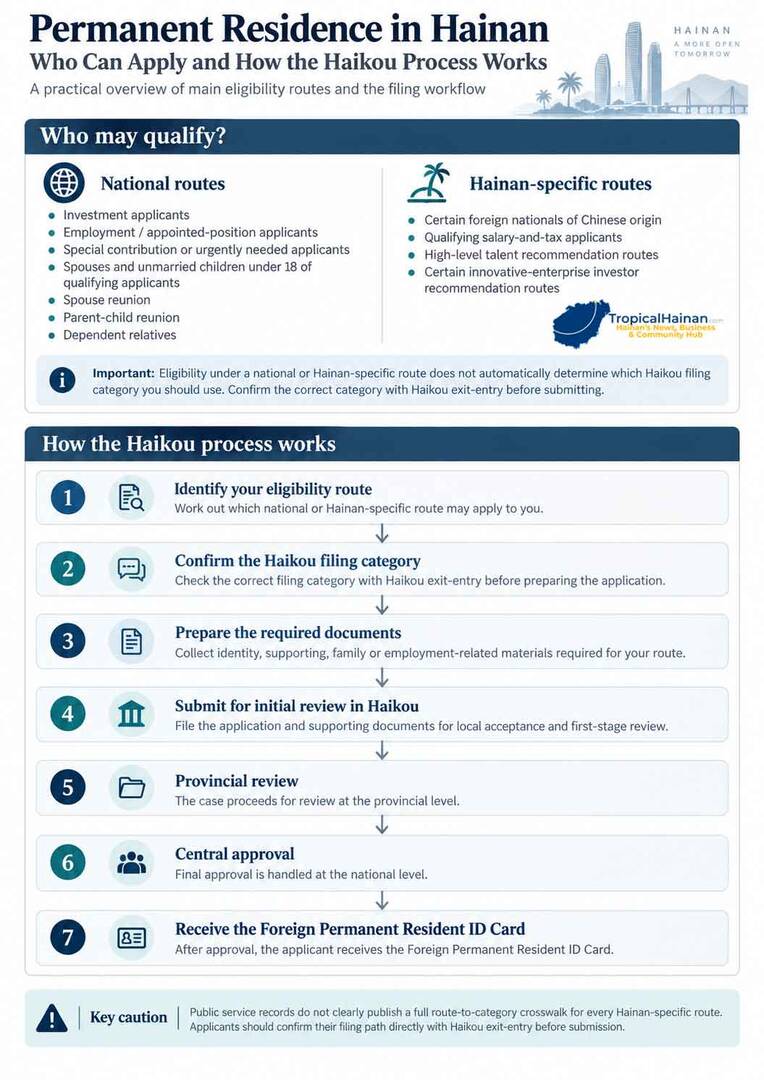
Identify your eligibility route → Confirm the Haikou filing category → Prepare documents → Submit for initial review → Provincial review → Central approval → Receive the Foreign Permanent Resident ID Card
Is an in-person visit required?
Applicants should plan to attend in person during the process.
Haikou’s service records are slightly awkward on this point. Their summary data shows zero required visits, while the same records say on-site handling is required and instruct applicants to have their application photograph taken at the Haikou government service centre. The practical reading is that this should not be treated as a wholly online procedure.
National rules still allow an authorised representative to submit an application. The receiving authority may also require original-document checks, supplementary information or further investigation. Haikou’s published records do not state that every applicant must attend a formal interview or provide fingerprints.
Processing time
Haikou’s permanent-residence records publish a 90-working-day statutory limit for the local initial-review service. The headline field gives a 29-working-day committed processing time, while the FAQ on the same records refers to 30 working days from acceptance. In practical terms, the local commitment is about 30 working days.
That is not the timetable for the entire permanent-residence application. The National Immigration Administration service guide states that the overall decision should be made within six months from acceptance, covering investigation, provincial review and final approval.
Applicants should therefore plan around the national approval timetable rather than assume the Haikou commitment is the time needed to receive the card.
Application fee
The National Immigration Administration lists an RMB 1,500 application fee and a further RMB 300 for the Foreign Permanent Resident ID Card. Haikou’s local initial-review records show no separate local fee item; this does not remove the national charges. Different fees apply where a card is lost or damaged.
Responsible authority
For a Haikou case, the Haikou Municipal Public Security Bureau is the receiving authority. The application is reviewed at provincial level by the Hainan Provincial Public Security Department, while the Ministry of Public Security is the statutory approving authority for foreign permanent residence.
Haikou service centre
Haikou’s permanent-residence service records list two locations where the service can be handled.
Haikou Citizens and Visitors Centre
Talent and Engineering Construction Comprehensive Service Window
Windows 01–15, Zone B, 1st Floor, Government Service Hall
No. 1 Binhai Park Road, Longhua District, Haikou
海口市龙华区滨海公园路1号海口市民游客中心政务服务大厅1楼B区01–15号人才和工程建设综合服务窗口
Haikou Municipal Public Security Bureau Exit-Entry Reception Hall
Windows 11 and 12, 1st Floor, West Annex Building
No. 2 Changbin East 3rd Street, Xiuying District, Haikou
海口市秀英区长滨路东三街2号海口市公安局西辅楼一楼出入境接待大厅11、12号窗口
Opening hours: Monday to Friday, 08:30–12:00 and 14:00–17:30, excluding public holidays
Enquiries: 0898-68590746
National immigration service hotline: 12367
Government-service complaints: 12345
Handling arrangements can change, so it is worth calling before travelling to confirm which location is best for the application.
What the applicant receives
Successful applicants receive a Foreign Permanent Resident ID Card.
The card is valid for 10 years for people aged 18 or above and five years for those under 18. Permanent residents may enter and leave China using a valid passport together with the card.
Permanent residence also comes with continuing residence requirements. Holders must normally spend a cumulative total of at least three months in China each year. Where there is a genuine need to spend less time in the country, the provincial public-security authority for the place of long-term residence may approve a shorter stay, but the holder must still spend at least one cumulative year in China during any five-year period. Falling below those requirements without approval is one of the grounds on which permanent-residence status may be cancelled.
Important points before applying
Permanent residence is not a longer work-type residence permit. It is a separate immigration status, with different eligibility rules and a separate approval process.
Hainan’s additional eligibility routes do not map neatly onto the labels shown in Haikou’s filing system. Anyone applying through the high-level-talent, salary/tax, foreign-national-of-Chinese-origin or innovative-enterprise routes should confirm the correct category before filing.
Do not calculate the salary/tax threshold from a general Hainan or Haikou wage statistic. Official guidance publishes a formula, but the current RMB figure, geographic benchmark and statistical series used for immigration purposes are not clearly stated. Confirm the standard with Haikou exit-entry.
High-level talent recognition is not, by itself, the permanent-residence recommendation. The Hainan route requires recommendation by the provincial talent authority, so applicants should confirm how that recommendation is currently obtained and what supporting material is required.
Investors should confirm the meaning of “innovative enterprise” before relying on Hainan’s special investment route. The policy establishes the route, but the public guidance does not define the term for permanent-residence purposes or publish a standalone recommendation procedure.
Official service record
The Hainan Government Services portal publishes Haikou’s permanent-residence procedures as separate initial-review records for the different application categories, together with a separate service for the spouses and children of investment, employment and special-category applicants.
Employment-category initial-review service:
https://wssp.hainan.gov.cn/hnwt/handlingGuideline?id=2187333
National Immigration Administration permanent-residence service guide:
https://s.nia.gov.cn/mps/bszy/wgrcrj/yjjl/201903/t20190313_1008.html
Updated 17 September 2026.
Requirements and local handling arrangements may change. Applicants should check the linked service record and confirm current requirements with the responsible authority before applying.
If you have questions about this procedure or practical experience completing it in Hainan, you are welcome to post below.
This topic was modified 39 minutes ago by Expats in Haikou

Register Your Business

Follow Us on WeChat

Jobs in Hainan