A new industrial test case in Yangpu
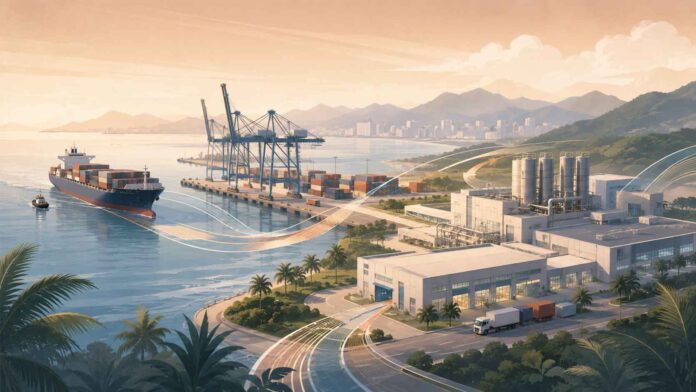
On the first day of Hainan’s island-wide special customs operations, Siemens Energy broke ground on a gas turbine assembly base and service centre in Yangpu. The project gives Hainan an early industrial case study for its new free trade port framework: a foreign-invested manufacturer using the island’s new customs and policy structure to support China-facing industrial operations.
Siemens Energy’s own public comments focused on logistics and administrative efficiency. Lars Voelker, general manager of Siemens Energy (Hainan) Co Ltd, said the free trade port option gave the company “the chance to optimize our logistic processes and to reduce administration effort and make everything faster.” That is a useful starting point for understanding Hainan’s appeal. The island’s post-customs-closure framework is not simply a conventional manufacturing-zone offer. It gives companies a customs-separated operating structure for selected China-facing activities.
The customs mechanism behind Hainan’s offer
Since December 18, 2025, Hainan has operated under island-wide special customs arrangements. China’s State Council describes the system as “freer access at the first line,” meaning trade between Hainan and overseas markets, and “regulated access at the second line,” meaning goods moving between Hainan and the mainland. Under the new framework, the share of zero-tariff products in Hainan rose from 21% to 74%, expanding from about 1,900 tariff lines to more than 6,600.
The commercially important point is not simply that more goods can enter Hainan with lower import costs. It is that qualifying goods processed inside the Hainan FTP may move into mainland China free of import tariffs if local processing generates at least 30% value-added. Import-stage VAT and consumption tax are not removed by this mechanism and remain payable under the applicable rules.
General Administration of Customs Announcement 2025 No. 158 provides the operative customs framework for value-added processing goods in the Hainan FTP. In practical terms, the rule gives qualifying enterprises a way to import materials or components into Hainan, conduct processing that meets the value-added threshold, and then sell qualifying goods into the mainland market with import tariffs waived. That makes Hainan relevant not only as a duty-free import platform, but as a possible processing channel for China-facing supply chains.
Where Hainan fits in China-facing supply chains
That is where Hainan’s relevance to China-facing supply chains becomes clearer.
Many international companies are reviewing how to structure production, sourcing and assembly across China and other markets. Hainan’s specific contribution is the second-line mechanism: qualifying goods processed on the island may enter the mainland with import tariffs waived after meeting the required value-added threshold.
Hainan should be assessed on its own terms rather than as a direct substitute for other regional business hubs or manufacturing locations. Its role is most relevant to companies that need continued access to the mainland market and can use qualifying value-added processing on the island. The US-China Business Council described Hainan’s new customs status as giving multinationals more supply-chain options for China-centred operations and broader China Plus One strategies, while also noting that policy consistency and talent availability will affect how companies use the opening.
Early data shows the first stage of use
The early data supports a measured conclusion: Hainan’s new customs mechanism is operating, and its processing role is beginning to develop. In the first 100 days after island-wide special customs operations began, Hainan’s import and export value exceeded 80 billion yuan, up 32.9% year on year. Official data also reported 186 zero-tariff transactions involving nearly 1.7 billion yuan in goods, with 271 million yuan in duties exempted.
A more directly relevant indicator than headline trade value is the relationship between first-line zero-tariff imports and second-line value-added domestic sales. According to Haikou Customs data for December 18, 2025 to January 17, 2026, first-line imported zero-tariff goods were valued at about 750 million yuan, while processed and value-added goods sold domestically through the second line were valued at about 85.9 million yuan. The second-line channel was active in the first month, but remained much smaller than the first-line zero-tariff import channel by reported value.
That comparison should be read carefully. It does not show how quickly the processing side may grow as more projects move from registration to production.
It shows the processing layer is operating, and its scale will depend on enterprise uptake, supplier development and continued implementation experience.
The first operational cases
The most concrete operational cases remain concentrated in a small number of specific supply chains. Siemens Energy shows how Hainan can attract high-value industrial activity linked to imported components, logistics efficiency and China-market service capability.
Dufengxuan Group, through its Zhongao Soup Industry project in Yangpu, provides a clearer tariff-arithmetic case: the company processes imported beef bones into food products for the mainland market and said it imports nearly 1 billion yuan worth of bones each year, translating into roughly 130 million yuan in tax cuts.
SINOPEC Hainan Petrochemical illustrates another feature of the system: cumulative value-added. The company imports propane to produce polypropylene, but its own processing did not reach the 30% threshold. According to Beijing Review, it worked with Danzhou Weida Chemical Co. Ltd., which further processes the polypropylene into packaging films and bags, allowing the final goods to reach the 30% requirement and qualify for tariff exemption when entering the mainland.
These cases show that the rule can matter commercially. They point to an early pattern: Hainan appears most relevant where imported inputs are significant, processing margins are clear, mainland demand is important, and the business can use the island’s customs framework effectively.
How the 30% rule works in practice
The 30% rule is also more demanding than a simple reference to the threshold suggests. Companies must be able to calculate value-added, document material costs and sales prices, register through the relevant Hainan systems, and submit customs declarations that can withstand review. The policy is an incentive, but using it depends on customs accounting, documentation and compliance systems.
This is why Hainan should not be assessed simply through comparisons with Singapore or Hong Kong. Its role is different. Singapore and Hong Kong are established international finance, legal and services centres. Hainan’s distinctive feature is its separate customs framework inside China, combined with a tariff mechanism for qualifying goods entering the mainland after value-added processing.
Where Hainan fits in China-facing supply chains
That distinction makes Hainan relevant to companies with specific China-facing needs. For businesses that require continued mainland market access and can use qualifying processing in Hainan, the FTP offers a possible customs structure between overseas sourcing and mainland sales. It allows qualifying activities to be placed outside the mainland customs line while remaining inside China’s legal and commercial environment.
The same feature also defines the scope of the strategy. Hainan may reduce some tariff and customs friction while remaining part of China’s legal and regulatory environment. Companies using the Hainan structure will still need to assess their own sector, ownership structure, product category and cross-border compliance obligations. Hainan is most relevant where the business issue is tariff treatment, customs structure and mainland market access.
The next stage: implementation and cluster development
The island’s wider supply-chain role will depend on how quickly supporting ecosystems develop. The Siemens Energy case shows how anchor projects may help create demand for upstream suppliers, logistics providers and technical services. That makes the issue one of cluster formation and implementation, rather than headline policy design alone.
European business representatives have also identified practical execution priorities. The European Union Chamber of Commerce in China said in April 2026 that Hainan Free Trade Port was recognised by chamber representatives as attractive for companies looking to deepen their presence in China while maintaining global connectivity. It also cited specialised talent, experienced service providers and integrated supply chains as areas for further development as the FTP moves from policy design into wider commercial use.
There is also a planning-horizon point for companies considering larger commitments. The preferential corporate income tax policy for Hainan Free Trade Port enterprises has been extended to December 31, 2027, according to the Ministry of Finance and State Taxation Administration notice cited by Hong Kong’s Trade and Industry Department. For capital-expenditure decisions made over five-to-ten-year cycles, companies will watch not only the current rate, but also how the post-2027 framework develops.
What multinational planners should watch
The practical conclusion is focused rather than sweeping. Hainan’s China-facing processing role is still at an early operational stage, but it is no longer only a policy concept. The legal mechanism exists, customs has begun processing the relevant flows, and identifiable companies are using the system. The available evidence points to an emerging structure that appears most relevant for tariff-sensitive, China-facing supply chains with clear value-added activity.
For multinational supply-chain planners, Hainan addresses one part of the China-facing supply-chain question. The island offers a way to adjust the customs and processing structure of operations serving the mainland market while remaining connected to China’s legal and commercial system. That will be commercially relevant for some companies and less relevant for others.
Over the next several years, the key indicators will include whether second-line value-added domestic sales expand as a meaningful share of first-line zero-tariff import activity, whether supplier clusters develop around early industrial entrants, and whether companies gain enough practical experience with the customs process to use the mechanism at larger scale. The early numbers show movement. Scale will depend on execution.
For now, the most revealing detail remains Siemens Energy’s starting point. A major industrial company entered Hainan at a stage when the local supplier ecosystem for its core gas turbine components was still developing. That may mark the beginning of a new manufacturing cluster. It also shows that Hainan’s wider supply-chain role will be built through continued implementation, supplier development and enterprise uptake, not through tariff design alone.
Related article: 2026 Guide to Registering a Company in Hainan: Address Rules, Requirements, and Compliance