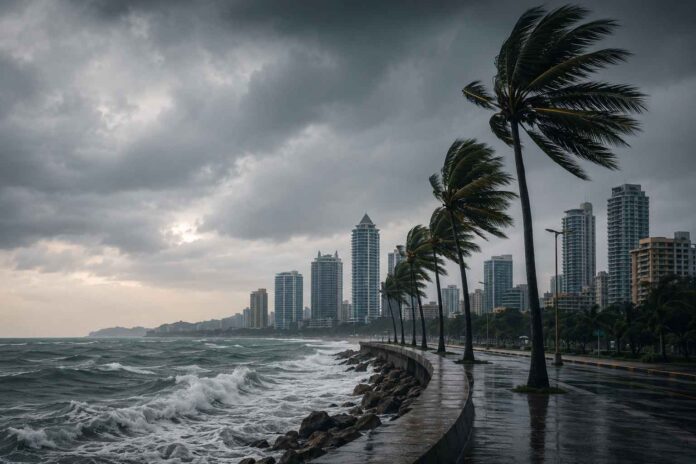
- The 2026 typhoon season is expected to produce near-normal numbers of storms for Hainan, but intensity is forecast as stronger than normal
- The developing El Niño is reducing frequency risk: storms are forming further east and are less likely to track into the South China Sea
- Fewer storms, but any storm that does arrive may hit harder than usual
- The rainy season is already underway. The core typhoon threat for Hainan runs July to October
The South China Sea monsoon arrives in Hainan around mid-May. By August, the island is in the wettest months of the year. Somewhere between those two points, typhoon season begins in earnest, and for most residents, the first real indication is usually a notice of a school closure or a message in a WeChat group.
Here is what the 2026 season is predicted to look like.
What the forecasters are saying about 2026
China’s National Climate Centre (国家气候中心, NCC) released its 2026 forecast in early April.
The numbers: 24 to 26 named storms across the western Pacific and South China Sea, with 7 to 9 making landfall somewhere on the China coast. Both figures are close to the historical average.
The consistent word in NCC’s language is intensity: storms this year are forecast to be stronger than normal.
For Hainan specifically, frequency risk is lower than those headline numbers suggest. The reason is ENSO. The 2025–26 La Niña ended in February. An El Niño is developing and expected to consolidate by mid-year. In El Niño years, typhoon genesis shifts eastward, storms form further from China and are more likely to curve away before reaching the South China Sea.
That pattern is already visible: all four storms that formed between January and April 2026 did so in the eastern part of the basin, well away from Hainan.
Hainan averages roughly two direct typhoon landfalls per year. In 2026, that number is likely at or below average. The risk that warrants attention is not how many storms arrive, it is how strong any storm is when it does.
Super Typhoon Yagi (摩羯台风) in September 2024 and Typhoon Rammasun (威马逊台风) in 2014 are the reference points for what a strong-to-super-typhoon-strength landfall on Hainan looks like: mass evacuations, widespread power loss, serious infrastructure damage.
The 2026 intensity forecast puts that kind of event back on the table.
When to start paying attention
The typhoon threat for Hainan is concentrated from July through October. August and September account for the largest share of historical Hainan landfalls. October remains active.
The rainy season is already underway.
May rain is normal. monsoon moisture builds from early May and intensifies through summer. Increased rainfall from now through June is not a typhoon signal. The storm risk that matters for Hainan starts around July.
The warning system: what the colours mean
China uses a four-colour typhoon warning system issued by the China Meteorological Administration (中国气象局, CMA). The colours escalate from blue through yellow, orange, and red, based on expected wind speeds and time to impact.
| Level | Trigger | Time frame |
| Blue | Sustained Beaufort 6 / gusts Beaufort 7 | Within 24 hours |
| Yellow | Sustained Beaufort 8 / gusts Beaufort 9 | Within 24 hours |
| Orange | Sustained Beaufort 10 / gusts Beaufort 11 | Within 12 hours |
| Red | Sustained Beaufort 12 / gusts Beaufort 14 | Within 6 hours |
Blue means a storm is approaching and conditions may deteriorate. Secure loose outdoor items. Monitor forecasts.
Yellow means worsening conditions are imminent. Avoid coastal areas. Maritime activity begins to be restricted.
Orange means strong typhoon conditions within hours. Schools in Hainan typically suspend at this level. Outdoor work stops. Ferry operations across the Qiongzhou Strait (琼州海峡) are generally disrupted or suspended.
Red is full emergency posture. Stay indoors. Major transport is disrupted. Evacuation of high-risk areas is underway where ordered.
One point that matters: the colour signal tells you what is coming meteorologically. It does not automatically trigger a fixed set of actions identical across all of China. School closures, workplace decisions, ferry suspensions, flight cancellations, and evacuation orders are all determined locally, through government notices, operator decisions, and employer communications.
Ferries and airports
The Qiongzhou Strait (琼州海峡) ferry link is one of the first transport systems to be disrupted in a Hainan typhoon event. Operators and maritime authorities suspend services based on actual sea and wind conditions, usually before the highest-impact phase arrives. There is no fixed public table specifying which warning colour triggers suspension. For any storm forecast to significantly affect Hainan, assume ferry disruption is likely and check with the operator before traveling.
Haikou Meilan Airport (海口美兰国际机场) and Sanya Phoenix Airport (三亚凤凰国际机场) make operational decisions case by case. For stronger storms, large-scale flight cancellations are common, often beginning before landfall if the storm’s wind field is broad. Monitor airline notices directly.
Where to get information in English
While there is no official English-language typhoon warning service for Hainan, TropicalHainan publishes regular major weather (and typhoon) updates.
For more precise tracking and situational awareness:
Windy (windy.com) and Zoom Earth (zoom.earth) provide real-time visual track forecasts, wind fields, and satellite imagery. Both are the fastest way to see where a storm is and where it is headed.
The Joint Typhoon Warning Center (JTWC) publishes official western Pacific tropical cyclone warnings and track forecasts in English. Search “JTWC western Pacific” for the current advisory page, the URL changes periodically.
For local implementation, when schools close, when evacuation notices are issued, when employers send instructions TropicalHainan issues updates.
What to do now
Preparation before a storm arrives is less stressful than dealing with an underprepared home when a storm is on your doorstep.
Balconies and outdoor areas. Unsecured furniture, plant pots, and any loose items are a hazard at typhoon-strength winds, not just to the resident but to anyone below. Check and secure before the season is active.
Windows and doors. Gaps and weak seals that are tolerable in normal conditions become serious problems at sustained Beaufort 10 or above.
Vehicles. Move away from trees, walls, and any underground or low-lying parking areas prone to flooding. Do this as a storm approaches, not after warnings have been upgraded.
Supplies. Water, non-perishable food, a flashlight, power banks, medications. Power and delivery infrastructure on Hainan recovers reasonably quickly from most storms, but not always quickly enough to be relied upon in the immediate post-landfall period.
The bottom line for 2026
- Near-normal frequency.
- Stronger than normal intensity.
- The El Niño signal points to fewer storms reaching the South China Sea.
- The early 2026 season, four named storms, none near Hainan, supports that picture so far.
- The Hainan Provincial Meteorological Service (海南省气象局) will issue its 2026 season-specific guidance in mid-July. That is the point at which Hainan-specific operational forecasts replace basin-wide estimates.
- Pay attention from July onward.
Typhoon warnings for Hainan are issued by the Hainan Meteorological Service and the China Meteorological Administration. During active storm events, follow official local government notices for school closures, evacuation orders, and transport disruption.
Related article: Why Every Household Needs a 72-Hour Emergency Kit