


Foreign professionals in China have recently begun encountering surprisingly high salary figures associated with the foreign work permit system, particularly with regards to Category A and Category B classifications.
This has led some to worry that new salary rules have been introduced in 2026.
In reality, the underlying formulas have existed for years; the figures appear higher today mainly because local average wages have increased, application systems now apply the formulas more consistently, and the high-salary qualification route is sometimes confused with the points-based pathway used by most professionals.
What’s going on?
As of early 2026, there has been no publicly released nationwide regulation that fundamentally rewrites the salary rules governing foreign work permits. The core framework continues to derive from the unified Foreigner Work Permit system introduced nationally between 2016 and 2017.
Recent developments primarily concern stricter enforcement and recalculation of existing salary-multiplier rules through the national online system and local implementation documents, rather than the introduction of an entirely new legal framework.
Understanding how the system actually operates helps clarify the situation considerably.
How China’s Foreign Work Permit System Works
China’s unified Foreigner Work Permit system has been in operation nationwide since April 2017. It replaced the earlier dual arrangement, the Foreign Expert Certificate and the Alien Employment License, with a single permit administered through a national online platform.
Under this framework, foreign workers are classified into three categories:
Category A: High-end foreign talent
Senior specialists, internationally recognised experts, and other high-level professionals identified as urgently needed.
Category B: Professional talent
Skilled professionals including teachers, engineers, consultants, and corporate staff. In practice, many ordinary foreign professionals fall into this category.
Category C: Other foreign workers
Foreigners meeting specific labour-market needs, often subject to quotas or more restrictive administrative management.
Applications may be assessed through a points-based evaluation system. Factors considered include:
• educational qualifications
• work experience
• salary level
• age
• Chinese language ability
• location of employment
• professional achievements
Where the points-based route is used, applicants are classified into the relevant category based on their aggregate score, although some applicants may instead qualify through direct talent channels specified in the national standards.
The Role of Salary Within the System
Salary performs two distinct functions within the work permit framework.
First, it contributes points within the overall scoring system. A higher salary increases an applicant’s score and can assist in reaching the threshold required for Category B or Category A classification.
Second, salary level can also function as an independent classification criterion within the national rules.
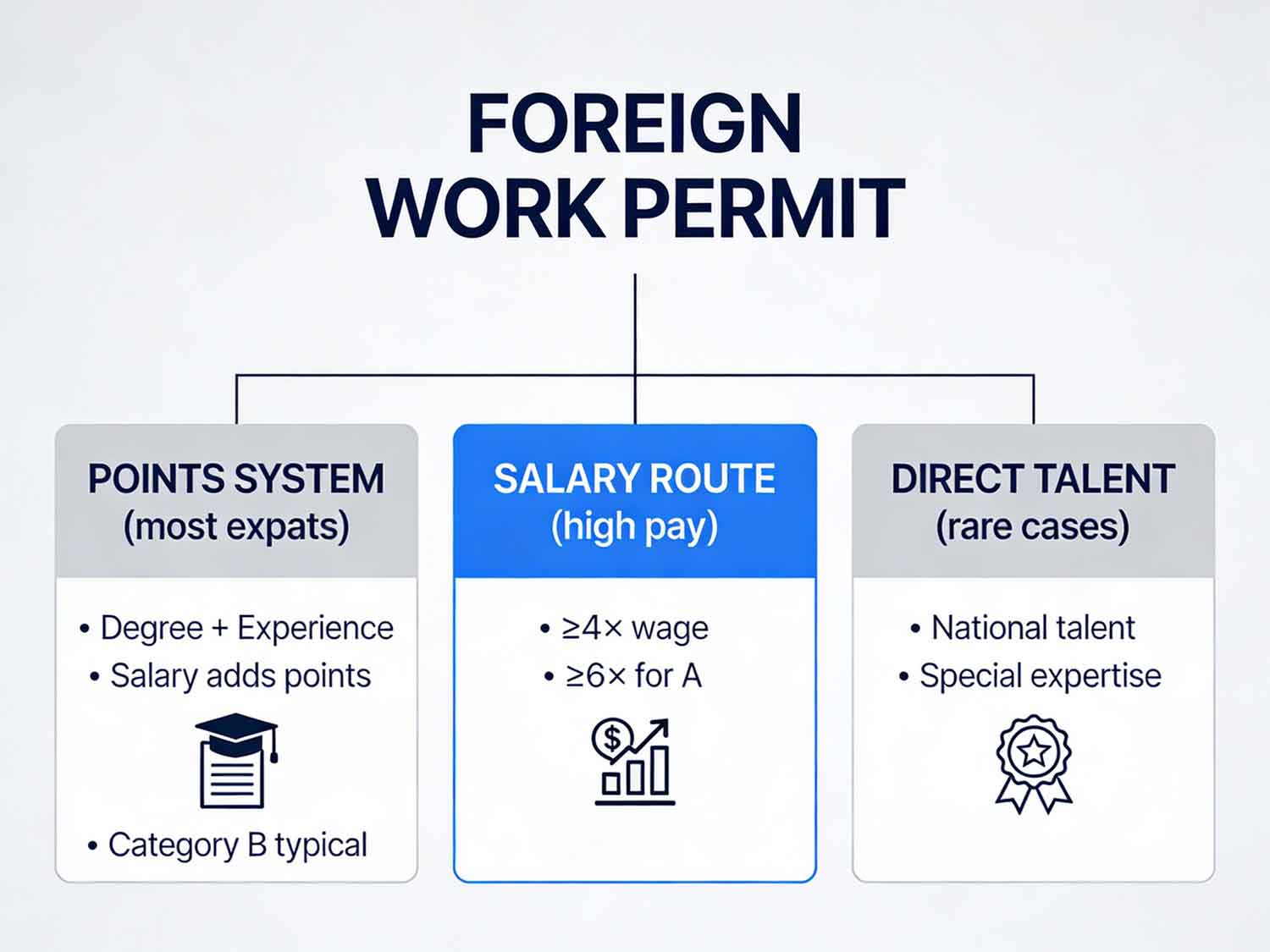
Under the national classification standards issued in connection with the unified Foreigner Work Permit system, Category A and Category B salary-based routes are defined by reference to multiples of the local average wage, commonly described in practice as:
• Category A: salary at or above 6× the local average wage
• Category B: salary at or above 4× the local average wage
Advisory and implementation materials issued since the rollout of the unified system consistently describe these multipliers as part of the classification framework.
They represent one route to qualification, not the only one.
Why the Salary Figures Appear High
Because the rules apply multiples of the local average wage, the precise salary figures vary by city and change as wage statistics are updated.
By way of illustration, based on recent published average wage data, Beijing’s social average monthly wage is around 12,000 RMB. Applying the national multipliers yields indicative salary levels of approximately:
• Category A (6×): roughly 71,000–72,000 RMB per month
• Category B (4×): roughly 47,000–48,000 RMB per month
In Shanghai, where recent average wage data is approximately 12,400 RMB per month, the corresponding figures would be roughly:
• Category A: approximately 74,000–75,000 RMB per month
• Category B: approximately 49,000–50,000 RMB per month
These figures are illustrative calculations derived from official multipliers applied to local average wage data. They do not represent fixed national salary requirements.
Why Salary Thresholds Are Receiving More Attention
Although the salary multipliers have been part of the work permit classification system for several years, their practical implications have become more visible in recent discussions among employers and foreign professionals.
One reason is that, in some cases, employers may rely on the high-salary criterion when submitting an application even where the points-based route would be more appropriate for the applicant’s profile.
In many situations, applicants may in fact qualify more naturally through the points system, supported by factors such as educational qualifications, relevant work experience, and employer sponsorship.
In key cities such as Beijing, employers must now sign salary commitment documents confirming that declared salaries meet the applicable thresholds, and upload employment contracts as supporting evidence. Other cities may impose similar documentation requirements through their local application systems.
As a result, the issue is often less about the introduction of new rules and more about how existing qualification criteria are selected and applied within the framework.
A Critical Distinction: When the Multipliers Apply
The salary multipliers do not apply uniformly to all foreign professionals. They are primarily relevant to applicants who use the high-salary criterion as their primary basis for qualifying for Category A or Category B.
Many foreign professionals qualify through the points system instead, combining factors such as:
• degree qualifications
• relevant professional experience
• salary at a standard professional level
• employer sponsorship
• other scoring components
Even where the high-salary route is not used, declared salary is still reviewed for consistency with employment contracts and tax documentation as part of the overall application assessment.
Depending on the scoring table used by the local authority, applicants can often reach the Category B threshold without meeting the 4× salary level. In practice, roles such as teachers, engineers, consultants, and corporate professionals frequently proceed via this points-based route.
Practical Implications for Foreign Professionals
For many foreign professionals, the practical effect of these rules may therefore be limited.
Where an applicant’s work permit is primarily supported by educational credentials, professional experience, and employer sponsorship rather than by the high-salary criterion, the salary multipliers may not determine eligibility.
For example, foreign teaching positions are commonly approved on the basis of:
• a relevant degree
• verified teaching qualifications
• an adequate number of years of professional experience
• a licensed sponsoring employer
In such cases, salary contributes to the overall points score but does not need to meet the multiples associated with the salary classification criterion.
Applicants who rely principally on high salary levels to qualify for Category A or Category B, however, should verify whether their compensation package satisfies the applicable multipliers in their specific city of employment.
Understanding how these elements interact within the work permit framework is generally more useful than focusing on salary multipliers in isolation.
Sources and Legal References
The framework described in this article is based on China’s unified Foreigner Work Permit system and the official classification standards introduced in 2017.
Primary regulatory reference: “Classification Standards for Foreigners Coming to Work in China (Trial)” (《外国人来华工作分类标准(试行)》), Attachment 3 to Notice 外专发〔2017〕40号, jointly issued by the State Administration of Foreign Experts Affairs, Ministry of Human Resources and Social Security, Ministry of Foreign Affairs, and Ministry of Public Security. Effective nationwide April 1, 2017.
Points-based classification system: Shanghai Municipal People’s Government, “What is the Points-based System for the Foreigner’s Work Permit?” (Official English FAQ) https://english.shanghai.gov.cn/en-FAQHome/20231217/85561bb224f14a2ba6705e25dbefb6e5.html
Local implementation (2026 enforcement): Beijing Overseas Talent Center, Salary Commitment Letter requirements and implementation guidance, issued February 2026.
Salary figures cited in this article are illustrative calculations derived from official multipliers applied to local average wage data and therefore vary by city and by the year of the wage statistics used.
Related article: Why Foreign Teachers in China Are Facing Stricter Document Checks in 2026