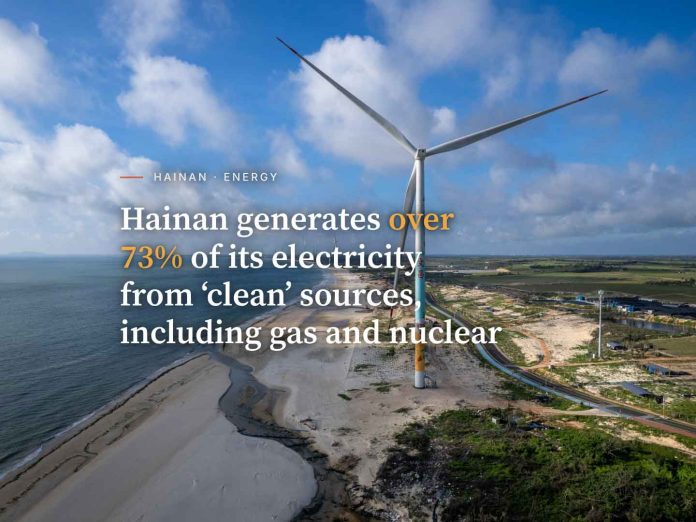
Hainan continues to expand ‘clean energy’ as its Linglong One nuclear reactor undergoes commissioning tests ahead of connection to the power grid.
‘Clean energy’ now produces more than 73% of Hainan’s electricity and accounts for 88% of the province’s installed power generation capacity.
Feng Fei, Hainan’s Communist Party secretary, announced the figures at the 7th New Power System International Forum in Haikou.
The forum opened on 2 November, where Feng said that clean energy now makes up 88% of Hainan’s installed generating capacity and produces more than 73% of its electricity. The province confirmed the 88% figure, measured as of September 2026, when it released its annual climate white paper on 10 November.
At the end of 2024, clean energy accounted for 83.9% of Hainan’s installed generating capacity, according to the provincial development and reform commission. This means its share has increased by about four percentage points in less than two years.
In China’s official statistics, “clean energy” includes more than renewable sources such as wind and solar. It also includes nuclear power and natural gas. As of September 2026, non-fossil energy sources produced 55.4% of the electricity managed through the province’s central grid dispatch system, which schedules electricity supply through the grid operator.
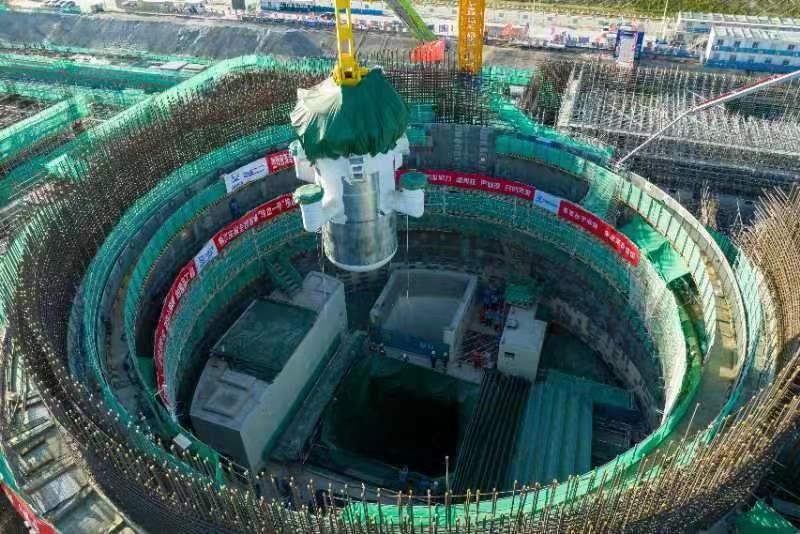
Feng also highlighted progress on the Linglong One (玲龙一号) nuclear reactor, under construction at the Changjiang nuclear power base on Hainan’s west coast. He described it as the world’s first onshore commercial small modular reactor to pass a safety review by the International Atomic Energy Agency (IAEA).
The review was completed in 2016 and focused on the reactor’s design. It did not give the reactor permission to operate, according to the China Nuclear Information Network. On 16 October 2025, Linglong One completed a cold functional test of its primary circuit. This was the first full test of the reactor’s main systems under high pressure.
Once operational, the reactor is expected to generate about 1 billion kilowatt-hours of electricity each year, enough to supply 526,000 households in Hainan. It is also expected to prevent about 880,000 tonnes of carbon dioxide emissions annually. Construction began in July 2021, and the reactor’s civil construction work has been completed. However, it was still undergoing commissioning tests before connection to the electricity grid in late October 2026.
Hainan’s progress is part of China’s wider expansion of electricity generation capacity.
Yang Kun, executive vice-chairman of the China Electricity Council, told the forum that China’s total installed generating capacity had reached 4.13 billion kilowatts by September 2026.
China is the first country to exceed 4 billion kilowatts of generating capacity. Its total capacity is now greater than that of the United States, the European Union, India, Japan and Russia combined.
Solar power has also overtaken coal as China’s largest single source of installed generating capacity, reaching 1.31 billion kilowatts.
However, installed capacity and actual electricity generation are not the same.
Installed capacity measures how much electricity power facilities are capable of producing, while generation measures how much electricity they actually produce.
Li Licheng, an academician of the Chinese Academy of Engineering, told the forum that wind and solar power generated 21.8% of China’s electricity in 2025. By comparison, the two sources accounted for 45% of electricity generation in Germany, 42% in Spain and nearly 19% in the United States. Li stressed that installed capacity shows what a power system can potentially produce, but actual electricity generation is the more important measure of its performance.
Clean energy accounts for 88% of its installed capacity but produces just over 73% of its electricity.
The province is also improving its electricity grid to support the growing use of renewable energy.
Zheng Waisheng, chief technical expert at China Southern Power Grid, described how voltage fluctuations had previously caused renewable energy units in Wenchang, on Hainan’s east coast, to disconnect from the grid.
The problem was resolved after grid-forming energy storage was installed to help maintain grid stability. Hainan has also completed a new 500-kilovolt electricity transmission network, alongside its existing 220-kilovolt network. The upgrade allows larger amounts of electricity to be transported more efficiently across the island.
China’s National Development and Reform Commission has recognised Hainan’s clean-energy power system as a major example of new electricity technology being put into practice.
Hainan is also developing zero-carbon industrial parks and communities designed to balance the electricity they generate, store and consume.
At the same time, the province is working to improve its markets for green electricity and green certificates. For households and businesses, Hainan already has a established mechanism for trading green electricity and green certificates, according to the provincial development and reform commission.
Trading volumes have grown significantly
In 2025, green electricity and green certificate transactions reached a combined 14.727 billion kilowatt-hours, nearly ten times the 1.488 billion kilowatt-hours recorded in 2024.
Looking ahead, Li Licheng’s research team studied three possible scenarios for the growth of wind and solar power in China. Under a scenario in which wind and solar generation grows by 7% annually, the two sources could supply half of China’s electricity by around 2043. If annual growth slows to 5%, they would not reach that level until around 2050.
For Hainan, an important next step is completing the Linglong One reactor at Changjiang. The reactor must finish commissioning before fuel loading, criticality testing and grid connection.
Commercial operation will follow those stages.
Related article: Hainan’s Li’an education zone reaches 15,000 students and staff, incubates student AI start-ups