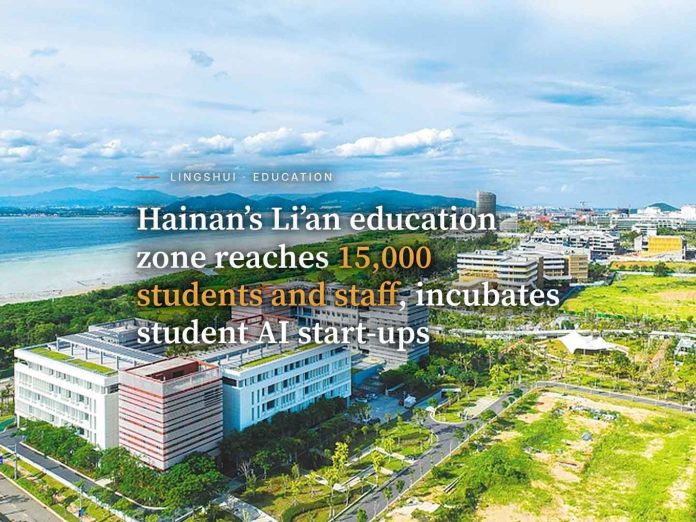
A tropical island campus built so Chinese students could ‘study abroad’ without leaving the country has reached 15,000 students and staff, Hainan Daily reported, and has started growing companies of its own.
On 17 July, at the World Artificial Intelligence Conference in Shanghai, Huang Xiande, 23, showed visitors a desktop machine designed to pack a hospital’s systems into one terminal.

His start-up, Degong Intelligent, was one of only two Hainan companies at the show. It was also the only AI company there grown inside a Hainan education park, Hainan Daily reported on 5 November.
The park is the Lingshui Li’an International Education Innovation Pilot Zone (陵水黎安国际教育创新试验区), a campus town being built from scratch on a 12.72-square-kilometre stretch of coast in Lingshui Li Autonomous County. Jointly run by the Ministry of Education and the Hainan provincial government, it is the only one of the free trade port’s 13 key parks dedicated to opening up education. Its new coastal campus took in a first batch of 296 students in autumn 2022.
Four years on, the zone has signed up 30 Chinese and foreign universities and won approval for 24 joint-education institutions and programmes. Its students and staff number 15,000, Hainan Daily reported, up from more than 4,000 in autumn 2024. Students from more than 50 countries and regions attend. Some degrees run “4+0”: four years in Hainan, with graduates who meet the requirements receiving the foreign partner university’s certificate.
The pitch is price as much as place. Joint-programme tuition runs about 100,000 yuan a year. Four years of tuition cost roughly a third less than tuition in Britain or the United States, the zone’s administration told Xinhua in 2024. It put annual living costs at about 30,000 yuan, roughly 60% lower than in Britain or the United States.
Now the zone wants to turn out companies as well as graduates. The clearest example is Degong. Fresh out of university, Huang and his partners were turned away in Beijing, Shanghai and Guangzhou as too young and too inexperienced. Then the zone phoned and invited them back.
Instead of simply offering office space and financial support, the zone allows start-ups to test their technology in real campus operations for free. These include administrative services, student services and drone inspections.
Under an “invest first, take equity later” scheme, early funding converts into a stake only after the company proves its technology and enters market-based financing, Hainan Daily said.
Degong registered in September 2025. Its “Li’anshu” smart-park operating system now runs services zone-wide. In November 2025, the county’s digital investment company signed a strategic agreement with the start-up, People’s Daily reported.
Others are gathering. A community for digital nomads and one-person companies, opened in 2025, has passed 100 members. They work in AI development, cross-border e-commerce and digital art. The Li’an Digital Laboratory, the province’s first joint digital-economy innovation platform, has filed ten patent applications and released five marketable software products.
A maker space offers student founders rent-free desks. One of its first residents, a sports-university student named Li Le, runs a café now in its second year, Hainan Daily reported.
The zone’s larger industrial ambitions are still taking shape. Its biggest project is a planned second phase called the Li’an International Sci-tech Innovation Port, which would provide space for technology companies, research facilities and new businesses. The development would cover 248.8 hectares, with estimated total investment of about RMB 30 billion.
Of the zone’s 273 bachelor’s degree graduates in 2026, 158 went abroad for further study. Another 35 entered employment, but only four took jobs in Hainan.
The zone is also expanding its international education programmes. Six new joint programmes were approved in 2026, including partnerships between Xi’an Jiaotong University and the University of British Columbia, and between China University of Political Science and Law and the University of Ottawa.
Foreign universities get a shared campus and a base for approved joint programmes. Students on qualifying programmes can earn a foreign university’s degree at what the zone says is a lower cost than studying overseas. Founders get rent-free desks and a real testbed.
Related article: Harrow’s Hainan school offers scholarships worth up to about RMB 776,000