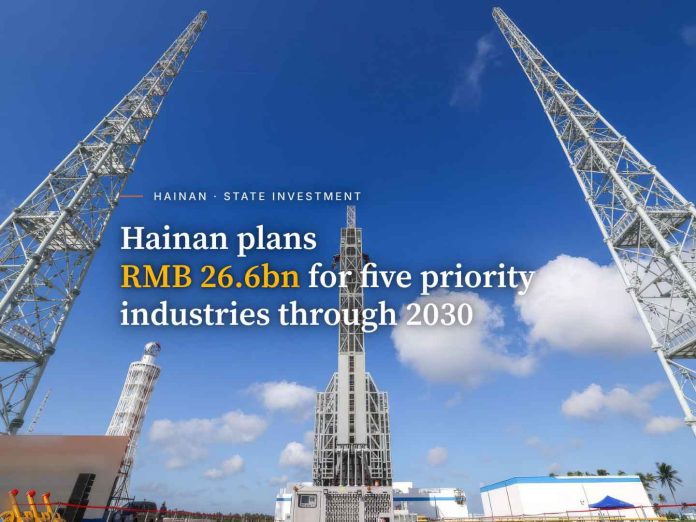
Hainan’s provincial state-owned companies plan to invest RMB 26.6 billion in 26 “landmark” projects from 2026 to 2030. The projects cover the five industries the province groups as its “five directions” (五向图强): seed breeding, the ocean, space, green industries and data. Shen Qi, deputy director of the Hainan Provincial State-owned Assets Supervision and Administration Commission (SASAC), which oversees the companies, told a press conference in Haikou on 12 November.
Officials named state companies to lead or support work in each of the five priority industries, but did not say how the RMB 26.6 billion would be divided between projects.
Hainan also plans to shift the balance of its state-owned companies’ assets away from infrastructure and towards industry and public services.
Under the new five-year plan, industry’s share of these assets is to rise from 40% to 50%, SASAC director Ma Yonghua said. Infrastructure’s share is to fall from 48% to 30%, while the share devoted to public services and livelihoods will rise from 12% to 20%.
In practice, this could mean state-owned companies taking a bigger role in businesses such as commercial space launches, seed breeding, marine technology and data services, rather than focusing so heavily on building infrastructure. It does not necessarily mean less spending on roads and other infrastructure, but a change in the balance of what these companies own and operate.
The RMB 26.6 billion is a planned total, not money already spent. It is about a sixth of the RMB 158.1 billion that, according to SASAC, the companies invested in fixed assets in 2021–25. That total covered all fixed-asset investment, not designated projects. Officials gave no cost for any single project.
The space strand carries the clearest numerical target. SASAC will “fully support” Hainan International Commercial Aerospace Launch Co. (海南商发), the provincial company that built and runs the commercial launch site in Wenchang, in assessing new launch pads. The aim is for the site to be able to handle 100 rocket launches a year by 2030. SASAC also wants the “satellite super factory” completed and in production. Its production line had entered trial production, with the first satellite scheduled to roll off the production line by the end of this year.
That target goes beyond what the site’s existing and nearly finished pads are expected to deliver. The company has completed 27 launches so far, Shen said. Two launch pads are currently in use. Two additional pads began testing launch procedures on 29 September and are expected to be ready for launches by the end of 2026.
Once those pads and the site’s tracking and recovery systems are complete, the site will be able to handle more than 60 launches a year, according to Xinhua. SASAC tied the 100-launch goal to new pads that are still being assessed, and to exploring offshore launch and recovery platforms and onshore landing pads.
The plans also name companies for work in seed breeding, the ocean, low-altitude flight, energy and data:
- Seeds: the provincial state-farm group, Haiken (海垦集团), is to build smart seed-trial fields for Nanfan (南繁) breeding and a national wild rice germplasm nursery.
- Ocean: a new provincial ocean group is to plan a smart-manufacturing base for deep-sea equipment. Deep-sea aquaculture and a marine ranch are planned for Sanya Bay.
- Low-altitude flight: China General Aviation (中国通航), which already operates a smart low-altitude management platform, is to lead further development of the province’s low-altitude infrastructure. SASAC will support Hainan Jiaotou (海南交投), which invested in the “double ring” (双环) tourist highways, in planning vertiports along them.
- Energy: Hainan Holding (海南控股) is to speed up construction of the Huangzhuping pumped-storage power station in Qiongzhong.
- Data: Hainan Information Industry Investment Group (海南信投) is expected to accelerate its transition towards becoming a provincial data group and lead the creation of a new computing centre. SASAC will also support its participation in expanding an undersea data centre that officials describe as the world’s first commercial one.
The data strand also favours domestic suppliers. SASAC said the companies will promote replacing IT products in key areas with domestically made alternatives, known as xinchuang (信创). It did not say which products would be affected. The same strand includes taking part in a pilot on cross-border data flows.
The first dated test of the space target comes by the end of 2026, when the two new pads are due to become capable of launching rockets.
Related article: Starting a one-person AI firm in Hainan? Here’s what the support really offers