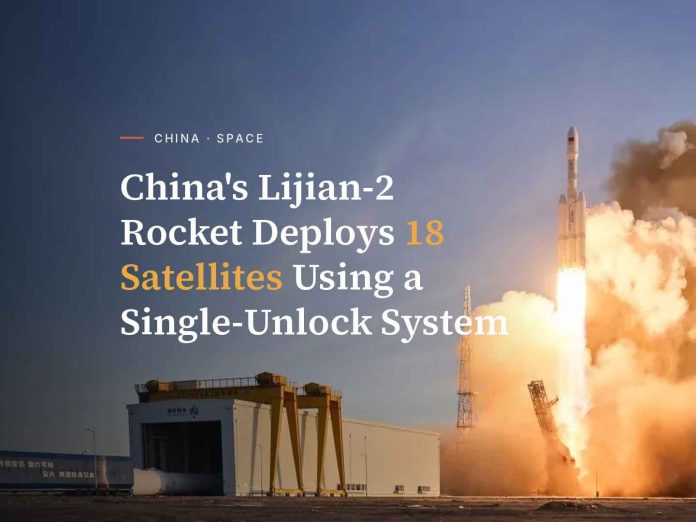
The traditional way to get 18 satellites off one rocket is to unlock them one at a time and push each away in turn. On Tuesday 3 November 2026, at 08:15 Beijing time, a Chinese commercial rocket carried a device built to free all 18 with a single unlock.
“To use an analogy, the traditional separation of 18 satellites from one rocket is throwing a shot put 18 times. Now it is flinging out 18 hammers at once,” said Zhang Yanrui, deputy chief designer of the Lijian-2 (力箭二号) rocket, according to a Science and Technology Daily report republished by The Paper.
The rocket lifted off at 08:15 Beijing time on 3 November from the Dongfeng commercial space innovation pilot zone in north-west China and placed its 18 satellites in their planned orbit, Xinhua reported. They form the 21st polar-orbit group of Qianfan (千帆, “Thousand Sails”), a Chinese low-orbit broadband internet constellation.
One unlock instead of 18
The device, which the rocket’s maker CAS Space (中科宇航) helped to develop, holds the satellites together in a stack rather than releasing them one by one. Tuesday’s flight was its first use on a Lijian-2, the newspaper reported, and the satellites separated in order and accurately. The device itself is not new to spaceflight: it had already completed more than ten test flights on several types of rocket.
Zhang described the design as swapping a mechanical solution for one based on motion. Its advantages, he said, are fewer mechanisms, fewer steps and less weight. The difficulty lies in the motion itself: the stack must be held down firmly but not too tightly, and flung apart without scattering in disorder.
Qianfan is built and operated by Shanghai Spacesail Technologies (垣信卫星). The paper said this was the first time the company had used a rocket from a private commercial launch firm to put 18 satellites up at once.
A young rocket
CAS Space said it was only the second flight of the Lijian-2. It was also the rocket’s first mission to deploy a large batch of internet satellites. The first flight, on 30 March, put three payloads into orbit, one of them a 4.2-tonne experimental spacecraft, according to an earlier Xinhua report.
The liquid-fuelled rocket can lift 12 tonnes to a 200-kilometre low Earth orbit, or 8 tonnes to a higher, 500-kilometre sun-synchronous orbit.
Yang Haoliang, the rocket’s chief designer and commander said China’s low-orbit satellite internet had entered a period of intensive deployment, with heavy demand for launches and a large shortfall in the number of satellites in orbit.
Fifty to go
Qianfan satellites also fly from Hainan. On 5 July a Long March 8A carried the constellation’s 15th polar-orbit group from the Hainan commercial spaceport in Wenchang.
After Tuesday’s launch Qianfan has 274 satellites in orbit. The first phase calls for 648, and the long-term plan for more than 15,000. According to a Jiefang Daily report published by the Shanghai government on 28 October, Qianfan would strive to have launched 324 satellites in total this year and so meet the basic conditions for commercial operation.
Related article: Icebreaker that reached the North Pole holds open day in Sanya