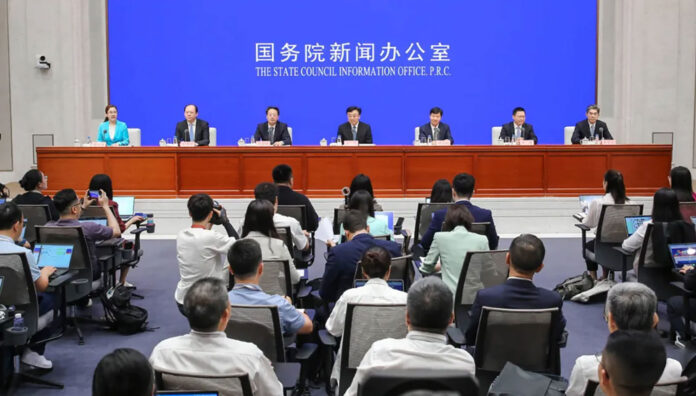
On July 23, the State Council Information Office held a press conference to update the progress of the Hainan Free Trade Port (FTP).
Feng Fei, Secretary of the Hainan Provincial Committee, announced that preparations for the island-wide customs closure are complete. Supporting policies and documents are finalized, including the Import Taxable Goods Catalog, the Prohibited and Restricted Goods Lists, and the duty-exemption policy for domestically sold value-added products.
Here’s a breakdown of the major policies unveiled and how they will impact businesses operating in and with Hainan.
1. Goods Taxation Policy
Status: Released
Source: Notice on Tax Policies for Goods Entering/Exiting the “Primary” and “Secondary” Customs Lines and Circulating Within Hainan FTP
Once the customs closure takes effect:
Enterprises, qualified public institutions, and private non-enterprise organizations registered in the Hainan FTP can import goods outside the Import Taxable Goods Catalog via the primary line without paying import duties.
Duty-free goods and their processed products can circulate tax-free among eligible entities within the island, no need to pay additional import taxes.
Goods produced in Hainan FTP’s encouraged industries that achieve at least 30% local value-added processing will be exempt from import tariffs when entering mainland China via the secondary line (though VAT and consumption tax still apply).
What’s changing? Three key upgrades after customs closure:
Much wider duty-free coverage.
The old “positive list” of duty-free goods is replaced with a negative list (the Import Taxable Goods Catalog).
Duty-free tariff lines expand from 1,900 to around 6,600, covering about 74% of all tariff categories, an increase of nearly 53 percentage points.
More businesses eligible.
Previously, only enterprises and public institutions registered in Hainan FTP qualified.
After closure, all types of organizations with genuine import needs, including private non-enterprise units, can benefit.
Relaxed circulation rules.
Duty-free goods and their processed products will no longer be restricted to self-use.
They can circulate freely among eligible entities without triggering extra import taxes, helping extend industrial chains, boost competitiveness, and create industry clusters.
2. Prohibited and Restricted Goods List
Status: Released
Source: Hainan FTP Prohibited and Restricted Import/Export Goods List
This list clarifies all goods and items nationally prohibited or restricted for import/export, giving businesses a clear understanding of regulatory boundaries.
Key changes:
60 HS-coded used mechanical and electrical products have been removed from license requirements, covering 80% of license-controlled used equipment, a major step to meet production needs for self-use in Hainan.
38 HS-coded products are now eligible for bonded maintenance within the FTP, reaching the highest level of openness in China for bonded repair services.
(HS-coded products are goods classified under the international Harmonized System (HS) of product nomenclature. The World Customs Organization maintains the HS, which assigns a six-digit code to virtually every traded commodity so that customs administrations worldwide can uniformly identify, tariff, and track them.)
3. Cross-Border Asset Management Pilot
Status: Released
Source: Implementation Rules for Cross-Border Asset Management Pilot in Hainan FTP
After customs closure, the Hainan FTP will gradually establish financial policies tailored to a highly open economy:
The Free Trade Account system will be upgraded with more functions and broader application scenarios.
The financial sector will open further, both inward and outward, and cross-border asset management pilots will be expanded to support innovative financial services.
4. Duty-Free Policy for Value-Added Domestic Sales
Status: Pending Release
This upcoming policy allows goods produced in Hainan FTP’s encouraged industries using imported materials to enter mainland China tariff-free, as long as at least 30% of their value is added within Hainan. VAT and consumption tax will still apply.
Optimizations after customs closure include:
Lowering the eligibility threshold: Removing the requirement that encouraged industries must account for at least 60% of a company’s total revenue.
Expanding eligible materials: Extending coverage beyond bonded goods to include duty-free imported goods.
Improved value-added calculation: Locally produced goods in Hainan now count toward the 30% threshold.
Cumulative processing value: Value-added from different upstream and downstream enterprises can be combined, encouraging collaboration and longer industrial chains.
5. Customs Supervision Measures
Status: Pending Release
To implement zero-tariff imports and relaxed trade controls, the General Administration of Customs has drafted new supervision rules for Hainan FTP.
Key principles:
- Qualifying imports get immediate release upon arrival via the primary line. Goods moving from Hainan into the mainland via the secondary line are subject to streamlined customs checks.
- Ensure efficient, precise, and convenient customs oversight.
What this means in practice:
Primary line (imports):
Faster customs clearance across the entire FTP.
Goods like duty-free and bonded items are released directly unless they require quarantine or licensing.
Secondary line (mainland entry):
Separate customs and non-customs channels.
Only three categories of goods go through customs channels:
Duty-free goods
Value-added processed goods
Goods under relaxed trade controls
All other domestic-circulation goods use non-customs channels, managed by Hainan Province under existing domestic regulations.
New clearance model:
“Batch release, centralized declaration”, enterprises move goods first, submit declarations later.
Fewer paperwork requirements: customs declaration fields drop from 105 to just 42.
6. Policies in the Pipeline
The press conference also hinted at several upcoming policies still under development:
Island resident consumption tax policy: Post-closure, tax reforms will deepen to better align with FTP construction and expanded openness. A positive list for residents’ imported goods consumption is being studied.
New market-access measures: Further relax foreign investment entry, introduce new special measures, and streamline admission reforms to build a more convenient investment environment.
Entry–exit management: More flexible policies for temporary business entry, streamlined work visas, and improved residence permit systems.
Shipping & aviation:
Accelerate the “China Yangpu Port” registry
Optimize ship inspection policies
Loosen airspace controls and push for seventh-freedom air traffic rights
Cross-border data flows:
Build a secure and efficient data-flow mechanism
Adjust the negative list for outbound data management
Fast-track international telecom gateways and submarine cable projects to grow the digital economy.
Why It Matters
Hainan’s full customs closure marks a significant step toward becoming a globally competitive free trade port. Expanded duty-free policies, relaxed circulation rules, and new financial and trade facilitation measures will open up more opportunities for domestic and international businesses.
Companies operating in Hainan, or those considering entry, should carefully review these policies to maximize the coming policy dividends.
Related article: Hong Kong Investment Firm Launches Hainan’s First Foreign-Led Stem Cell Venture