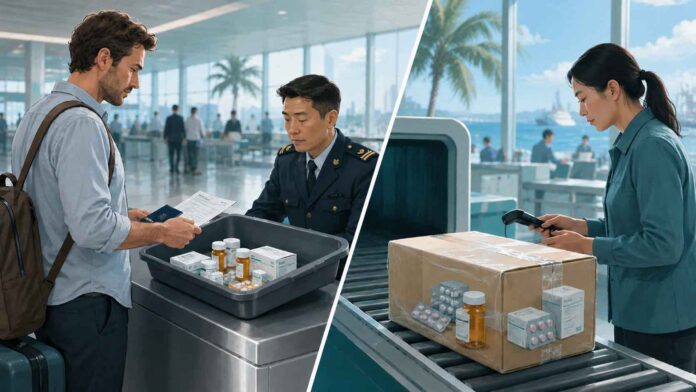
- China treats medicine carried in luggage and medicine arriving by post or private courier as different entry channels.
- Some controlled medicines have a documented procedure when carried personally, but no equivalent procedure has been verified for post or courier delivery.
- There is no universal national rule allowing a 30-day or 90-day supply of prescription medicine.
- Chinese authorities classify medicines by active ingredient and formulation, not by foreign brand name.
A foreign resident flies back to China with several boxes of prescribed medicine in a suitcase. A few months later, the supply runs low and a relative offers to send exactly the same medicine from overseas. It may seem like a straightforward replacement, but Customs does not necessarily treat the two situations in the same way.
The tablets have not changed. The route has.
China applies different rules to medicine carried in a traveller’s baggage and medicine arriving by international post or private courier. The distinction becomes especially important when China classifies the active ingredient as a narcotic or psychotropic drug (a substance that affects the brain and alters mood, perception, behaviour or mental function). A medicine may have a clearly documented procedure when carried by the patient, while no equivalent procedure has been verified for sending it separately.
The question is not simply whether the medicine was prescribed legally overseas. Before travelling or arranging delivery, the patient needs to know the active ingredient, how China classifies it and which entry channel will be used.
Start with the ingredient, not the brand name
Chinese control catalogues determine a medicine’s legal category by listing specific active substances, formulations, salts, stereoisomers and certain combination products. Medicines sold under different brand names may therefore receive the same treatment, while two versions of the same active ingredient can fall into different categories because the formulation or amount contained in each dosage unit is different.
China divides psychotropic medicines into Category I and Category II according to their potential to cause dependence and harm to health, with Category I subject to tighter controls. The current psychotropic catalogue places methylphenidate and dexamfetamine in Category I, while medicines including diazepam, modafinil, tramadol, zolpidem and zopiclone appear in Category II. Morphine, fentanyl, oxycodone and hydrocodone are listed as medicinal narcotics.
The same active ingredient can fall into a different category depending on the formulation.
Formulation can change the classification. Buprenorphine base and single-ingredient preparations are Category I psychotropic medicines, while buprenorphine patches and buprenorphine-naloxone oral products are Category II. Midazolam injections are Category I, while other midazolam formulations are Category II. Some oxycodone and hydrocodone combination products also change category according to the amount of active ingredient in each dosage unit.
This is why the brand name alone is not enough. Check the generic ingredient, strength, dosage form and quantity shown on the packaging.
What a patient can carry personally
For ordinary, non-controlled prescription medicine, Customs applies the standard of personal use and reasonable quantity. The national rules do not set a fixed number of boxes or days’ supply, so there is no automatic 30-day or 90-day allowance.
The rules become more specific for medicinal narcotics and Category I psychotropic medicines. Article 44 allows an individual to carry them for treatment with two documents: a medical diagnosis certificate issued by a medical institution and personal identification. The quantity must remain within the maximum amount permitted on a single prescription, and Customs applies the principles of personal use and reasonable quantity.
Article 44 sets a separate rule for medical personnel carrying controlled medicines for professional medical use. They require a government-issued carriage certificate. This requirement does not apply to patients carrying their own medicine.
A simple doctor’s note is not necessarily the same as the medical diagnosis certificate required by Article 44. The national regulation also does not explain whether a certificate issued outside China will be accepted or whether Customs may require a translation, authentication or paper original.
Category II psychotropic medicines are less clearly covered. Article 44 does not mention them. China’s domestic prescription rules generally limit a Category II prescription to seven days, while allowing a longer amount for chronic conditions or other special circumstances when the doctor records the reason. Shanghai Customs have used these prescription rules as a practical reference for travellers, but this is local guidance rather than a binding national border rule.
The practical point is simple: do not carry loose tablets in an unmarked bag with only an old pharmacy receipt. Keep the medicine identifiable and carry the prescription, medical record or diagnosis certificate, original labelled packaging and information showing the ingredient, dosage and treatment period. Some of these are practical precautions rather than universal legal requirements, but they give Customs clear information to examine.
Why sending medicine is different
The documents used when a patient carries controlled medicine into China do not automatically apply when the same medicine is sent separately by post or courier.
For psychotropic medicine, the published position is not completely consistent. China’s Prohibited Inbound Articles Table covers addictive drugs and psychotropic substances, and Customs has applied it in cases involving Category II medicines such as zopiclone and zolpidem sent through postal or express channels. No published procedure has been identified for a private patient receiving psychotropic medicine from overseas.
One 2019 GACC enforcement report published on the official GACC English website (General Administration of Customs of the People’s Republic of China) in connection with the seizure of 1,000 modafinil tablets sent by post from India, included a reminder that psychotropic substances ‘may be released in reasonable personal-use quantity on the basis of medical prescriptions.’ That sentence appears to soften the prohibition, but it was issued as a public-awareness note at the end of a seizure report, not as a formal regulatory guidance document.
Morphine is named in China’s Prohibited Inbound Articles Table. A patient may carry medicinal morphine under Article 44 with a medical diagnosis certificate, identification and a quantity within the maximum allowed on a single prescription. No equivalent procedure has been established for receiving it through an ordinary postal parcel or private courier shipment.
Ordinary prescription medicine
The position is clearer for ordinary prescription medicine that does not contain a narcotic or psychotropic substance. Official government service materials describing Customs practice say it may be sent as a personal postal item when it is for the recipient’s own use, remains within a reasonable quantity and is supported by the original prescription.
Customs retains the original prescription after clearance, and the same prescription cannot be used to clear a second shipment. Each separate parcel requires its own prescription covering that parcel’s contents.
Express carriers must refuse items prohibited under Chinese Customs rules and may also apply their own restrictions. Customs makes the final decision on classification and entry, so anyone sending psychotropic or other controlled medicine should check both the carrier’s rules and the Customs requirements before shipment.
A separate rule for some hormones
Some anabolic agents and peptide hormones follow a different rule. Article 25 expressly allows qualifying substances, including testosterone, insulin and human growth hormone, to be carried or sent by post for personal medical use within a reasonable quantity, using a prescription from a medical institution.
The rule refers to postal mailing, not private courier delivery. It also does not explain how Customs treats prescriptions issued outside China, so anyone planning a shipment should confirm the required documents with Customs first.
There is no universal 30-day or 90-day rule
The line repeated across travel forums is usually something like: bring no more than 30 days, or sometimes 90 days, and everything will be fine.
No binding national rule establishes either allowance for ordinary prescription medicine. The legal standard is personal use and reasonable quantity. For controlled medicine, domestic Chinese prescription rules set different ceilings according to the drug category, formulation and clinical circumstances.
For standard outpatient prescriptions involving narcotics or Category I psychotropics, the domestic rules generally allow one normal dose for injections, up to three days for other formulations and up to seven days for controlled-release products. There are important exceptions. Methylphenidate prescribed for childhood attention deficit hyperactivity disorder may cover up to 15 days, while prescriptions for cancer pain and moderate-to-severe chronic pain may also allow longer periods.
These are domestic Chinese prescribing limits, not a universal allowance for travellers. No official guidance located for this article explains exactly how Customs applies them to a prescription issued outside China, and the quantity written on a foreign prescription does not automatically determine how much will be admitted.
What to check before travelling or arranging delivery
Before the medicine leaves the cupboard, pharmacy or family home overseas:
- Find the generic active ingredient, strength and formulation.
- Check the current Chinese narcotic, psychotropic, anabolic-agent and peptide-hormone catalogues.
- Decide whether the medicine will travel with the patient or arrive separately by post or courier.
- Identify the documents expressly required for that category and confirm whether documents issued outside China will be accepted.
- Keep the medicine in its original labelled packaging with clear dosage information.
- Do not assume that the quantity written on a foreign prescription will automatically be accepted.
- Where the classification, entry channel or paperwork remains unclear, confirm the requirements with Customs before travelling or arranging shipment.
A prescription shows that a medical professional authorised the medicine. It does not determine how Chinese Customs will classify the ingredients, how much Customs will consider reasonable or whether the medicine may arrive separately from the patient.
Related article: A Spouse on an S Visa: What They Can and Cannot Legally Do in China