Hainan’s first post-closure data separates sectors with measurable business activity from those supported by regulatory access and specialised platform.
Nearly five months after the island-wide customs closure, Hainan has enough data to show that its new customs system is processing real commercial activity.
From December 18, 2025 to April 30, 2026, Hainan recorded RMB 137.06 billion in goods trade, RMB 2.26 billion in enterprise zero-tariff imports and RMB 510 million in domestic sales under the processing value-added tariff exemption. Companies also used direct-release customs procedures, simplified second-line declarations and bonded-maintenance arrangements.
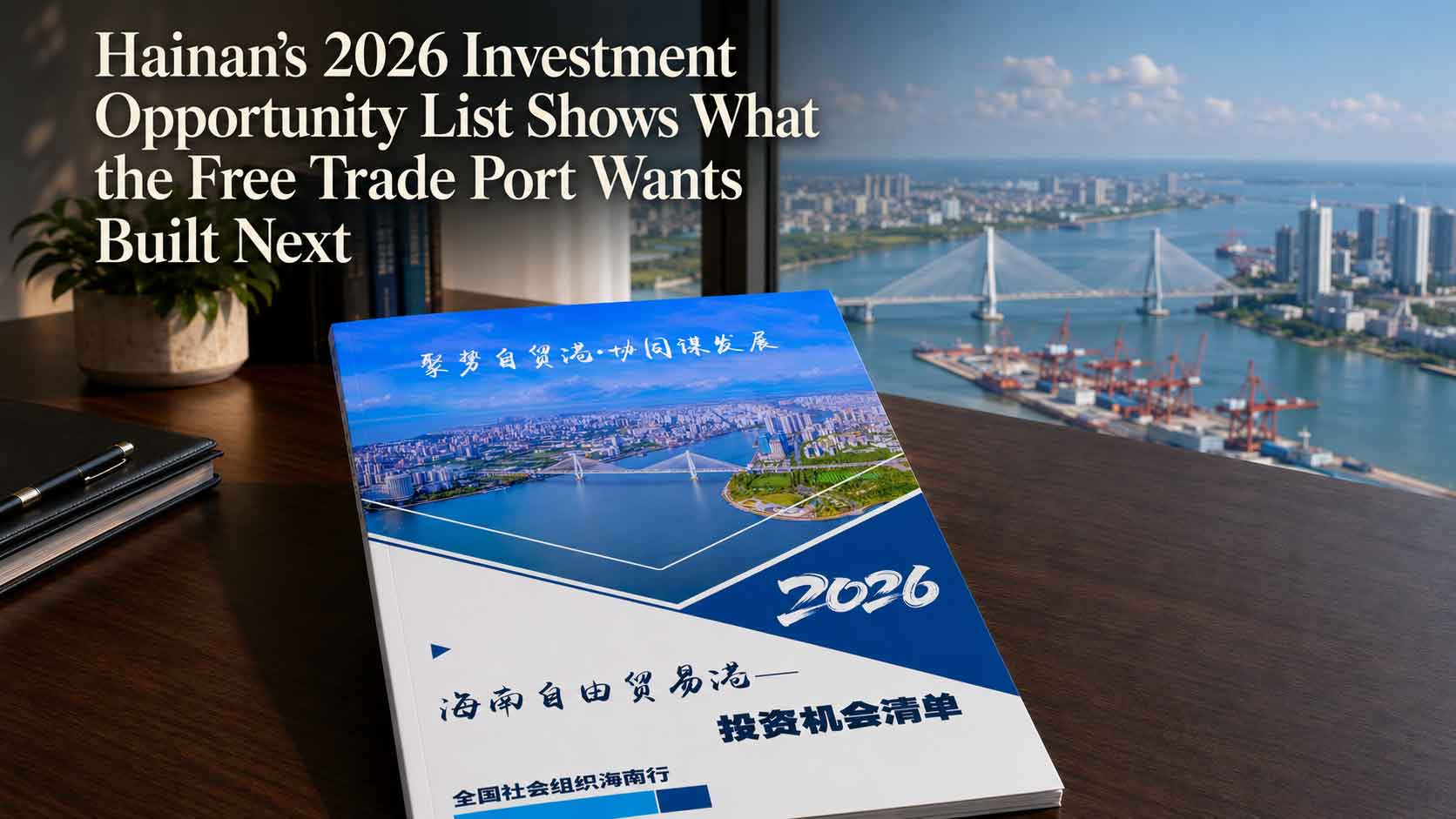
The official 2026 Hainan Free Trade Port Investment Guide, compiled by the Hainan Provincial Department of Commerce and the Hainan Provincial Bureau of International Economic Development, explains the province’s customs, tax, market-access and cross-border finance mechanisms, identifies key industrial parks and presents selected operating cases. A separate 336-project opportunity list shows where cities, counties and parks are seeking additional capital and operators.
Together, the data and the investment materials point to two different types of opportunity
Ports, logistics, processing, maintenance, duty-free supply chains and cross-border settlement can already be assessed against published transaction volumes. The commercial question is whether those flows are large and durable enough to support additional operators and capacity.
Digital services, healthcare, aerospace and advanced manufacturing require a different test. Their investment case depends less on province-wide customs volumes and more on the licences, regulatory arrangements, infrastructure and anchor companies available within specific Hainan platforms.
Where measurable commercial flows already exist:
Ports, Shipping and Logistics
Cargo provides the clearest flow. During the first 134 days after closure, Hainan recorded RMB 137.06 billion in goods trade and 1,932 vessel movements. Five companies used direct-release procedures for 70,000 tonnes of imported goods. Another 12 companies moved 1,496 batches across the second line under a procedure allowing goods to leave the island in batches before a consolidated customs declaration is filed.
Yangpu entered the post-closure period with the island’s strongest port base. It handled 3.31 million twenty-foot equivalent units in 2025, an increase of more than 65% from 2024. Foreign-trade throughput reached 1.09 million TEUs, more than double the previous year’s level, and Yangpu had opened 65 container routes, including 35 international services. Most of that growth occurred before customs closure, but it established the infrastructure and route network available when the new regime took effect.
The investment case extends beyond docks and terminals. Cargo flows create demand for bonded storage, cold-chain handling, customs documentation, freight forwarding, inspection, insurance, shipping finance and onward distribution. Hainan’s opportunity list includes port, shipping and logistics projects across Yangpu, Haikou, Wenchang, Dongfang and other coastal locations.
CEVA Logistics provides a concrete example of an international operator positioning itself behind those flows. According to the Investment Guide, its Hainan company leased a 3,000-square-metre bonded warehouse in the Haikou Comprehensive Bonded Zone and launched the first phase of an Asia-Pacific logistics service centre. The operation developed from an earlier cooperation agreement involving Bolloré Logistics, which CEVA subsequently acquired.
None of this proves that Hainan needs unlimited new logistics capacity. Route economics, cargo composition, customer concentration and competition from established regional hubs still matter. The evidence does show that Hainan’s logistics proposition begins with real cargo, functioning customs procedures and existing international services.
Processing and Manufacturing
Processing provides the strongest connection between imported goods, Hainan-based production and access to the mainland market.
Enterprise zero-tariff imports reached RMB 2.26 billion during the first 134 days, an increase of 99.6% from the corresponding period one year earlier. Companies using the processing value-added mechanism sold RMB 510 million of qualifying goods into mainland China and received RMB 24.573 million in customs-tariff relief.
Under the current rules, goods containing imported materials can enter mainland China without import duties when an encouraged-industry enterprise carries out qualifying production in Hainan and achieves at least 30% value added. Import VAT and consumption tax remain payable where applicable. Minor operations such as simple labelling, repacking, dilution or basic cutting do not qualify.
Hainan Ausca International Oils and Grains shows how the model can operate at industrial scale. The company imports soybeans and rapeseed, processes them in Yangpu and sells its products in Hainan, mainland China and overseas markets. Hainan’s Investment Guide reports that Ausca produced RMB 6.8 billion of output in 2025. During the first month after closure, it produced RMB 377 million and imported more than 100,000 tonnes of raw materials.
A separate Hainan government account reported that Ausca recorded USD 825 million in foreign trade in 2025 and had saved approximately RMB 300 million in tariffs through the processing value-added policy. Its products had entered more than 10 overseas markets, including Japan, South Korea and Singapore.
Jia Green Chocolate Works provides a smaller day-one example. The joint-venture producer began shipping products to Beijing and Hanzhong when customs closure took effect, after completing qualifying processing in Hainan. The company said the tariff treatment reduced the cost of that shipment by about 10%.
The relevant operator profile is therefore specific: a company with imported inputs, production capable of exceeding the value-added threshold and an identified mainland or export market. The existence of the mechanism does not mean every factory project qualifies. It means the route has moved beyond policy design into repeated commercial use.
Bonded Maintenance and After-Sales Services
Bonded maintenance remains smaller, but the customs framework is active. By April 30, six companies had obtained bonded-maintenance qualifications and three were operating under the “two ends offshore” model, in which goods enter Hainan for repair and are then re-exported rather than sold into mainland China. The scorecard did not publish transaction values or identify the companies.
The Investment Guide makes clear that this is not an unrestricted repair regime. Eligible bonded-maintenance operations cover products under 38 HS codes, including engines, television receivers, motorcycles, all-terrain vehicles and medical devices. Operators must have compliant premises and equipment, customs-linked management systems and end-to-end traceability for goods, components and waste materials.
Hainan already has an established maintenance base in the aviation sector. An official provincial account said the island’s one-stop aircraft maintenance base had serviced more than 2,400 aircraft and painted more than 300, serving over 20 international airlines. It also said the expanded zero-tariff coverage for aviation materials had reduced operating costs after closure.
Bvlgari illustrates a related but legally distinct after-sales model. The Investment Guide says its integrated service centre in the Haikou Comprehensive Bonded Zone repaired and returned its first batch of nearly 100 jewellery items in June 2025. Its current scope covers products sold through Hainan’s offshore duty-free stores, with planned expansion towards mainland and wider Asia-Pacific after-sales work.
The investment opportunity is consequently broader than a single customs category. It includes qualifying two-ends-offshore repairs, aviation maintenance, bonded after-sales support and specialist servicing linked to Hainan’s ports and consumer channels. Each model carries different customs, licensing and operational requirements.
Duty-Free Supply Chains
Offshore duty-free remains Hainan’s largest visible consumer flow. From December 18 to April 30, customs-supervised offshore duty-free sales reached RMB 18.43 billion, covering 2.433 million shopper visits and 14.38 million purchased items.
For international companies, the opportunity does not end at direct retail. Millions of purchases require bonded warehousing, inventory control, brand operations, distribution, e-commerce, returns and after-sales support. CEVA’s bonded warehouse and Bvlgari’s repair centre show international operators building services behind the consumer channel rather than competing only for direct retail access.
Offshore duty-free retail and enterprise zero-tariff imports remain separate systems. The first serves eligible consumers purchasing through designated channels. The second applies to qualifying entities importing goods under the Free Trade Port’s enterprise customs framework.
Cross-Border Finance and Settlement
Hainan’s multi-functional free trade accounts provide the financial layer around cross-border activity. By May 25, 1,174 EF accounts had been opened. Cumulative business volume since the system was launched in May 2024 had reached RMB 582 billion, covering transactions connected with 220 countries and regions.
That figure represents gross cumulative business volume, not net foreign capital invested in Hainan and not activity generated solely after customs closure. It may include trade settlement, foreign exchange, lending, repayments and funds moving in both directions. The published total does not disclose how much represents trade finance, direct investment, project finance or asset management.
The Investment Guide describes freer transfers between eligible EF accounts and overseas accounts through the international first line, alongside controlled transfers through the second line. It also states that certain capital-account transactions can be handled without standard foreign-exchange pre-registration, while national approvals for activities such as overseas direct investment remain unchanged.
Where Customs Data May Not be the Right Test
The customs data filter works well for cargo, processing, repair, consumer purchases and settlement. It is less useful for sectors whose commercial advantage comes from a licence, regulatory exception, research platform or specialised infrastructure.
The official Investment Guide is valuable here because it identifies operating cases that do not appear in the five-month customs scorecard. It is also an investment-promotion document, not an independent performance audit. Its selected company cases show where Hainan believes its platform model is working, but investors still need to verify operating status, approvals, ownership restrictions, customers and economics independently.
Digital Trade and Data Services
Dun & Bradstreet demonstrates the difference between a flow-backed sector and a platform-led one. The company established a wholly owned subsidiary in Haikou’s Fullsing Internet Industrial Park in 2022 and began developing a Hainan node for its global data cloud. It later became the first company in Hainan to pass the national data-export security assessment and was selected as an early pilot enterprise for value-added telecommunications services.
By March 2025, the Hainan subsidiary had provided coding and registration services to nearly 70,000 domestic enterprises and data-processing services to more than 210,000 companies in Hong Kong, according to the provincial government account. These figures provide a more relevant test of the platform than cargo numbers or EF-account turnover.
The investor question is whether Hainan’s data infrastructure, permitted telecom scope, cross-border data procedures and physical-presence requirements fit the company’s service model.
Healthcare and Medical Services
Boao Lecheng is also platform-led. The State Council-approved medical zone had 36 medical institutions in operation by June 2025. It received 413,700 medical-tourism visits in 2024 and had imported more than 470 medicines and devices not yet approved on the mainland by April 2025, covering more than 110,000 patient visits.
Lecheng’s investment case rests on special rules allowing designated hospitals to use selected overseas medicines and medical devices before wider mainland approval, and to generate clinical evidence that can support research and regulatory applications in China.
The correct filter here is regulatory and clinical: which products or treatments can be introduced, which licences are available, whether suitable medical partners and patients exist, and how the payment and reimbursement model works.
Commercial Aerospace
Wenchang International Aerospace City combines a launch zone, high-tech zone and tourism zone. Its investment positioning covers satellite and rocket research, assembly and testing, aerospace data, high-end equipment, international cooperation and the Aerospace Supercomputing Centre.
The platform cannot be assessed primarily through the five-month customs scorecard. More useful indicators include launch frequency, factory output, satellite and rocket orders, paying data customers, use of testing facilities and the number of companies conducting substantive operations in the park.
Imports of components and equipment may eventually appear in customs data, but they are a consequence of the industrial platform, not the main evidence that the platform has commercial value.
Energy Equipment and Advanced Manufacturing
Siemens Energy sits between the two filters. It is an advanced-manufacturing project that may eventually create measurable imports, assembly output, service transactions and mainland sales. Its current evidence comes from company registration, construction and integration with Yangpu’s industrial base.
The company established a Hainan branch and an innovation centre in Yangpu in September 2024. On December 18, 2025, it registered a Hainan subsidiary and broke ground on a heavy-duty gas-turbine assembly base and service centre, described as the company’s first project of its kind in China.
The relevant questions concern construction and commissioning, imported component treatment, local assembly scope, named customers and demand for maintenance services.
The same principle should be applied to Hainan’s more speculative future-industry projects. Brain-computer interfaces, embodied intelligence and some hydrogen proposals appear in the province’s opportunity materials, but the five-month scorecard does not publish sector-level data for them. Unlike Dun & Bradstreet, Lecheng, Wenchang or Siemens Energy, the available public evidence does not yet show the same combination of operating infrastructure, named anchor companies and measurable customers across many of these projects.
Two filters, two investment decisions
The post-closure data gives international companies a useful first filter. Ports and logistics have cargo behind them. Processing has imported inputs and qualifying mainland sales. Maintenance has operating customs routes. Duty-free services have a large consumer channel. Cross-border settlement has an active account system.
Those sectors can be tested through volumes, route economics, customer demand, capacity and qualification for the relevant Free Trade Port mechanism.
Platform-led sectors require a different test. Digital trade depends on data and telecom approvals. Healthcare depends on medical access and clinical infrastructure. Aerospace depends on launch, assembly and data capacity. Advanced energy equipment depends on anchor projects, industrial customers and execution.
Cargo, processing, retail and settlement require a flow test. Data, healthcare, aerospace and advanced manufacturing require a platform test. For international companies, the distinction is practical: flow-backed sectors can be judged against existing business volumes, while platform-led sectors depend on regulatory access, infrastructure and execution.
Join the discussion in the Hainan FTP Business Forum and share what this development means for your company or sector.
This article is for general information and does not constitute legal, customs, tax or investment advice. Eligibility for specific Hainan Free Trade Port policies depends on the company, activity, goods, transaction structure and current regulatory requirements.
Related article: Hainan’s 2026 Investment Opportunity List Shows What the Free Trade Port Wants Built Next