
Lunar Explorer Arrives in Hainan: Will Launch from Wenchang in First Half of This Year

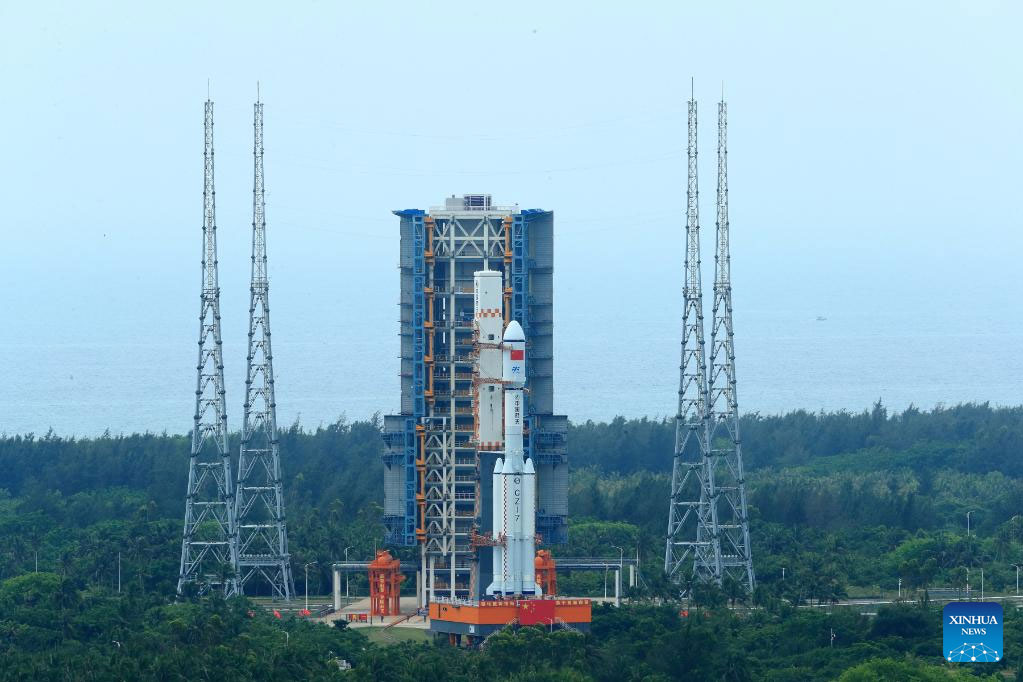
In a significant stride toward lunar exploration, China is set to launch its next lunar explorer, Chang’e 6, from the Wenchang Space Launch Centre in Hainan province during the first half of this year. The China National Space Administration (CNSA) confirmed the mission’s objective is to collect samples from the moon’s little-explored far side.

Components of the Chang’e 6 probe were transported by two military cargo planes to Haikou, on Monday and Tuesday, and were then carried by truck to the Wenchang Space Launch Centre on the east coast of the island.

After the probe reaches lunar orbit, the components will separate into two parts, with the orbiter and re-entry module remaining in orbit while the lander and ascender head for the moon’s surface.

The lander/ascender combination will make a soft landing and then use a drill and a mechanical arm to gather lunar rocks and soil.

Once the surface operations are done, the ascender’s rocket will elevate it to lunar orbit to dock with the re-entry module. It will transfer the samples to the module, which will carry them to Earth.

The Chang’e 6 spacecraft, a product of the China Academy of Space Technology, follows in the footsteps of its predecessor, Chang’e 5, comprising an orbiter, lander, ascender, and re-entry module.

The operational process mirrors that of Chang’e 5, with the orbiter and re-entry module remaining in orbit while the lander and ascender head for the moon’s surface. Upon a soft landing, the lander-ascender combination will utilize a drill and mechanical arm to collect lunar rocks and soil.

Chang'E 6 landing site
CHANG’E-6 LANDING SITE China’s Chang’e-6 mission will land on the lunar far side in the SPA basin, outlined on this map by a black dashed line. The landing zone is outlined by a red box and the cross indicates where the earlier Chang’e-4 mission landed. The base map is a shaded-relief map created from Chang’e-1 data. Image: CNSA

What sets Chang’e 6 apart is its mission to the far side of the moon, a region largely unexplored until China’s Chang’e 4 mission touched down in the South Pole-Aitken Basin in January 2019. The upcoming mission aims to land in the South Pole-Aitken Basin once again, targeting a region with unique geological features.

Experts highlight the mission’s complexity, emphasizing that collecting samples from the moon’s far side presents a distinct set of challenges. The South Pole-Aitken Basin, a colossal crater at the moon’s bottom, holds geological significance, potentially offering insights into lunar materials from the basin’s impact.

According to Pang Zhihao, an expert on space exploration technology, “The South Pole-Aitken Basin, a gigantic crater at the bottom of the moon, is the largest and deepest known basin in the solar system. It has a mineralogy distinct from other locations that may reflect materials from the inside of the moon that were brought up by the impact that created the basin. The far side is also considerably more mountainous than the near side for reasons researchers have yet to find out,”.

To foster international collaboration, the CNSA has allocated space on the lander and orbiter for foreign equipment. Scientific instruments from France, Italy, and the European Space Agency will accompany the Chang’e 6 lander, while a Pakistani payload is slated for the orbiter.

As China advances its lunar exploration ambitions, this mission signifies a crucial step in enhancing our understanding of the moon’s geology and geological evolution. With the United States also pursuing lunar goals, including a planned moon landing in 2026, the global interest in lunar exploration continues to intensify.

Related article: Wenchang Gears Up as China’s Premier Commercial Space Launch Hub in 2024
Wenchang Gears Up as China's Premier Commercial Space Launch Hub in 2024

SourceSource

- Follow Us on WeChat -

spot_img

Related articles:

Hainan’s 2026 Investment Opportunity List Shows What the Free Trade Port Wants Built Next

Hainan’s 2026 Investment Opportunity List shows what the Free Trade Port wants built next, from ports and digital trade to medical platforms and future industries …

Explainer: Apostille vs Consular Authentication for Hainan Work Permit Documents

Apostille has replaced Chinese consular authentication for relevant documents from Convention countries, but notarisation, translation and validity rules can still apply ...

Lost Your Passport in China: The Emergency Document You Should Know About

Lost your passport in China? If your embassy, consulate, or relevant home-country institution in China cannot reissue a travel document, China has an Exit-Entry Permit for Foreigners …

Hainan’s Free Trade Port Is Moving From Incentives to Usability

Hainan’s new services plan points to a shift in how foreign operators may use the FTP: banking, permits, policy access and talent recognition …

Get weekly email updates for new articles published!

Follow Us on WeChat

spot_img

Latest Articles ...

How Hainan’s 30% rule is beginning to shape business decisions for companies using the FTP’s customs route into mainland China ...
Typhoon Season 2026 in Hainan: What residents need to know about storm forecasts, El Niño impacts, ferry suspensions, airport disruptions, warning levels, and how to prepare for typhoons from July to October ...
How international graduates can stay in China after graduation through Hainan’s startup residence route, and why it does not allow paid work ...
What spouses on S visas in China can and cannot legally do, including work, tutoring, remote work, volunteering, tax, and permit risks ...
spot_img

Why Foreigners Lose Access to Their Chinese Bank Accounts

Frozen accounts, blocked cards, restricted access. Most expats in China don't think about their bank account until they can't access it …

China’s Green Card: How Rare Is It, and What It Takes to Get One

Between 2004 and 2017, China issued just over 10,000 permanent residency permits to foreign nationals. This guide explains the four eligibility routes, the real criteria, and your honest odds of qualifying …

Why Your Passport Doesn’t Work: A Foreigner’s Guide to China’s ID-Only Systems

Your passport is legally valid for trains, hotels, SIM cards and payment accounts in China. The problem isn't the rules, it's the systems built on top of them …

China’s 2026 Work Permit Salary Rules: Who Actually Needs to Worry?

China’s work permit salary thresholds have raised concerns among foreign professionals. This explainer clarifies the 6× and 4× rules, why the figures appear high, and who is actually affected ...
spot_img

Looking for an international pre-school in Haikou?

Flora's International Preschool has three preschools in the Haikou area. Our schools follow a European curriculum

Continue Reading ...

Hainan’s 2026 Investment Opportunity List Shows What the Free Trade Port Wants Built Next

Hainan’s 2026 Investment Opportunity List shows what the Free Trade Port wants built next, from ports and digital trade to medical platforms and future industries …

Explainer: Apostille vs Consular Authentication for Hainan Work Permit Documents

Apostille has replaced Chinese consular authentication for relevant documents from Convention countries, but notarisation, translation and validity rules can still apply ...

Lost Your Passport in China: The Emergency Document You Should Know About

Lost your passport in China? If your embassy, consulate, or relevant home-country institution in China cannot reissue a travel document, China has an Exit-Entry Permit for Foreigners …

Get weekly email updates for new articles published!

Never miss another important notice or event. Be informed of what you need to know, when you need to know it.