- One project in Hainan’s 2026 investment handbook carries a stated scale of RMB 50bn, almost twice the entire future-industry block.
- The 336-project list is broad, but the weight is uneven. Tourism and services still dominate by count, while medical consumption, logistics, digital trade and industrial platforms carry much of the business signal.
- The list does not prove investor demand or project viability. It shows where Hainan wants operators, capital and sector specialists to engage.
One project in Hainan’s 2026 investment handbook carries a stated scale larger than the entire future-industry section.
The 博鳌乐城国际医疗旅游先行区(琼海市) (Boao Lecheng International Medical Tourism Pilot Zone, Qionghai) project is listed at RMB 50bn. The handbook’s four forward-looking future industries, covering biomanufacturing, hydrogen, brain-computer interfaces and embodied intelligence, have a combined stated scale of RMB 26.59bn.
The list is not simply a catalogue of 336 investment opportunities. It shows how Hainan is weighting its Free Trade Port story: broad in project count, concentrated in capital signal.
For years, Hainan has been discussed through Free Trade Port incentives: tax rates, customs closure, zero-tariff treatment, visa access and cross-border finance. The 336-project list moves the question from policy design to market execution. It shows what Hainan wants built next.
A broad list with uneven weight
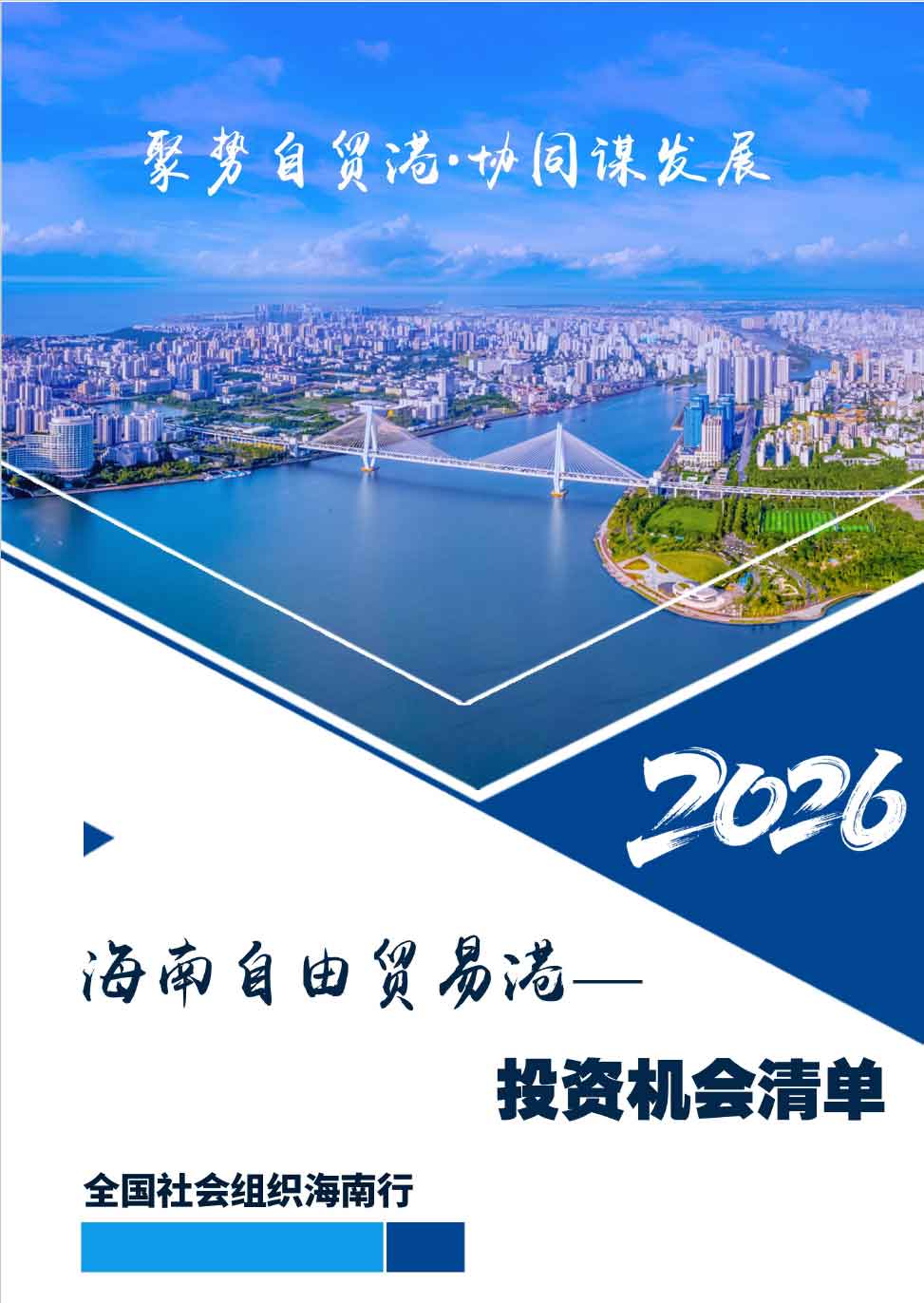
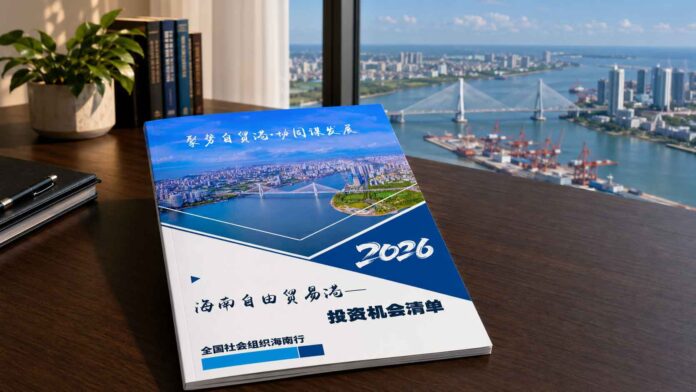
The document reviewed by TropicalHainan is the 海南自由贸易港投资机会清单 (Hainan Free Trade Port Investment Opportunity List), internally titled the 2026年重点投资合作项目手册 (2026 Key Investment Cooperation Project Handbook). It was prepared for the 全国社会组织海南行 (National Social Organizations Hainan Tour) and compiled by the 海南省金融发展促进会 (Hainan Financial Development Promotion Association) in April 2026.
The handbook describes itself as an investment guidance and project-cooperation document. It says the 336 key investment cooperation projects cover Hainan’s cities, counties and key parks. It also says the list is based on the Hainan Free Trade Port master plan, the provincial 45432 industrial system, project promotions from local governments and parks, and relevant investment guidance.
This is not a binding policy instrument, and it is not an investor prospectus. The handbook states that project information is for cooperation reference, and that specific matters depend on actual project contact. In practical terms, the list tells investors and operators where to look. It does not tell them whether a specific project is investable on acceptable terms.
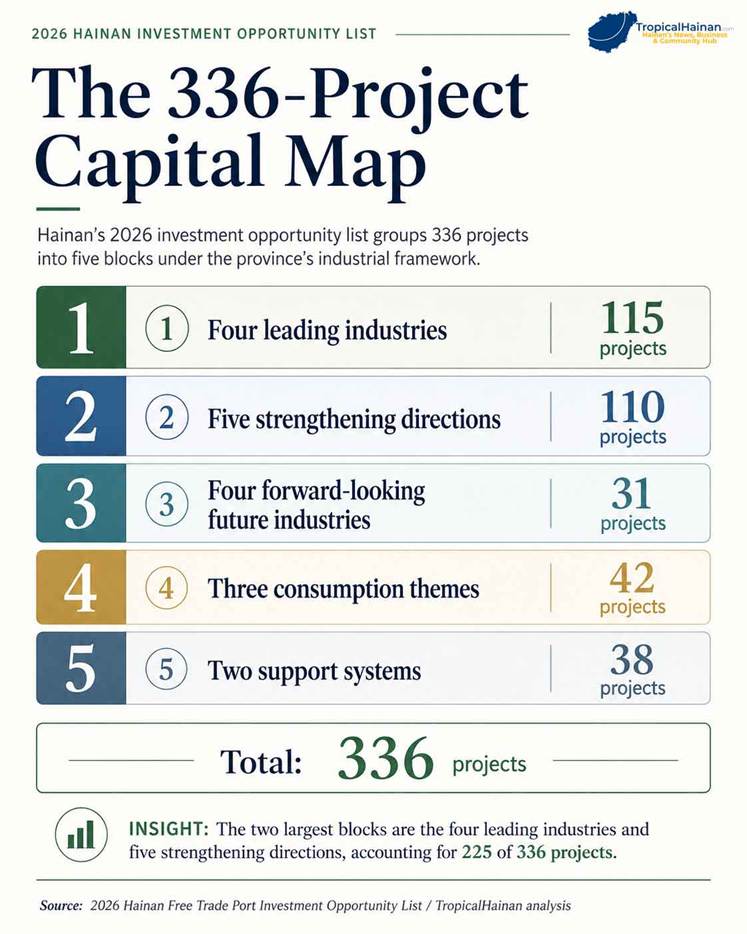
The handbook groups the 336 projects into five blocks: 115 projects in the four leading industries, 110 in five strengthening directions, 31 in four forward-looking future industries, 42 in three consumption themes, and 38 in two support systems.
Hainan’s visible project pipeline remains anchored in the sectors it is already familiar with: tourism, modern services, consumption, agriculture and high-tech platforms.
But the same list also points to what Hainan still needs built: ports, logistics platforms, business-service centres, digital trade hubs, medical projects, aerospace capacity, seed-industry bases, hydrogen projects, biomanufacturing platforms, brain-computer interface projects, embodied-intelligence projects and technology-support systems.
The four leading industries and five strengthening directions together account for 225 of the 336 projects. These are the practical, near-term blocks. The future-industry section is much smaller, with 31 projects, but its significance lies in signal rather than scale. It names sectors Hainan is trying to seed before mature local supply bases exist.
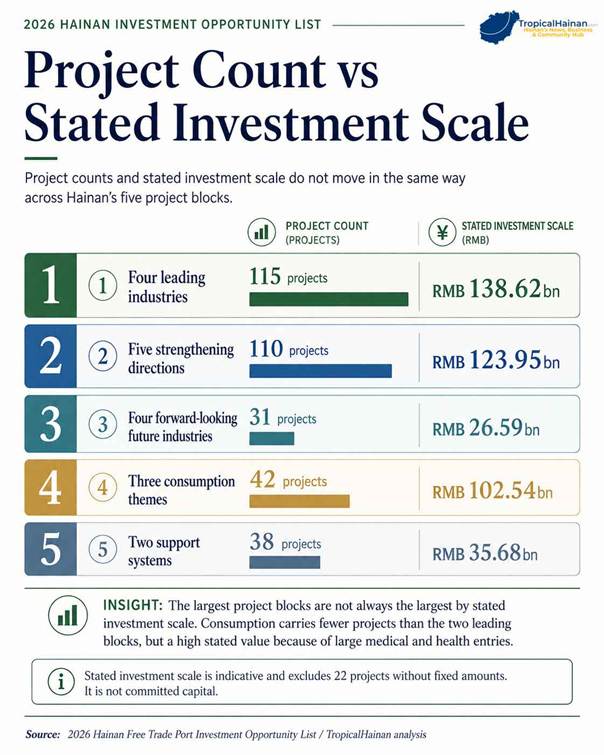
Of the 336 projects in the handbook, 314 include a stated investment scale. Together, those projects total RMB 427.38bn. The remaining 22 projects do not give a fixed amount. The RMB 427.38bn figure should be read as indicative project scale, not as committed, pledged or approved investment.
By stated numerical project scale, the four leading industries account for RMB 138.62bn. The five strengthening directions account for RMB 123.95bn. The three consumption themes account for RMB 102.54bn. The two support systems account for RMB 35.68bn. The four forward-looking future industries account for RMB 26.59bn.
The count and the money do not tell the same story
The three consumption themes contain only 42 projects, but carry RMB 102.54bn in stated scale, largely because the medical and health consumption section includes large projects. The future-industry block contains 31 projects and RMB 26.59bn in stated scale. That makes it important as a strategic signal, but not the centre of gravity by value.
The handbook is therefore showing where Hainan sees gaps large enough to package for external engagement. Some are familiar: tourism, services and consumption. Others are structural: logistics, port services, industrial platforms, data services, aerospace, medical technology and research-linked production.
The list shows not only what Hainan wants to attract. It also shows what Hainan still lacks.
Hainan is being divided into operating lanes
The geography does not present Hainan as one generic Free Trade Port opportunity. It divides the island into different operating roles.
Sanya has 32 projects with RMB 73.8bn in stated scale. Qionghai has 21 projects with RMB 70.91bn, driven heavily by Boao Lecheng medical and health projects. Haikou has 33 projects with RMB 69.06bn, reflecting business services, digital trade, high-tech and urban platforms. Danzhou has 19 projects with RMB 46.35bn, much of it tied to Yangpu, shipping, logistics and industrial functions. Wenchang has 22 projects with RMB 28.73bn, anchored by aerospace. Dongfang has 28 projects with RMB 25.08bn, while Chengmai has 26 projects with RMB 24.94bn.
Those figures do not show where capital has already arrived. They show how Hainan is packaging demand.
Haikou carries the business-services and digital layer. The 海口江东新区国际商务服务中心项目 (Haikou Jiangdong New Area International Business Service Centre Project), with RMB 3.2bn in stated scale, points to the soft infrastructure Hainan needs if companies are to do more than register entities on paper. The 海口复兴城国际数字贸易港项目 (Haikou Fuxing City International Digital Trade Port Project), with RMB 3.8bn in stated scale, points toward digital trade, cross-border data and digital services.
Danzhou and Yangpu carry the port and industrial layer. The 儋州洋浦国际航运与海洋物流中心项目 (Danzhou-Yangpu International Shipping and Marine Logistics Centre Project), with RMB 6.8bn in stated scale, anchors this layer. Shipping, bonded logistics, distribution, cross-border marine trade and port services are not peripheral to the FTP. They are the functions Hainan needs if the island is to become operationally relevant for trade and supply chains.
Wenchang carries the aerospace layer. The 文昌国际航天城卫星研制及应用总装项目 (Wenchang International Aerospace City Satellite Manufacturing and Application Assembly Project), with RMB 3bn in stated scale, shows why Wenchang is not only a launch story. The project list pushes the sector further into manufacturing, assembly and satellite applications.
Qionghai and Boao Lecheng carry the medical and biomedical layer. The 博鳌乐城国际医疗旅游先行区(琼海市) (Boao Lecheng International Medical Tourism Pilot Zone, Qionghai) project carries RMB 50bn in stated scale, the largest representative project in this article. That does not make it confirmed investment. It does show why Lecheng dominates the medical-consumption reading of the list.
Lecheng also appears in the future-industry section. The 博鳌乐城生物制造与特医食品产业园(琼海市) (Boao Lecheng Biomanufacturing and Special Medical Food Industrial Park, Qionghai) lists RMB 1.5bn in stated scale, while the 博鳌乐城脑机接口与神经康复中心(琼海市) (Boao Lecheng Brain-Computer Interface and Neurorehabilitation Centre, Qionghai) lists RMB 600m. These projects point to a different role for Lecheng: not only treatment and medical consumption, but also biomanufacturing, rehabilitation technology and medical-device-adjacent activity.
Sanya and Yazhou Bay carry tourism, seed industry, deep-sea science and technology-linked development. The 三亚崖州湾南繁育种核心基地项目 (Sanya Yazhou Bay Southern Breeding Core Base Project), with RMB 5bn in stated scale, shows why seed industry belongs in the capital map. It is one of the sectors where Hainan is trying to connect tropical conditions, research capacity and national strategic demand.
Western Hainan appears as an industrial and energy lane. The 东方海上风电制氢融合项目(东方市) (Dongfang Offshore Wind Power Hydrogen Integration Project, Dongfang), with RMB 3bn in stated scale, ties hydrogen to offshore wind and western Hainan’s industrial-energy geography. That entry shows how future-industry language is being connected to specific physical locations.
Hainan is not asking capital to look at the island as one market. It is presenting a set of sector-specific operating zones.
A logistics operator should not read the list the same way as a medical-device company. A digital services firm should not read it the same way as an aerospace supplier. A chamber of commerce should not read it as a general investment brochure. The value lies in matching sector capability to the part of Hainan that is being asked to build that capability.
The list opens doors, but does not unlock them
The handbook gives project names, locations, responsible units, construction content, advantage conditions, benefit-analysis language, indicative investment scale and contact routes. It does not consistently provide project stage, land status, ownership structure, procurement route, foreign-investor eligibility, approval status, expected return model, implementation timetable or legal structure.
For a logistics operator, the list points toward Yangpu, Danzhou, Chengmai, Dongfang and western Hainan. For a digital services company, it points toward Haikou, Fuxing City and data-linked platforms. For a medical or medtech operator, it confirms Lecheng’s central role and shows its expansion into biomedical and rehabilitation-related fields. For aerospace and low-altitude economy companies, it shows Wenchang as the anchor, but not the whole island story. For chambers and sector associations, it identifies which local governments and parks are actively looking for business partners, project operators and sector specialists.
For several years, Hainan’s Free Trade Port has been described through incentives and architecture: customs closure, zero-tariff treatment, tax preferences, visa access and financial opening. The 2026 Investment Opportunity List shows where Hainan wants those mechanisms to meet actual projects.
This reveals the next test for the FTP. A policy framework can be announced from the top down. Operating capacity has to be built project by project, partner by partner, and sector by sector.
For investors and operators, the question is not whether Hainan has 336 opportunities. The question is whether one of those entries matches something a company can actually build, operate, finance or supply.
Source note: Figures in this article are drawn from the 2026 Hainan Free Trade Port Investment Opportunity List / 2026 Key Investment Cooperation Project Handbook, and should be read as analysis, not as confirmation of project approval, financing or investor eligibility.
Related article: How Hainan’s 30% Rule Is Beginning to Shape Business Decisions