

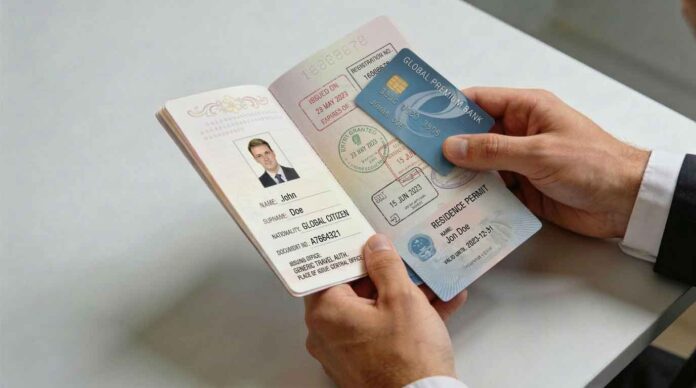
- There is no unified automated system connecting China’s administrative departments. Each records your name independently.
- Each system is required to match your passport, but no automated check enforces consistency across them.
- One name discrepancy can halt a work permit renewal, a tax audit, or a bank review until it’s resolved.
- When you get a new passport, you have 24 hours, 10 working days, and 10 calendar days to update three different systems, in that order.
Why this happens, and why the burden falls entirely on you
If you have lived in China for any length of time, there is a reasonable chance your name is recorded differently across at least two of the systems you depend on every day. Your bank account might show your full name. Your work permit might have dropped your middle name. Your tax record might have reversed your given name and family name. Your residence permit might have split your hyphenated surname into two separate words.
The rules are clear:
Every Chinese administrative system is legally required to record your name as it appears on your passport. State Council Order No. 285 establishes the real-name requirement for bank accounts.
The 2024 Anti-Money Laundering Law, in force since January 1, 2025, requires banks to keep verifying your identity on an ongoing basis, meaning an expired or mismatched passport on file is an active compliance problem, not a dormant one. Work permit and residence permit regulations require the same passport-based recording standard.
The problem is not that no standard exists.
The problem is that there is no unified automated digital bridge between Chinese administrative departments to ensure a single version of your name is used across all systems simultaneously.
Each department applies the same rule, match the passport, independently, with no cross-system verification. Errors introduced at the point of manual data entry persist indefinitely because nothing checks the bank’s record against the tax office’s record, or the work permit against the residence permit.
The rules are strict, but the infrastructure to enforce them consistently across systems does not yet exist. Errors accumulate silently until an audit, a renewal, or a compliance review surfaces them, at which point the burden of reconciliation falls entirely on you.
The most common causes:
Middle names truncated or dropped entirely at account or permit opening. Hyphenated surnames split into two words, joined without the hyphen, or entered with the hyphen in some systems and without it in others. Given name and family name reversed, a persistent issue because Chinese convention places the family name first, and staff entering foreign names sometimes apply the same logic.
Legal name changes, marriage, divorce, formal changes updated on the passport but never carried across to existing system records. Manual data entry errors at the time of registration that were never caught because no cross-system check exists to identify them.
Each of these causes a different type of mismatch, in a different system, with different consequences.
The sections below work through each one.
Where mismatches cause real problems
Not all mismatches carry the same risk. Some are dormant, sitting in a record, causing no immediate friction, until they are discovered during a review. Others surface immediately and block access to something you need.
Banking:
A name mismatch between your bank record and your current passport creates a compliance risk that surfaces during anti-money laundering (AML) reviews, passport update procedures, or routine re-verification.
In practice, name variations often enter bank records during manual data entry and sit undetected until a transaction is flagged or an account is suspended. A mismatch can block salary payments, prevent WeChat Pay and Alipay from linking to your account, and cause overseas transfers to be rejected. Under the 2026 cross-border remittance rules, outbound transfers above RMB 5,000 per transaction require verified name information, a discrepancy at this stage can delay or block the transfer.
Individual Income Tax:
Name mismatches in the IIT system cause complications at the annual reconciliation filing stage, can flag the record for manual review, and delay refund processing. If your employer’s payroll records use a different name format from your IIT registration, the reconciliation process requires manual correction before it can proceed.
Work permit:
A name error on your work permit creates compliance risk for your employer and complications at renewal. Since December 2024, the work permit and social security card have been integrated the physical social security card is being phased out in favour of the Electronic Social Security Card linked to the work permit. A name error on the work permit now propagates automatically to your social security record.
Residence permit:
A name mismatch on your residence permit creates complications at renewal and inconsistencies with your employer’s records, your bank, and your tax filings. If the update window after a passport renewal is missed, the consequences extend beyond a name discrepancy, (see the next section).
Overseas transfers:
Under the 2026 remittance rules, name discrepancies between your bank record and your current passport can trigger AML review flags on outbound transfers and cause automated rejections at the receiving institution.
The passport renewal sequence, legally binding, strictly timed
This is the section most expats wish they had seen before they needed it.
When you receive a new passport, whether through routine renewal, loss and replacement, or a name change, a legally binding sequence of updates begins immediately. The deadlines are not suggestions.
Within 24 hours of receiving your new passport:
Update your accommodation registration with the local police station. This obligation has existed since 2013 under Article 39 of the Exit and Entry Administration Law. In most of China this requires a visit to the local police station. In Hainan, it can be done through the Haiyiban (海易办) app.
Within 10 working days:
Update your work permit through your employer’s HR department or directly via the online work permit system. Under the December 2024 integration, updating your work permit simultaneously updates your Electronic Social Security Card record. One process, two systems resolved.
Within 10 calendar days:
Update your residence permit at the PSB or NIA service centre. In Hainan, the 16 Measures for Foreign Nationals allow you to do this at any PSB across the province rather than returning to the original issuing office.
Missing the residence permit update window is not merely an administrative inconvenience. A residence permit that no longer reflects your current passport details can be classified as a residency irregularity.
Do not let this deadline pass.
After the legally required updates are complete, update the systems with no fixed deadline next: your bank records, your IIT registration, and your WeChat Pay and Alipay verification. There is no law specifying how quickly these must be updated, but the longer you wait, the greater the risk that a routine compliance check surfaces the discrepancy before you do.
Recommended order for these updates:
Bank first, because your salary, daily payments, and mobile payment linkages all depend on it. Then IIT. Then mobile payments.
The one document you must not discard: your old passport. Banks, the IIT system, and the PSB all require it when processing a passport number or name update. Keep it until every system has been updated and confirmed.
How to fix a mismatch in each system
Banking
All major banks currently require an in-person branch visit to update passport details or correct a name mismatch. Bring your new passport, your old passport, and your current residence permit.
For name format issues specifically, where the name on the bank record differs from your new passport due to a format change rather than a simple passport number change, an embassy-issued letter confirming that both documents belong to the same person is the most widely accepted supporting document.
A notarized statement from a Chinese notary office is also accepted at most branches. Resolution time ranges from the same day to several days depending on branch staff competence and prior experience with the procedure. If a branch is unfamiliar with the process, call the bank’s national customer service hotline while you are at the counter.
Work permit and social security
Your employer’s HR department handles this in most cases through the online work permit system. The December 2024 integration means the Electronic Social Security Card record updates simultaneously, confirm with HR that both records have been corrected before closing out the process. If your employer is unfamiliar with the procedure, the relevant authority is the local human resources bureau under MOHRSS.
Individual Income Tax
Update through the 个人所得税 (Personal Income Tax) app or in person at the local tax bureau. A passport number change requires an in-person visit in most cases. Your employer’s finance or HR department often handles IIT updates as part of their payroll compliance, flag the issue to them first and confirm whether they will handle it or whether you need to act independently.
Residence permit
In person at the PSB or NIA service centre. Bring your new passport, old passport, and employment contract. In Hainan, any PSB in the province can handle this under the 16 Measures, you do not need to return to the office that originally issued the permit.
WeChat Pay and Alipay
If you don’t link a Chinese bank card to WeChat Pay or Alipay, this section doesn’t apply to you. If you do, read on.
Real-name re-verification is required through each platform’s customer service process. For straightforward passport number updates, the process is typically handled within the app.
For name format variations, where the name on the platform differs from the new passport due to a format change, a documented request through customer service, supported by an embassy letter in some cases, is the reported resolution pathway. Platform-level resolution depends on customer service discretion, and no binding regulation specifies exactly how these platforms must handle name variation cases.
The claim that has no regulatory basis
It circulates widely in expat WeChat groups, relocation agency guides, and forum threads: PBOC prohibits hyphens in bank account names, so hyphenated surnames must be entered without the hyphen or split into two words.
This claim could not be traced to any primary official source, no PBOC circular, no banking regulation, no State Council notice. It may reflect an operational convention at specific banks or branches, or a limitation of older banking software that cannot process hyphens as a character.
But it is not a confirmed regulatory requirement.
If a bank tells you your hyphenated name cannot be entered correctly, ask to speak to a manager. Ask them to identify the specific regulation that requires this. Branch-level staff regularly apply internal conventions as if they were law. In many cases, a more senior staff member or a call to the national customer service hotline resolves what the counter staff presented as an immovable rule.
Four things to do before there’s a problem
- Check all your records: Open your bank account details, your IIT app record, and look at the name on your work permit and residence permit. Note any discrepancies before they surface in a compliance review, a tax audit, or a permit renewal.
- When you get a new passport, update in sequence: Accommodation registration within 24 hours. Work permit within 10 working days. Residence permit within 10 calendar days. Then bank, IIT, and mobile payments as quickly as possible. Keep your old passport until every system confirms the update.
- If your name has a hyphen, middle name, or unusual format: At every new registration confirm exactly how it will be recorded and get written confirmation. A printout or screenshot of the record as entered is your evidence if a correction is needed later.
- If you find a mismatch, fix the work permit first: Under the December 2024 integration, correcting the work permit simultaneously corrects the Electronic Social Security Card record. Start there, then work outward to banking and tax.
The rules are strict. Every system is required to match your passport. The gap is not in the law, it is in the infrastructure connecting the systems together. Until that gap closes, the burden of ensuring consistency falls on you.
Related article: Why Foreigners Lose Access to Their Chinese Bank Accounts