

For many foreign teachers and professionals, changing jobs is a normal career step.
A contract ends. A better offer appears. A new employer is ready to hire.
In most countries, this is mainly an employment matter.
In China, it is also an immigration and administrative process involving multiple authorities. When handled in accordance with applicable rules, job changes can proceed smoothly. When procedural requirements are overlooked, they can result in delays, loss of work authorisation, or the need to leave China.
This article explains how job changes normally work in practice, where problems arise, and how to reduce avoidable risk.
Because procedures vary by city and by individual circumstances, this article provides general guidance only. Readers should confirm local requirements with the competent authorities.
Why Changing Employers Is Different in China
For foreign employees, legal status in China is built around three linked elements:
- A specific employer
- A work permit (外国人工作许可证)
- A work-type residence permit (工作类居留许可)
Under the Exit–Entry Administration Law, foreigners working in China must hold both a valid work permit and a work-type residence permit.
The work permit is tied to a specific employer and is recorded under a unique lifetime number in the national system.
When you change employers, the existing work permit must normally be cancelled, and a new one must be applied for. The residence permit may also need to be updated or reissued.
This is why job changes are not simply a matter of resigning and starting again. They involve a structured administrative process.
The Assumption That Causes Most Problems
Many foreign employees assume that a new job offer ensures continuity of legal status.
In practice, a job offer does not constitute legal authorisation to work.
Before beginning work with a new employer, the required administrative approvals must be completed. Working without valid permits constitutes unlawful employment under Chinese law.
Most problems arise when people resign first and try to “sort out the paperwork later.”
The Standard Job-Change Procedure (General Sequence)
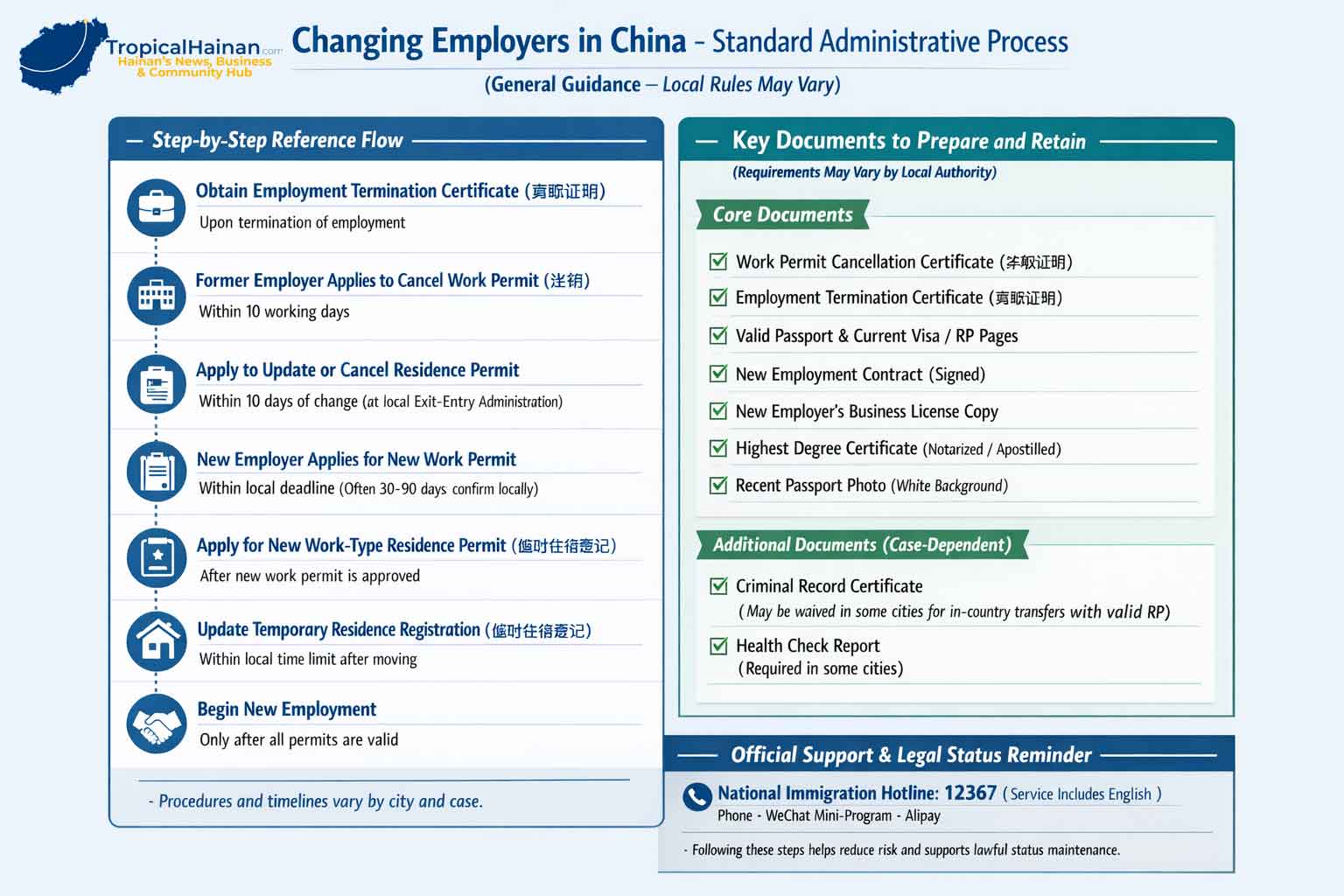
Based on national guidance and municipal practice, the typical sequence is:
| Step | Action | Typical Deadline | Main Responsibility |
| 1 | Obtain termination certificate (离职证明) | Upon termination | Former employer |
| 2 | Cancel existing work permit (注销) | Within 10 working days | Former employer |
| 3 | Update or cancel residence permit | Within 10 days of change | Employee |
| 4 | Receive stay visa if needed (停留签证) | At cancellation | PSB Exit-Entry |
| 5 | Apply for new work permit | Varies by city | New employer |
| 6 | Apply for new residence permit | After WP approval | Employee + employer |
| 7 | Update residence registration | Within 24 hours of move | Employee |
Local rules may modify this sequence. Some cities allow limited overlap when a new application is in progress. Others require stricter cancellation first.
Always confirm local procedures.
Key Administrative Deadlines to Know
While no single national “transfer window” applies everywhere, several commonly enforced deadlines include:
- 10 working days
Former employer must apply for work permit cancellation after termination. - 10 days
Changes to registered items on a residence permit must be reported. - 30 days before expiry
Residence permit extensions should be filed. - Around 30 days (typical)
Stay visas issued after residence permit cancellation. - Up to 3 months (Beijing)
Period for new work permit application after cancellation.
Other cities may apply different timelines.
Missing deadlines can result in loss of work-authorised status and may require applying for a stay visa or leaving China.
In some cases, violations may also trigger fines under the Exit–Entry Administration Law.
Why Your Former Employer Still Matters
Even after you resign, your former employer remains legally involved.
In most cases, the former employer must:
- Apply for work permit cancellation (注销)
- Issue a termination certificate (离职证明)
- Cooperate with document handover
Without this cooperation, the new employer may be unable to proceed.
In some cities, special procedures apply if the employee leaves without notice. For example, public notice requirements may be imposed before cancellation can proceed.
Maintaining a cooperative exit relationship is therefore important.
When Complications Arise in Practice
During job changes, common complications include:
- Residence permits expiring while applications are pending
- Delays in work permit cancellation
- Requests for supplementary documents
- Processing backlogs
- Issuance of short-term stay visas instead of work permits
Possible outcomes may include:
- Temporary stay status
- Delayed employment start dates
- Requirement to exit and reapply
- Additional administrative reviews
These outcomes often result from procedural timing issues rather than intentional violations, but the consequences can still be significant.
Work Permit Records Are Retained
China’s work permit system assigns each foreigner a unique lifetime number.
Records are retained in the national management system and do not disappear when employment ends. Previous records may be referenced in future applications.
For this reason, maintaining clear documentation is advisable.
Documents You Should Secure During a Job Change
Before leaving your current position, obtain copies of:
- Work permit cancellation certificate (注销证明)
- Employment termination certificate (离职证明)
- Final employment contract records
- Current passport and residence permit pages
- New employment contract (if available)
These documents are often difficult to obtain later, especially if employers close, restructure, or change staff.
Social Insurance During Job Changes
Changing employers does not automatically close your social insurance account.
Depending on local rules, your account may:
- Continue under the new employer
- Be transferred
- Remain dormant
- Be refunded upon departure
New employers are generally required to re-register foreign employees for social insurance after work permit issuance. Because procedures vary by city, it is advisable to clarify your status before leaving your current job.
Temporary Residence Registration
If you change address during a job change, you must update your temporary residence registration (临时住宿登记) within 24 hours.
This is a legal requirement and is checked during residence permit processing. Some cities now allow online registration, but others still require in-person reporting.
If Your Employer Will Not Cooperate
If your former employer refuses to cancel the work permit or issue documents, possible options include:
- Contacting the local Science and Technology Bureau / Foreign Expert Bureau
- Consulting the exit-entry administration
- Calling the national immigration hotline 12367
- Seeking assistance from licensed immigration agencies
In some cities, special procedures exist to allow cancellation without direct cooperation after formal notice periods.
Early action is important.
Same-City vs Cross-City Transfers
Procedures differ depending on location.
Same city, same occupation
Often simpler. Some cities allow direct new applications if the residence permit remains valid.
Cross-city or occupation change
Usually requires a full new application. Additional documents such as health checks or criminal record certificates may be required.
Do not assume processes are identical.
New Employer Registration
If your new employer has never hired foreign staff before, they must first register with the relevant authority. This process can take several weeks and often delays transfers.
Confirm this early.
Official Support: 12367 Immigration Hotline
The National Immigration Administration operates the 12367 service. It provides multilingual assistance by phone, WeChat mini-program, and email. For unclear cases, this is a reliable first point of contact.
How to Reduce Risk When Changing Jobs
While procedures vary, the following principles help reduce problems:
- Do not resign before understanding timelines.
- Confirm document responsibilities in writing.
- Track cancellation and application deadlines.
- Keep personal copies of all records.
- Communicate early with both employers.
Many disputes arise from assumptions rather than misconduct.
Why This Matters for Long-Term Mobility
For professionals whose careers extend beyond China, accurate records may be relevant to future immigration, tax, or employment verification. Clear documentation helps preserve future options.
Practical Summary
Changing employers in China is not only a career decision. It is a multi-step administrative process involving:
- Former employer
- New employer
- Work permit authority
- Exit-entry administration
When handled in compliance with applicable rules and deadlines, transitions can proceed smoothly. When procedures are overlooked, significant complications may arise.
Understanding and complying with administrative requirements remains the most effective safeguard.
Related article: Why Foreign Teachers in China Are Facing Stricter Document Checks in 2026