Hainan’s Intangible Cultural Heritage: Coconut Carving and Traditional Fire Making

Firewood Chopping Dance

Firewood-chopping-Dance

The Firewood Chopping dance is one of the oldest and most popular types of dance in the history of the Li Minority, called “Zhuancha” in the Li’s language. It originated from a funeral custom in ancient Yazhou City (today’s Sanya City).

It is a dance used by the ancient Li people to protect the body after someone dies, to drive beasts away, to help someone get over a shock and to worship their ancestors. Now it has become a leisure and entertainment presentation representing a unique part of the Li culture, and has achieved world-wide fame, long praised by people from other countries as the “world’s rarely seen calisthenics”.

On 2nd June, 2006, the Firewood Chopping dance was officially inscribed into the list of National Intangible Heritage.

On lunar 3rd March, or at a harvest celebration, people gather at a grain-sunning ground or a terrace on hillside. Two thick, long bamboo poles are put on the ground, and four thinner bamboo poles placed on them.

One group of people, responsible for the thinner bamboo poles, sit, squat or stand and strike thick poles with thinner poles or slide the thinner over the thick to produce rhythms. The other group are dancers, and they spring up and down agilely at the moment when the poles open or close, and should also be graceful and natural.

When one and another pair of dancers jump out of the poles, the pole holders will hail “hey, he-hey” loudly. Hence the name Bamboo Pole dance or Firewood Chopping dance.

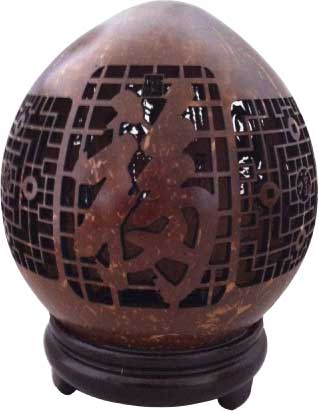
Hainan Coconut Carving

coconut-carving

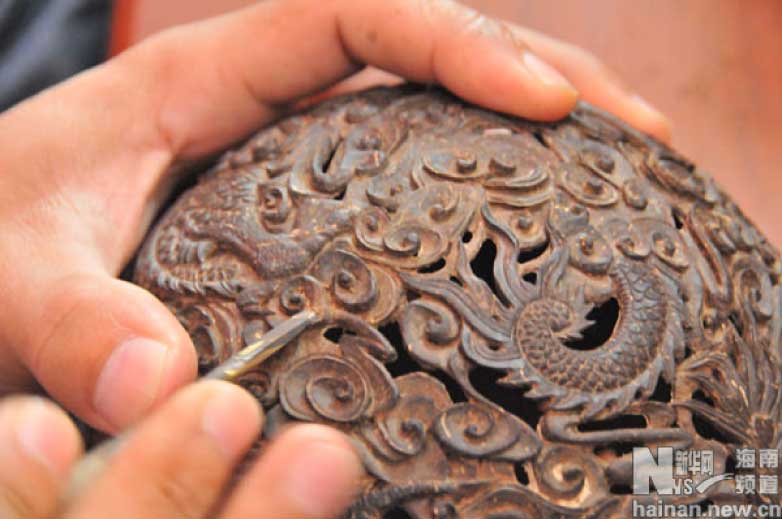
People have fashioned coconut shells, husk fibers and woods into different things for thousands of years, and coconut carving is a highlight of Hainan handicrafts. Coconut wine cups came to light in the early Tang Dynasty (618 – 907 CE) and carved coconut items became tributes to the emperors during the Ming and Qing dynasties (1368 – 1644 CE).
Hainan coconut carvings are handicrafts made mostly from coconut shells. They appear in different shapes and colors, with unique Hainan characteristics.
There are various means to carve a coconut shell, plane relief carving, stereoscopic relief carving, reversible pattern relief carving, as well as shell carvings. You can find more than 300 different kinds of carved coconut  products, such as tableware, tea sets, wine sets, smoking sets, vases, and various hanging and standing screens. They are uniquely designed and easy to use.

Making Fire from Drilling Wood in Li Ethnic Groups

wood-drilling

The technique of drilling wood to make fire is practiced throughout the gathering places of the Li ethnic group on Hainan Island.
According to Chinese legend, in ancient times people lived on fruits, berries, and uncooked mussels and clams – things which upset stomachs and caused illness. Then a sage appeared who drilled with sticks into wood and produced fire that was used to cook food. People were delighted and made him ruler of the world, calling him the Drill Man.
To make fire, the Li people use a fire-by-friction technique called the bowdrill.

drilling-2
A piece of wood (called a baseboard) is drilled into by a wooden rod (the drill). The drill is rotated one way then the other by a back and forth movement of a bow made from another length of wood and a fiber string which is turned around the drill (see the photos). The hard, downward pressure and the turning causes the drilling to produce a fine, charred powder from the baseboard.
Once there is enough, the speed and pressure of the drill is increased, and the friction heats the powder to a high enough temperature to ignite it into a glowing coal or ember. This ember is put into fibers of dried banana trees, cotton fibers, dried grasses or other inflammable materials and blown gently into life as a fire.


- Follow Us on WeChat -

spot_img

Related articles:

Hainan’s Free Trade Port Is Moving From Incentives to Usability

Hainan’s new services plan points to a shift in how foreign operators may use the FTP: banking, permits, policy access and talent recognition …

How Hainan’s 30% Rule Is Beginning to Shape Business Decisions

How Hainan’s 30% rule is beginning to shape business decisions for companies using the FTP’s customs route into mainland China ...

Typhoon Season 2026, What Hainan Residents Can Expect in the Coming Months

Typhoon Season 2026 in Hainan: What residents need to know about storm forecasts, El Niño impacts, ferry suspensions, airport disruptions, warning levels, and how to prepare for typhoons from July to October ...

Want to Stay in China After Graduation? Hainan Has a Startup Route

How international graduates can stay in China after graduation through Hainan’s startup residence route, and why it does not allow paid work ...

Get weekly email updates for new articles published!

Follow Us on WeChat

spot_img

Latest Articles ...

What spouses on S visas in China can and cannot legally do, including work, tutoring, remote work, volunteering, tax, and permit risks ...
A complete guide, how to apply online for a provisional driving permit in Hainan as a foreign national, including the application steps, required documents, and the online learning module you must complete ...
Foreign employees in China may have a Housing Provident Fund account they have never checked. The balance, employer contributions included, can be withdrawn in full when you leave. Here is how to claim it before you go …
You contributed 8% of your salary to a Chinese pension account every month. Many expats leave without claiming it. Here is a breakdown of what you are owed and the window you cannot afford to miss ...
spot_img

China’s Green Card: How Rare Is It, and What It Takes to Get One

Between 2004 and 2017, China issued just over 10,000 permanent residency permits to foreign nationals. This guide explains the four eligibility routes, the real criteria, and your honest odds of qualifying …

Why Your Passport Doesn’t Work: A Foreigner’s Guide to China’s ID-Only Systems

Your passport is legally valid for trains, hotels, SIM cards and payment accounts in China. The problem isn't the rules, it's the systems built on top of them …

China’s 2026 Work Permit Salary Rules: Who Actually Needs to Worry?

China’s work permit salary thresholds have raised concerns among foreign professionals. This explainer clarifies the 6× and 4× rules, why the figures appear high, and who is actually affected ...

Change Jobs in China Without Losing Your Legal Status

A practical guide to changing employers in China without losing your work permit or residence status, with timelines, documents, and common risks explained ...
spot_img

Looking for an international pre-school in Haikou?

Flora's International Preschool has three preschools in the Haikou area. Our schools follow a European curriculum

Continue Reading ...

Hainan’s Free Trade Port Is Moving From Incentives to Usability

Hainan’s new services plan points to a shift in how foreign operators may use the FTP: banking, permits, policy access and talent recognition …

How Hainan’s 30% Rule Is Beginning to Shape Business Decisions

How Hainan’s 30% rule is beginning to shape business decisions for companies using the FTP’s customs route into mainland China ...

Typhoon Season 2026, What Hainan Residents Can Expect in the Coming Months

Typhoon Season 2026 in Hainan: What residents need to know about storm forecasts, El Niño impacts, ferry suspensions, airport disruptions, warning levels, and how to prepare for typhoons from July to October ...

Get weekly email updates for new articles published!

Never miss another important notice or event. Be informed of what you need to know, when you need to know it.