spot_img

How does a typhoon form?

There are 3 basic stages in the life of a typhoon, its origin (or source), the mature stage and the dissipation stage, where it dies out.

These occur in a continuous process, not as separate distinct stages.

Each stage may occur more than once during the life cycle of the typhoon.

As the typhoon develops, it may reach land and weaken before going back out to sea where it strengthens once more.
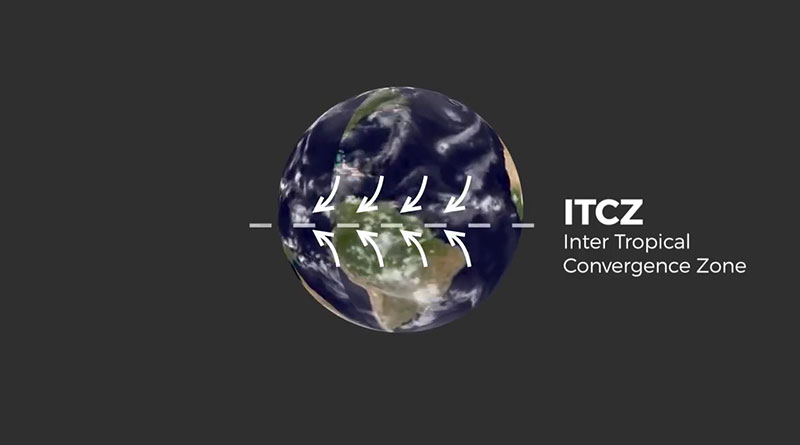
Typhoons are most likely to form in the Inter Tropical Convergence Zone (ITCZ)

Typhoons are most likely to form in the Inter Tropical Convergence Zone (ITCZ), where the North-East and South-East trade winds meet.

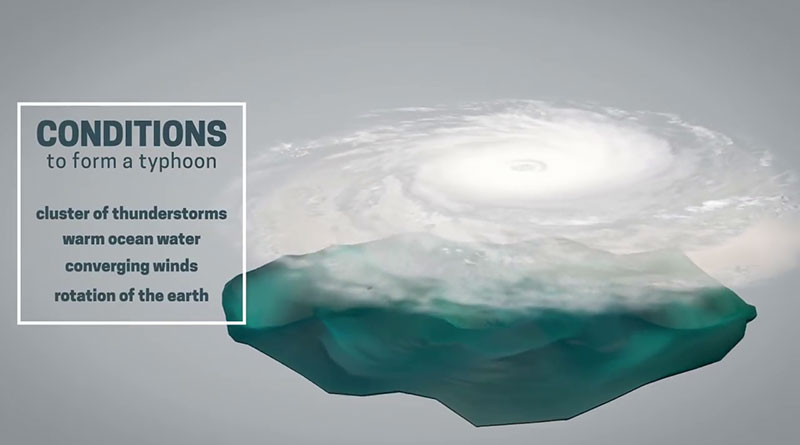
The formation of a typhoon depends on the following conditions coinciding.

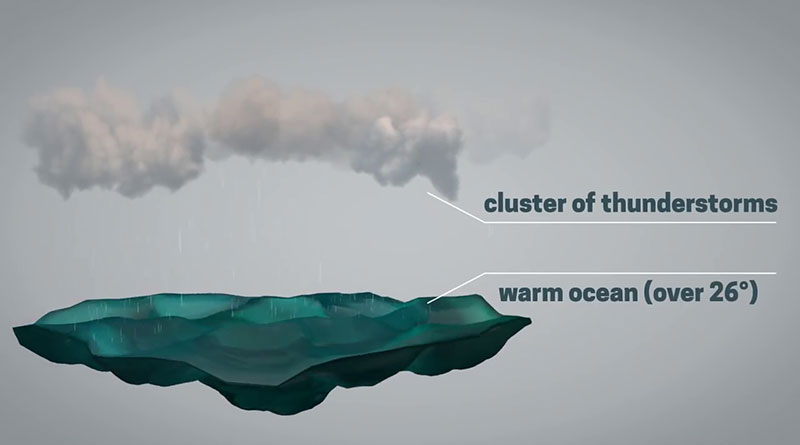
A large, still, warm ocean area with a surface temperature above 26.5 OC over an extended period of time.

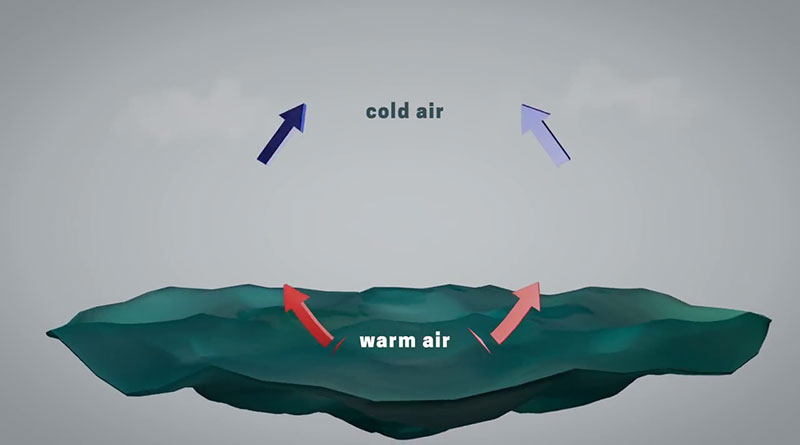
This allows a body of warm air to develop above the ocean surface.

Low altitude winds are also needed to form a typhoon.
warm-air-cold-air
The rising air contains a huge amount of moisture evaporated from the ocean surface.

As air warms over the ocean, it expands, becomes lighter and rises. Other local winds blow in to replace the air that has risen, which in turn warms and also rises. The rising air contains a huge amount of moisture evaporated from the ocean surface.
Cluster-of-thunderstorms
Rising drafts of air carry moisture high into the atmosphere which causes the clouds to become very thick and heavy.

As it rises the air cools, and the moisture condenses to form huge clouds about 10 km up in the troposphere.
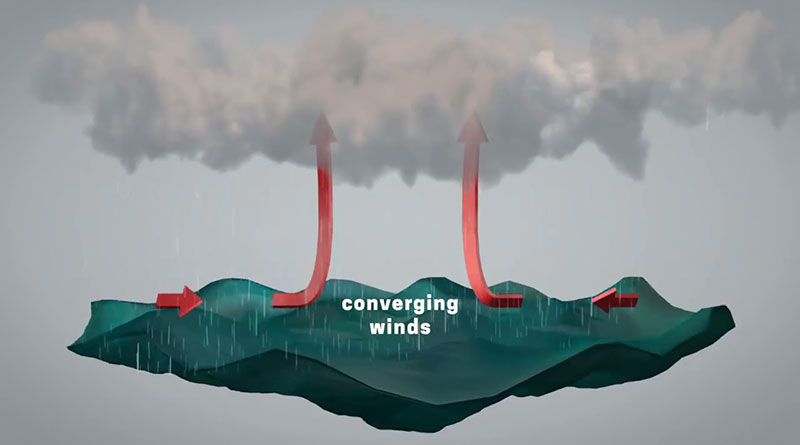
Converging-winds
Converging-winds

More warm air rushes in and rises, drawn in by the draft above. The rising drafts of air carry moisture high into the atmosphere which causes the clouds to become very thick and heavy.

Condensation then releases the latent heat energy stored in the water vapour, providing the typhoon with more power. This creates a self-sustaining heat cycle.

Drawn further up into the atmosphere by the release of energy, the clouds can grow up to 12 – 15 km high.
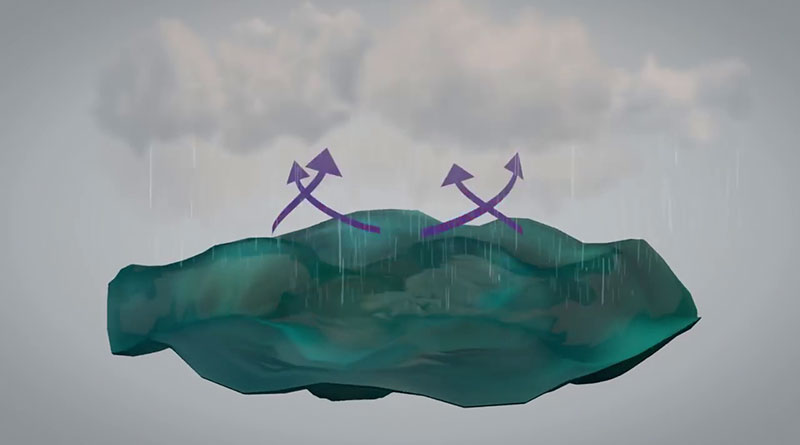
Vortex
The force created by the earth’s rotation on a tilted axis, (the Coriolis Effect), causes rising currents of air to spiral around the centre of the typhoon.

The force created by the earth’s rotation on a tilted axis, (the Coriolis Effect), causes rising currents of air to spiral around the centre of the typhoon. It’s at this stage that the typhoon matures, and the eye of the storm is created.

As the air rises and cools, some of the dense air descends to form the clear still eye as the typhoon rages around it.

The eye wall where the wind is strongest behaves like a whirling cylinder, (typhoons rotate anti-clockwise in the northern hemisphere).

The lowest air pressure in a typhoon is always found in the centre and is typically 950 millibars or less. The average air pressure at the earth’s surface is 1010 millibars, which means that typhoons have significantly lower air pressure than the air that surrounds them.

The bigger the pressure difference, the stronger the wind force.
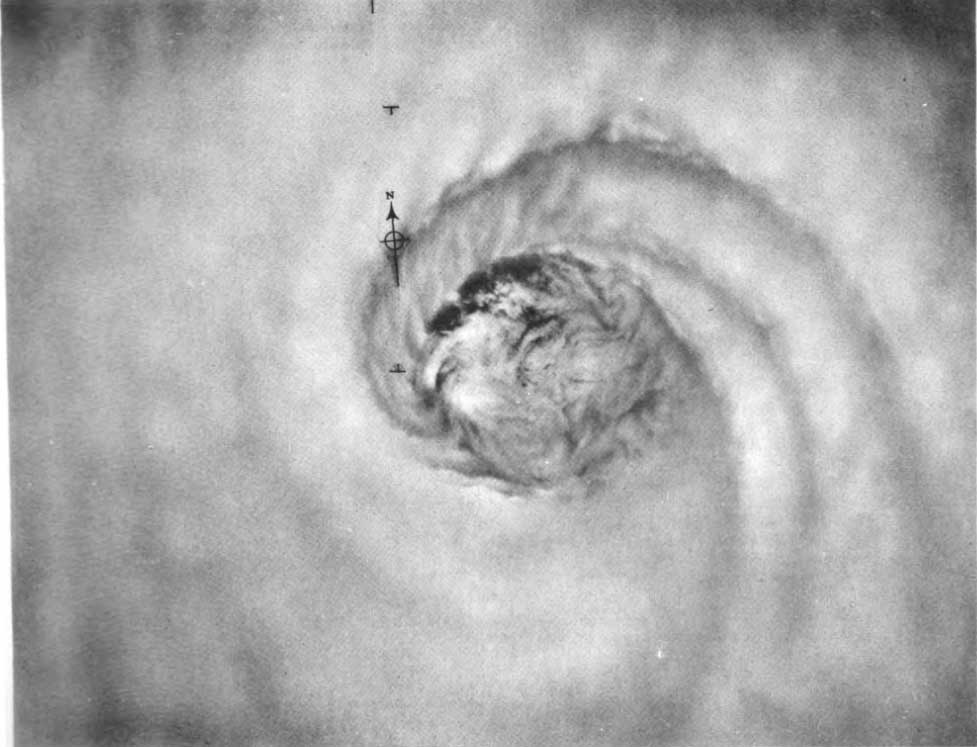
A look down into the eye of severe tropical typhoon Ida of 1958, Photo Public Domain, https://commons.wikimedia.org/w/index.php?curid=30016812

One of the lowest air pressures ever recorded was 877 millibars for typhoon Ida, which hit the Philippians in 1958 with wind speeds that reached 300 Km/h and resulted in 1,269 fatalities.

Once formed, the typhoon’s path or track follows a course driven by global wind circulation.

As warm ocean water feeds it heat and moisture the typhoon usually continues to enlarge.

When a typhoon passes over land or cold water, the basic fuel (warm ocean water) that drives the storm is cut off. Passing over land will quickly weaken the storm (not because of friction as some believe, but because of the loss of the warm moisture).

Related article: Typhoon Maqi 1973 – A reflection on one of the strongest & deadliest typhoons to hit Hainan

- Advertisement -

spot_img

Related articles:

China’s Green Card: How Rare It Is and What It Takes to Get One

Between 2004 and 2017, China issued just over 10,000 permanent residency permits to foreign nationals. This guide explains the four eligibility routes, the real criteria, and your honest odds of qualifying …

Why Your Passport Doesn’t Work: A Foreigner’s Guide to China’s ID-Only Systems

Your passport is legally valid for trains, hotels, SIM cards and payment accounts in China. The problem isn't the rules, it's the systems built on top of them …

Supporting Foreign Entrepreneurs in Hainan’s Free Trade Port

From Slovakian mineral water to African trade facilitation, how a Haikou support centre is helping foreign nationals start businesses in Hainan's Free Trade Port ...

China’s 2026 Work Permit Salary Rules: Who Actually Needs to Worry?

China’s work permit salary thresholds have raised concerns among foreign professionals. This explainer clarifies the 6× and 4× rules, why the figures appear high, and who is actually affected ...

Get weekly email updates for new articles published!

Follow Us on WeChat

spot_img

- Advertisement -

Latest News ...

Cosy Stays Beyond the Ordinary

Relax, Unwind, and Explore Hainan's Hidden Gems

Puerto Libre Tapas: A Taste of Latin and Mediterranean Cuisine

Located in Xiuying District, Haikou, Puerto Libre Tapas brings together Latin and Mediterranean flavors in a relaxed and inviting setting. The warm decor blends Mediterranean charm with Latin energy, making it a great spot for a casual meal or special night out ...

The Paddy Shack: A Taste of Comfort in Chengmai

Tucked away in the quiet streets of Laocheng Town, Chengmai, just outside Haikou, The Paddy Shack is a welcoming spot for anyone craving hearty...

Batumi: A Taste of Georgia in Haikou

Haikou's dining scene just got a flavorful upgrade with Batumi Georgian Food and Wine. If you're looking to try something new, this is the...
spot_img

Bored? Need to get out more?

Work and Residence Permit Mistakes Foreign Professionals in China Make in 2026

A practical explainer on the most common work and residence permit mistakes foreign professionals in China still make in 2026, and how employers and employees can reduce compliance risks …

Foreigners in Hainan Can Now Buy Imported Goods Tax-Free — Here’s How

Foreign residents in Hainan can now buy specified imported goods at zero tariff. This guide explains who qualifies, where to shop, purchase limits, and key compliance rules ...

Leaving China: The Exit Checklist Nobody Gives You

A practical guide for foreign teachers and professionals on how to leave China properly, covering work permits, residence permits, banking, social insurance, and records you may need years later …

Freelancing, Side Work, and Remote Jobs in China: What’s Legal — and What Isn’t

Can foreigners freelance or do side work in China? What the law actually says, how enforcement typically happens, and where legal risk begins ...
spot_img

Looking for an international pre-school in Haikou?

Flora's International Preschool has three preschools in the Haikou area. Our schools follow a European curriculum

Continue Reading ...

Program Announced for the 2026 Haikou New Year’s Concert

The 2026 Haikou New Year’s Concert brings two nights of symphonic and vocal music. View the full program, performers, and ticket discounts ...

Wanning Hosts Its First Major Surf Event Since 2020 as WSL Returns to Hainan

The WSL Qualifying Series returns to Riyue Bay, Wanning, from December 11–17, bringing more than 160 surfers from over ten countries back to Hainan’s coast …

ADEX Asia Diving Expo will be held in Hainan next year

The renowned dive-industry exhibition Asia Dive Expo (ADEX) is set to land in Hainan from October 30 to November 1, 2026, at the Hainan International Convention & Exhibition Center ...

Get weekly email updates for new articles published!

Never miss another important notice or event. Be informed of what you need to know, when you need to know it.