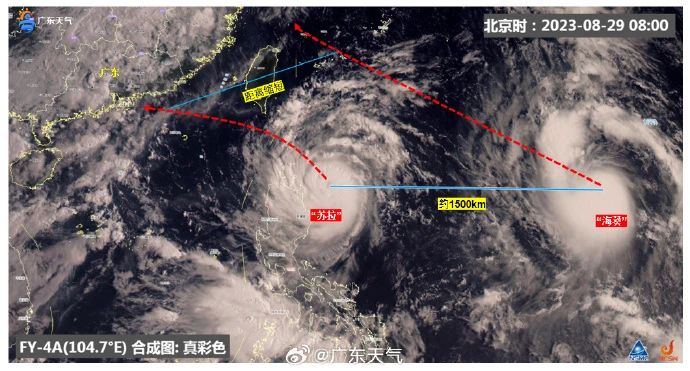
Typhoon Saola over north-eastern South China Sea, Potential Landfall Looms

Typhoon No. 9 of this year, named “Saola,” initially classified as a Severe Typhoon, has further escalated its intensity and is now officially categorized as a Super Typhoon.

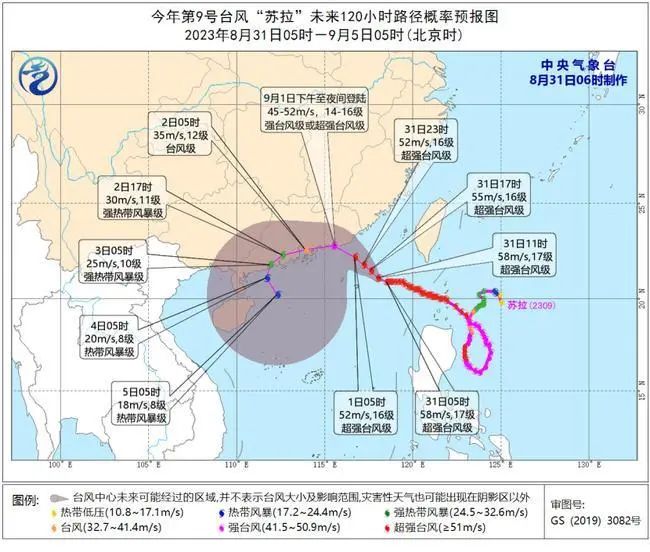
As of 06:00 AM on August 31st, the centre of the Typhoon was over the north-eastern South China Sea, situated approximately 320 kilometres southeast of Hui’an, Guangdong Province, with winds clocking in at 58 meters per second.
Typhoon Saola update
Predicted path of Typhoon Saola updated

Its movement is expected to edge it progressively closer to the eastern coast of Guangdong Province. While its strength is predicted to wane gradually as it nears landfall, (anticipated to occur between the afternoon and evening of September 1st) the impact zone is expected to span from Huilai, Guangdong, to Hong Kong.
Typhoon Saola update 2
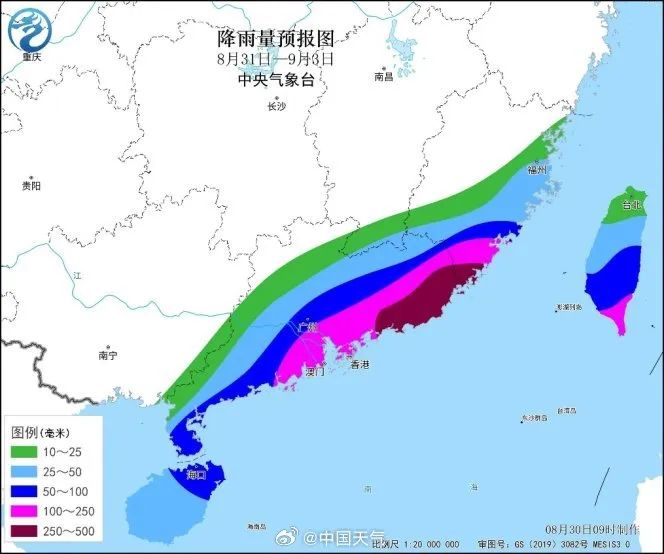
Typhoon Saola updated affected areas

Between August 31st, 08:00, and September 1st, 08:00, substantial precipitation is predicted. The south-eastern part of Fujian, eastern Guangdong, as well as central and southern areas of Taiwan are poised to receive heavy to torrential rain, with some localized zones possibly encountering heavy torrential rainfall ranging from 100 to 220 millimetres.

It’s expected that the typhoon’s ferocity at this juncture will qualify it as either a Severe Typhoon or even a Super Typhoon, with wind speeds raging between 45 and 52 meters per second, equivalent to Level 14 to 16 on the Beaufort scale.

Previously:

August 30th, 2023 – In a weather development of concern, Typhoon Saola is currently tracking toward the South China Sea, raising the possibility of an imminent landfall. The tropical cyclone is also expected to bring heavy rain to Hainan Province.

Earlier reports indicated that Typhoon No. 10, named “Dawei” has dissipated, while Typhoon Saola continues its trajectory, gaining strength. With maximum wind speeds of up to 52 meters per second and a minimum pressure of 935 hectopascals, the storm’s seventh-level wind circle spans 220-250 kilometres.
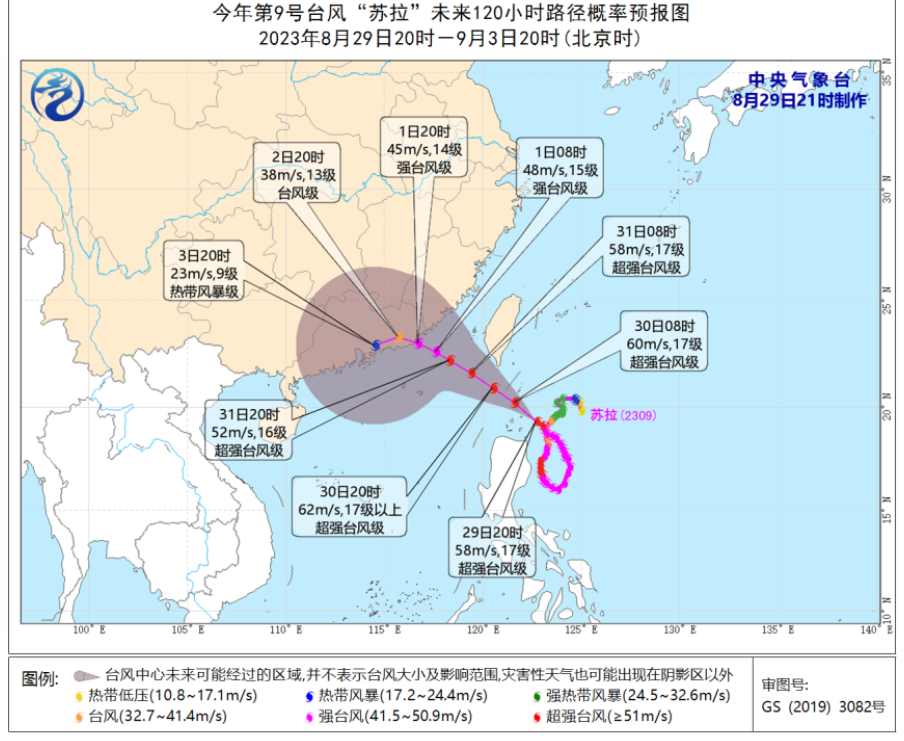
Typhoon Saola Approaches South China Sea, Potential Landfall Looms

Current forecasts suggest that Typhoon Saola, currently at super typhoon level, will move north-westward at a speed of 10-15 kilometres per hour. Expected to enter the northeastern South China Sea by August 31st, the storm is projected to gradually approach the coastal regions spanning from southern Fujian to eastern Guangdong. A potential landfall is predicted between the night of September 1st and the morning of September 2nd along this coastal stretch, with wind speeds ranging from typhoon to strong typhoon levels (38-45 meters per second, equivalent to 13-14 on the Beaufort scale).

Typhoon Saola’s path uncertain

Meteorological analysts point out that the proximity of another developing storm, Typhoon Haikui, might result in a dual-typhoon interaction, affecting Saola's course.

The storm’s path however, remains uncertain due to complex environmental factors. Meteorological analysts point out that the proximity of another developing storm, Typhoon Haikui, might result in a dual-typhoon interaction, affecting Saola’s course.

Typhoon Haikui, currently east of Typhoon Saola, is slowly strengthening as it moves in a north-westerly direction. Experts suggest that the interaction between these two storms could lead to unpredictable path shifts.

As Typhoon Saola’s impact unfolds, authorities advise residents to remain vigilant, as the situation could result in urban flooding, geological hazards, and potential flooding from small and medium-sized rivers.

In light of the rapidly changing weather conditions, the Central Meteorological Observatory issued a blue typhoon warning at 6:00 PM on August 29th, urging residents and relevant departments to take necessary precautions. Residents in Hainan Island should be prepared for heavy to torrential rain with some areas expecting localized accumulations exceeding 60 millimetres and alerts issued for the potential risks of flash floods and secondary hazards.

Related article: Navigating Hainan Island’s Rainfall Risks: Understanding Mudslides and Flash Floods

Navigating Hainan Island's Rainfall Risks: Understanding Mudslides and Flash Floods

SourceSource

- Follow Us on WeChat -

spot_img

Related articles:

How Hainan’s 30% Rule Is Beginning to Shape Business Decisions

How Hainan’s 30% rule is beginning to shape business decisions for companies using the FTP’s customs route into mainland China ...

Typhoon Season 2026, What Hainan Residents Can Expect in the Coming Months

Typhoon Season 2026 in Hainan: What residents need to know about storm forecasts, El Niño impacts, ferry suspensions, airport disruptions, warning levels, and how to prepare for typhoons from July to October ...

Want to Stay in China After Graduation? Hainan Has a Startup Route

How international graduates can stay in China after graduation through Hainan’s startup residence route, and why it does not allow paid work ...

A Spouse on an S Visa: What They Can and Cannot Legally Do in China

What spouses on S visas in China can and cannot legally do, including work, tutoring, remote work, volunteering, tax, and permit risks ...

Get weekly email updates for new articles published!

Follow Us on WeChat

spot_img

Latest Articles ...

A complete guide, how to apply online for a provisional driving permit in Hainan as a foreign national, including the application steps, required documents, and the online learning module you must complete ...
Foreign employees in China may have a Housing Provident Fund account they have never checked. The balance, employer contributions included, can be withdrawn in full when you leave. Here is how to claim it before you go …
You contributed 8% of your salary to a Chinese pension account every month. Many expats leave without claiming it. Here is a breakdown of what you are owed and the window you cannot afford to miss ...
Changing jobs in Hainan follows a legal sequence with defined deadlines at the key steps. Here is what the official rules and related official guidance say about work permit cancellation, the gap period, and when you can legally start work …
spot_img

China’s Green Card: How Rare Is It, and What It Takes to Get One

Between 2004 and 2017, China issued just over 10,000 permanent residency permits to foreign nationals. This guide explains the four eligibility routes, the real criteria, and your honest odds of qualifying …

Why Your Passport Doesn’t Work: A Foreigner’s Guide to China’s ID-Only Systems

Your passport is legally valid for trains, hotels, SIM cards and payment accounts in China. The problem isn't the rules, it's the systems built on top of them …

China’s 2026 Work Permit Salary Rules: Who Actually Needs to Worry?

China’s work permit salary thresholds have raised concerns among foreign professionals. This explainer clarifies the 6× and 4× rules, why the figures appear high, and who is actually affected ...

Change Jobs in China Without Losing Your Legal Status

A practical guide to changing employers in China without losing your work permit or residence status, with timelines, documents, and common risks explained ...
spot_img

Looking for an international pre-school in Haikou?

Flora's International Preschool has three preschools in the Haikou area. Our schools follow a European curriculum

Continue Reading ...

How Hainan’s 30% Rule Is Beginning to Shape Business Decisions

How Hainan’s 30% rule is beginning to shape business decisions for companies using the FTP’s customs route into mainland China ...

Typhoon Season 2026, What Hainan Residents Can Expect in the Coming Months

Typhoon Season 2026 in Hainan: What residents need to know about storm forecasts, El Niño impacts, ferry suspensions, airport disruptions, warning levels, and how to prepare for typhoons from July to October ...

Want to Stay in China After Graduation? Hainan Has a Startup Route

How international graduates can stay in China after graduation through Hainan’s startup residence route, and why it does not allow paid work ...

Get weekly email updates for new articles published!

Never miss another important notice or event. Be informed of what you need to know, when you need to know it.