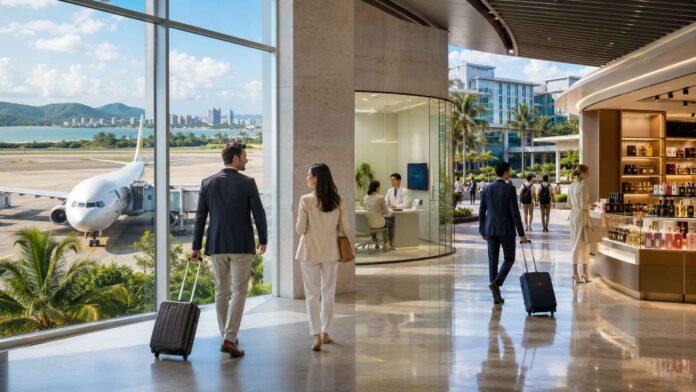
Hainan is targeting more international routes, longer visitor stays and higher spending by 2030. For businesses, however, the plan is as much a guide to future policy as it is a measure of current market access.
Hainan wants to more than double inbound visitor trips and medical-tourism visits by 2030, while expanding international air connections and pushing offshore duty-free sales above RMB 50 billion. The targets include more than 120 inbound passenger routes, 3.5 million inbound visitor trips and two million medical-tourism visits. The plan’s corresponding 2025 baselines are 92 routes, 1.5 million visitor trips, RMB 30.38 billion in duty-free sales and 865,300 medical-tourism visits. For international operators, the numbers point to a larger and more diversified consumer market.
The 15th Five-Year Plan for the Hainan International Tourism Consumption Centre (《“十五五”海南国际旅游消费中心规划》) identifies where Hainan intends to concentrate traffic, infrastructure, investment and regulatory effort through 2030. Some of the market openings behind that strategy are already in force. Others remain proposals that the province intends to “seek”, “explore” or test through pilot programmes.
A larger tourism market, with faster international growth
The plan spans 18 chapters and includes a schedule of major projects, activities and reform measures. It also contains 16 development indicators, all classified as 预期性, meaning indicative or expected, rather than 约束性, or binding. The targets are benchmarks for provincial policy and investment, not statutory obligations.
Hainan is targeting a broad expansion of its tourism economy. Total domestic and international visitor trips are targeted to rise by about 45%, from 106.07 million in 2025 to 154 million in 2030. Tourist spending is targeted to increase by about 61%, from RMB 225.4 billion to RMB 363 billion.
The inbound targets are steeper. Hainan aims to increase officially recorded inbound visitor trips from 1.5 million in 2025 to 3.5 million in 2030, while raising inbound visitor spending from US$1.01 billion to US$2.485 billion.
The 1.5 million figure does not mean Hainan received 1.5 million foreign holidaymakers. The indicator 入境游客人次, or inbound visitor person-trips, includes foreign nationals and visitors from Hong Kong, Macao and Taiwan. It also counts trips rather than unique individuals, so one person entering Hainan more than once can be counted several times.
A separate indicator, 免签入境外国人人次, or visa-free foreign-national entries, counts foreign nationals only. The plan gives a 2025 baseline of 608,000 visa-free foreign-national entries. This figure also counts entries rather than unique travellers and should not be compared directly with the broader 1.5 million inbound total.
The plan separately measures 入境过夜游客人天数, or inbound overnight visitor-days. That figure is targeted to rise from 5.94 million in 2025 to 17.5 million in 2030. Taken together, the targets point to more recorded inbound trips, longer aggregate stays and higher total spending, rather than 3.5 million foreign leisure tourists.
Aviation is central to that strategy. The plan calls for inbound passenger routes to increase from 92 to more than 120 and for the number of overseas cities connected to Hainan to rise from 43 to more than 60. Visa-free entries by foreign nationals are targeted to increase from 608,000 to more than one million.
For airlines, airports, hotels, destination-management companies and international visitor-service providers, the targets offer a measurable view of the market Hainan wants to build.
A more specialised economic map of the island
The plan gives different parts of Hainan distinct roles within the tourism and consumption economy.
Haikou and Sanya remain the island’s two core international tourism consumption centres. Six other areas are assigned more specialised functions: Danzhou for cultural and entertainment tourism, Boao Lecheng in Qionghai for medical tourism, Lingshui Li’an for international education, Wanning for sports tourism, Wenchang for aerospace tourism and the tropical rainforest areas for ecological and ethnic-cultural tourism.
The accompanying project schedule turns that geographic strategy into a more concrete development pipeline. It includes cruise facilities in Haikou, Sanya and Danzhou; a third phase of Sanya International Duty Free City linked to the Taikoo Li development; new aerospace tourism and viewing facilities in Wenchang; further education development at Lingshui Li’an; and international medical institutions under preparation in Hainan.
The plan is more than a set of province-wide growth figures. It assigns specific forms of consumption to particular cities, zones and projects.
For investors and service providers, the result is a clearer commercial map. Aviation and international events are concentrated around Haikou and Sanya. Medical demand is tied mainly to Boao Lecheng. International education is centred on Lingshui Li’an, while aerospace tourism is linked to Wenchang.
The project list should not be read as a guarantee of completion. It indicates where provincial authorities intend to direct policy support, infrastructure development and investment promotion.
Duty-free sales targeted above RMB 50 billion
Hainan’s offshore duty-free market already operates under an established national policy. Revised rules took effect on November 1, 2025, expanding the product list from 45 to 47 categories while retaining the RMB 100,000 annual allowance. The policy was also extended to travellers leaving Hainan directly for destinations outside mainland China.
Under the revised rules, island residents with a departure record during the calendar year can make repeated purchases from categories covered by the 即购即提, or immediate-collection, arrangement. Purchases remain subject to the RMB 100,000 annual allowance and the applicable category and quantity limits.
Against that regulatory background, Hainan is targeting offshore duty-free sales of more than RMB 50 billion by 2030, up from the plan’s 2025 baseline of RMB 30.38 billion. The earlier consultation draft had set the 2030 target at RMB 45 billion, meaning the final plan increased the target by at least RMB 5 billion.
The plan also calls for a “more open and convenient” offshore duty-free policy. It proposes additional product categories, more high-end and limited-release goods, an improved store layout and additional operating locations.
Those measures do not automatically take effect because they appear in the plan. The document uses the term 争取, meaning to seek or strive for, indicating that further changes would require separate policy decisions.
For retailers and international brands, the operating market is already in place. The outstanding questions are whether central authorities will approve additional product categories, purchasing arrangements, operating locations or a broader duty-free consumer-goods regime for residents.
Medical-tourism visits targeted to more than double
Hainan is targeting an increase in medical-tourism visits from 865,300 in 2025 to two million by 2030. The Boao Lecheng International Medical Tourism Pilot Zone remains the main platform for delivering that growth.
The plan calls for Lecheng to continue introducing internationally innovative drugs, medical devices, health products and specialised medical foods. It also supports the development of medical aesthetics, assisted reproduction, health management and commercial health-insurance services.
Assisted reproduction is an area where the plan’s sector ambitions and existing market-access rules need to be separated. The national pilot programme for wholly foreign-owned hospitals does not allow those hospitals to provide human assisted reproductive technology. The tourism plan’s support for assisted reproduction should therefore not be interpreted as permission for a wholly foreign-owned hospital to offer that service.
Foreign investors already have a route to establish wholly foreign-owned hospitals in Hainan. A national pilot issued in November 2024 covers the island, subject to individual approvals and operating conditions. Eligible institutions include general, specialist and rehabilitation hospitals, which must be established at tertiary, or Level III, standard. Traditional Chinese medicine hospitals, acquisitions of public hospitals and several higher-risk clinical activities are excluded.
The national rules require mainland-Chinese personnel to make up at least half of both hospital management and health-professional staff. Applications are first reviewed at city level and then submitted for provincial approval. A hospital must obtain establishment approval and a medical institution licence before it can operate.
The new tourism plan says the province will seek a further expansion of the wholly foreign-owned hospital pilot. The project schedule also identifies three contracted international hospitals that are under preparation. It includes plans to expand the use of international commercial insurance in Hainan’s medical sector, but does not specify what additional widening of the foreign-hospital pilot the province wants approved.
For hospital groups and medical investors, the immediate market-access route remains the existing national pilot. The tourism plan signals demand growth and further policy ambition, but does not replace the hospital approval process.
For medical concierge companies, insurers, translation services, accommodation providers and patient-support businesses, the commercial opportunity depends more directly on whether Lecheng attracts the patient volumes set out in the plan.
International education remains a consumption priority
Hainan treats international education as the third of its three main “consumption articles”, alongside duty-free shopping and medical services.
The plan targets 55 independent universities and Sino-foreign cooperative institutions or programmes by 2030, compared with a 2025 baseline of 34. The project schedule separately targets a total scale of 50,000 students, staff and training participants at the Lingshui Li’an International Education Innovation Pilot Zone by 2030.
Rules issued in 2023 already allow qualifying overseas universities and vocational institutions to establish science, engineering, agriculture and medical schools or campuses within the Hainan Free Trade Port. Each institution remains subject to approval, and the rules do not provide unrestricted access across all academic disciplines.
The tourism plan builds on that framework. It calls for Hainan to continue attracting high-level overseas universities and to expand international study programmes, research exchanges, professional training and education-related tourism.
Lingshui Li’an is the main international education cluster identified in the tourism plan, although the underlying education rules apply across the Hainan Free Trade Port.
The business implications depend on what comes first
For international operators, the opportunities outlined in the plan fall broadly into two groups: those driven mainly by demand and those that depend first on regulatory or institutional approval.
Demand-led businesses rely primarily on Hainan delivering more passengers, longer stays, larger projects and higher visitor spending. They include hotels, destination-management companies, cruise and yacht services, events companies, medical concierge providers, international student services, payment companies, translation businesses and travel-technology operators.
Approval-led businesses depend first on a licence, policy change or institutional decision before entering the market or pursuing certain forms of expansion. They include duty-free operators, foreign hospital investors, overseas universities and businesses whose models depend on future resident duty-free arrangements or cross-border aviation policies.
The two groups are not completely separate. Approval-led operators still need market demand, while demand-led companies remain subject to ordinary licensing. The practical distinction is which constraint must be resolved first.
Airlines and hotels need evidence that the route and passenger targets are translating into actual traffic. Medical and education operators need formal approvals. Duty-free companies need central policy notices, operating qualifications and store approvals.
The plan is most useful as a statement of provincial direction. It identifies where Hainan expects consumption to grow, which cities and zones are intended to carry that growth and which industries the provincial government plans to support.
It is less useful as proof that a specific commercial opening has already taken effect. Where the document uses terms such as “seek”, “pilot” or “explore”, investors must still monitor the relevant authorities for implementing measures.
More than one million visa-free foreign-national entries and over 120 inbound routes would support a larger international visitor economy than Hainan has today. The commercial meaning of those targets, however, varies by industry. A hotel group needs passenger growth. A hospital group needs approval. A university needs both institutional permission and students.
Hainan’s plan does not guarantee the tourism market it describes for 2030. It shows where the province intends to build that market. For sectors already operating under live rules, it provides a map of expected demand. For sectors that still require further approval, it provides a policy watchlist.
Related article: Hainan Island Open to Wholly Foreign-Owned Hospitals in Major Healthcare Reform