Hainan-registered companies exported RMB 22.23 billion of goods to ten ASEAN markets in the first half of 2026, almost three times the value recorded one year earlier.
Exports rose 185.8% from RMB 7.78 billion in H1 2025. Imports moved in the opposite direction, falling 6.8% to RMB 10.22 billion. The two changes turned a RMB 3.19 billion trade deficit into a RMB 12.01 billion surplus.
Two-way trade with the ten markets reached RMB 32.45 billion, up 73.1%. Hainan’s total merchandise trade grew 59.9% over the same period, raising the ten markets’ share of the provincial total from 15.38% to 16.65%.
The figures cover trade declared by companies registered in Hainan. Some goods were produced in the province, while others were traded through Hainan-based companies.
Hainan’s foreign-trade business base has also expanded since island-wide special customs operations began on December 18, 2025. Xinhua reported that 7,503 foreign-trade enterprises registered in Hainan during the first 100 days, 65.7% more than in the comparable period.
The figures do not show what drove the increase. New company registrations, changing demand, expanded shipping capacity and Hainan’s new customs arrangements may all have played a part. What is clear is that Hainan-registered companies declared far more exports in the first half of 2026.
Exports drove the increase in ASEAN trade
Hainan’s trade with the ten markets increased by RMB 13.71 billion year-on-year. Exports added RMB 14.45 billion, while imports fell by RMB 746 million. The export increase was larger than the net increase in two-way trade.
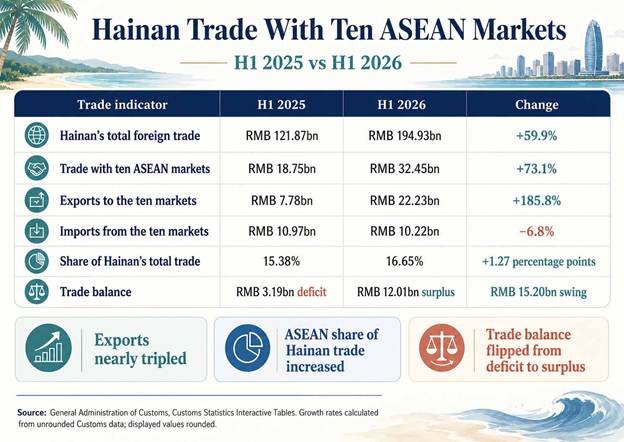
Imports had exceeded exports in H1 2025 but by H1 2026, exports were 2.18 times the value of imports.
Trade with the ten markets accounted for 18.8% of the RMB 73.05 billion increase in Hainan’s total foreign trade. Southeast Asia therefore became a larger part of Hainan’s trade structure, not simply a larger market in nominal terms.
Vietnam led, but every market recorded growth
Vietnam remained the largest export destination in the group. Hainan-registered companies exported RMB 6.08 billion to the country in H1 2026, up 169.9%. Indonesia followed at RMB 3.04 billion, an increase of 173.7%. The Philippines received RMB 3 billion, up 44%. Exports to Malaysia reached RMB 2.94 billion after rising 215.7%, while Thailand recorded the fastest growth among the five largest markets, up 262.2% to RMB 2.58 billion.
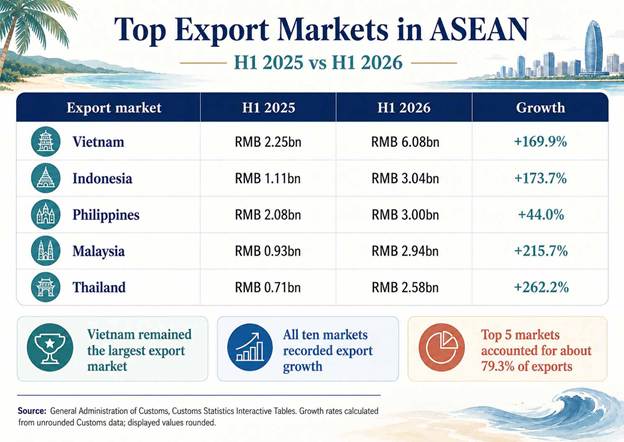
Singapore, Myanmar, Laos, Cambodia and Brunei also bought more from Hainan registered exporters than they had one year earlier. The five largest destinations accounted for 79.3% of export value, but exports increased across all ten markets. Vietnam and Indonesia were also the two largest partners when imports and exports were combined. Together, they accounted for 48.3% of Hainan’s trade with the ten markets.
For exporters, the figures point to two different market strategies in Southeast Asia. Vietnam, Indonesia, the Philippines, Malaysia and Thailand provide the deepest existing sales channels. The smaller markets offer less immediate volume but recorded faster percentage growth from lower bases.
Companies can either build scale through the established destinations or test products in markets where Hainan’s trade presence is still developing.
Customs has not yet published a product breakdown for the RMB 14.45 billion increase, so it is unclear which goods drove the growth. Exports rose across all ten markets, but the figures do not show whether that growth was spread across a wider range of products.
Form E certificates gave qualifying exports access to lower ASEAN tariffs
Haikou Customs issued 1,706 Form E certificates in the first half of 2026, covering RMB 1.957 billion of goods. The certificates allow qualifying exports to claim preferential tariffs under the China–ASEAN Free Trade Agreement. Certificate numbers rose 20.06% year-on-year, while the value of goods covered increased 60.44%.
Haikou Customs identified rubber and latex products, processed tropical fruit and vegetables, pulp and construction materials among Hainan’s main ASEAN export categories under the agreement.
Form E certificates allow qualifying goods to receive preferential tariff treatment when they enter participating Southeast Asian markets. The value to the exporter depends on the product, destination-country tariff and applicable rule of origin.
海南中信化工有限公司 (Hainan Zhongxin Chemical Co., Ltd.) obtained 52 China– ASEAN certificates during the first half of 2026. They covered more than RMB 13.3 million of goods and reduced destination-country tariffs by more than RMB 660,000, according to Haikou Customs. A company customs manager said the fastest applications took only a few minutes from submission to receipt.
Form E certificates covered RMB 1.957 billion of exports in H1 2026, equivalent to about 8.8% of exports to the ten ASEAN markets. The comparable figure for H1 2025 was approximately 15.7%.
The lower share does not mean Form E exports declined. Their value increased by 60.44% over the year, but total exports to the ten ASEAN markets grew even faster, reducing Form E’s proportion of the total.
Haikou Customs said the number of Regional Comprehensive Economic Partnership certificates issued in H1 2026 also grew rapidly, but it did not provide any figures.
The increase creates more business for customs brokers, freight forwarders, banks, insurers and logistics providers as export volumes grow, regardless of which tariff preference individual shipments use.
The trade balance changed direction in one year
In H1 2025, Hainan-registered companies bought more from the ten markets than they sold to them. One year later, they exported more than twice as much as they imported. That reversal moves Hainan’s ASEAN relationship beyond an import-led exchange. The province now has a larger base of companies declaring outbound trade, established high-volume markets in Vietnam and Indonesia, and growing sales across the rest of the region.
The unanswered questions concern the composition of the growth. The figures do not yet show how much came from Hainan factories and farms, how much passed through newly registered trading companies, or which products produced the largest gains.
For 海南中信化工有限公司, the commercial mechanism is visible: 52 certificates and more than RMB 660,000 in tariff savings. For most of the remaining RMB 22.23 billion in exports, the product mix, origin and tariff channel have not yet been published.
The next test is whether the increase becomes rooted in repeat orders, Hainan based production and durable regional distribution networks. The first-half figures provide the starting position: every market recorded higher exports, Southeast Asia took a larger share of Hainan’s trade, and the regional balance moved from deficit to a surplus of more than RMB 12 billion.
Data note
The figures come from China Customs and cover trade declared by companies registered in Hainan. They do not show where the goods were produced or which port handled them. The calculation covers Brunei, Cambodia, Indonesia, Laos, Malaysia, Myanmar, the Philippines, Singapore, Thailand and Vietnam. Timor-Leste, which joined ASEAN in October 2025, was not included.
Growth rates were calculated from unrounded Customs data.
Related article: From Engines to After-Sales Services: Hainan’s Bid to Build a Regional Repair Economy