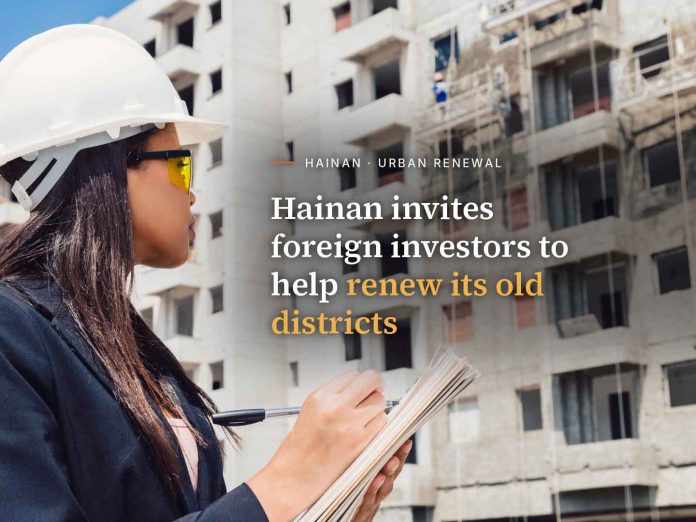
Overseas individuals, companies and other organisations will be expressly encouraged to take part in planning, building and operating urban renewal projects in Hainan, through wholly owned, joint-venture or cooperative arrangements and in accordance with the law, when the Hainan Free Trade Port Urban Renewal Regulation (《海南自由贸易港城市更新条例》) takes effect on 1 January 2027. The Standing Committee of the Hainan Provincial People’s Congress published the text in an announcement dated 10 October 2026.
Lin Chonggao, deputy director of the Legislative Affairs Commission of the Hainan Provincial People’s Congress Standing Committee, told a press conference held by the Hainan Provincial Information Office on 4 November 2026 that the regulation, with six chapters and 52 articles, was adopted on 30 September 2026 at the 26th session of the Standing Committee of the Seventh Hainan Provincial People’s Congress. He linked the provision on overseas participants to the Free Trade Port’s role in opening up to the outside world.
Foreign investors still face Hainan’s own negative list, which sets out the sectors closed or restricted to them, under the province’s Foreign Investment Regulation of July 2025. The new urban-renewal rules cover approvals, land and financing, but officials said the detailed implementing documents are still being drafted, with no date given.
What the regulation does
Three sets of provisions bear directly on investors and property owners.
First, city and county governments must carry out regular city health checks (城市体检), and the results must serve as the basis for special plans, district plans, annual plans and project implementation schemes. Lin described the assessment as a binding precondition. “Without completing the health-check assessment, renewal cannot be launched blindly,” he said.
Second, the regulation requires government departments at county level and above to set up mechanisms to simplify approvals: accepting applications with some documents still outstanding (容缺受理), parallel processing, expedited approval, notification and commitment (告知承诺) and exemption from approval.
Third, the regulation sets consent and resettlement rules at two separate stages. A project involving demolition and rebuilding, alteration or extension must obtain the consent of property-rights holders within its boundary before it enters a city’s annual renewal plan; for buildings in divided ownership, the vote follows the Civil Code.
Later, where old residential areas on state-owned land are demolished and rebuilt, city and county governments may expropriate the remaining unsigned homes only once both the number of rights holders who have signed compensation agreements and their share of exclusive floor area reach at least 90%, Wang Ke, deputy director-general of the Hainan Provincial Department of Housing and Urban-Rural Development, said.
Any expropriation must follow laws, administrative regulations and Hainan’s expropriation rules, the regulation says.
That double 90% test is not new: the Hainan Free Trade Port Expropriation and Requisition Regulation, in force since 1 January 2022, already sets it in Article 7 for demolition-and-rebuild projects on old residential areas. Owners may choose cash compensation, a replacement property or housing vouchers (房票). Lifts added to existing residential buildings may be exempt from a construction-project planning permit once owners have approved them by a vote held in accordance with the law.
Money and land
Officials tied the regulation to money already allocated. Zhao Mu, director of the fixed-asset investment division of the Hainan Provincial Development and Reform Commission, said that over the three years before the press conference, Hainan had arranged more than RMB 34 billion (340亿元) in policy funds to support more than 530 urban renewal projects. More than 350 further projects, with total investment of over RMB 12 billion, have been planned, he said.
Pang Xuebin, deputy director of the economic construction division of the Hainan Provincial Department of Finance, said Hainan had issued more than RMB 3.4 billion (34亿元) of local government special bonds for urban renewal in 2026 by the time of the press conference.
The regulation encourages eligible projects to raise money through infrastructure real estate investment trusts (REITs). Liu Peng, deputy director of the National Financial Regulatory Administration’s Hainan office, said his office would implement the Urban Renewal Project Loan Management Measures (Trial), which the administration drew up with the Ministry of Housing and Urban-Rural Development, and urge financial institutions in Hainan to engage early with urban renewal projects. The administration released the measures on 28 August 2026 as part of a set of property financing rules, Xinhua reported.
On land, Lin Fangjun, chief planner of the Hainan Provincial Department of Natural Resources and Planning, listed supply methods including transfer by agreement, transfer with flexible terms, long-term leasing and leasing before transfer. The regulation keeps a limit on those options: land-use rights for industrial, commercial, tourism, entertainment and commercial residential land, and for any plot with two or more prospective users, must be granted by tender, auction or listing, unless national rules on land transfer in the Free Trade Port provide otherwise. Scattered plots too small to develop on their own may be transferred by agreement and folded into a renewal project. Land-use-right prices start from a market valuation, may take account of costs such as public facilities handed over, and may be paid in instalments.
The limits
The tax incentive officials cited is not new. Pang said enterprises in industries such as “municipal infrastructure”, “urban quality improvement and housing security” and “smart city construction” that meet the conditions can pay corporate income tax at a reduced rate of 15%. That rate has applied since 2020. A Ministry of Finance and State Taxation Administration notice (Caishui [2020] No. 31) sets the conditions: an encouraged-industry enterprise must be registered and substantively operating in the Free Trade Port, with a main business listed in the encouraged-industries catalogue that accounts for at least 60% of its total income. The two bodies extended the incentive in a notice dated 24 January 2025 (Caishui [2025] No. 3) to 31 December 2027.
Wang said his department would issue urban renewal work guidelines and project management measures, and would work with other departments on supporting documents on planning, land, and investment and financing. He described a “1+1+N” system of the regulation plus supporting rules, to be coordinated with Hainan’s existing urban renewal action plan and support policies, but gave no timetable.
Officials did not say at the press conference whether any project types would be closed to overseas participants.
What it means for investors
For an overseas developer or fund, the regulation expressly recognises wholly owned participation in Hainan urban renewal, but it does not by itself guarantee a project, a site or an approval. Land-use rights for commercial land must generally be granted by tender, auction or listing, subject to any exception in national rules for the Free Trade Port; the walkway floor-area exclusion is discretionary; and the supporting documents Wang described have not been published.
A company counting on the 15% rate must be registered and substantively operating in Hainan, have a main business in the catalogue and meet the 60% income test.
For foreign residents who own flats in older blocks, the consent rules matter more: owners’ consent is needed before a demolition-and-rebuild project enters the annual plan, and on state-owned land expropriation of unsigned homes becomes possible only after both 90% thresholds are met.
The regulation takes effect on 1 January 2027, and 2027 is also the final year covered by the currently published extension of the 15% corporate tax rate.
Related article: Hainan After Customs Closure: Which Sectors Have Real Commercial Traction?