

Source: 《中共海南省委关于制定国民经济和社会发展第十五个五年规划的建议》adopted by the 8th Plenary Session of the 8th CPC Hainan Provincial Committee on 30 November 2025.
Reference: (BJD News)
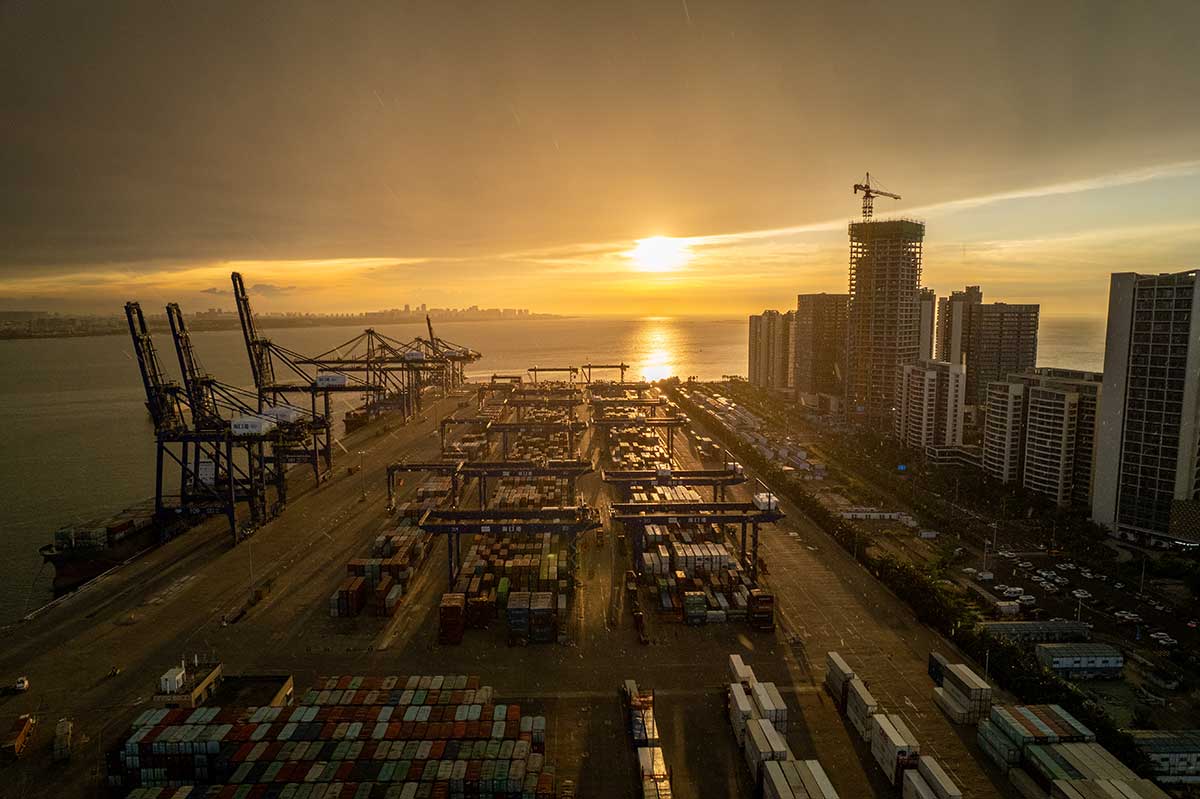
On 10 December, Hainan released the provincial Party committee’s proposal for the 15th Five-Year Plan for economic and social development, setting out a 2026–2030 roadmap for the island’s free trade port after customs closure. The document, adopted at the 8th Plenary Session of the 8th CPC Hainan Provincial Committee on 30 November, defines the coming five years as a “critical period” both for Chinese-style modernisation in Hainan and for building a high-standard free trade port.
From pilot phase to system building
During the 14th Five-Year period, Hainan completed most of the “front-loaded” policy work for the free trade port: three “zero-tariff” lists, (Self-use Production Equipment, Raw Materials and Auxiliary Materials and Operational Transport Vehicles, Vessels, Yachts, and Eligible Imports for Residents (e.g. Duty-free goods / consumer goods for island residents)), preferential 15% income-tax policies, a cross-border services negative list, visa-free entry policies for eligible countries under Hainan’s FTP regime, and the EF multi-functional free-trade account system. The proposal argues that these measures, combined with rapid growth in trade, foreign investment and tourism, have laid the groundwork for island-wide customs closure and more ambitious institutional opening.
Looking ahead, the 15th Five-Year period is framed as a bridge between initial set-up and a more mature system by 2035. The plan aims to complete and refine the free trade port’s policy architecture while maintaining a firm security baseline in areas ranging from finance and cross-border capital flows to data, public health and the environment.
Guiding principles and targets
The proposal follows the national template: Xi Jinping Thought provides the overall ideological framework; the “new development philosophy” and high-quality development remain the central themes; and the “Three Zones and One Centre” positioning, national ecological civilisation pilot zone, international tourism consumption centre, national strategic service and logistics zone, and international education innovation island, continues to guide sectoral policy.
The targets are qualitative rather than numerical at this stage. By 2030, Hainan aims to have:
- a more complete free trade port with higher levels of trade and investment liberalisation;
- a Hainan-style modern industrial system with stronger innovation capacity;
- more balanced regional and urban-rural development;
- leading ecological quality and a green, low-carbon growth model; and
- higher standards of public services, social security and safety.
Industry upgrade around Hainan’s comparative advantages
Industrial policy is the heart of the blueprint. Part Four focuses on building a modern industrial system with Hainan characteristics and advantages. The four existing pillar industries, tourism, modern services, high-tech industries and tropical efficient agriculture, remain central, but the document pushes them towards higher value-added, greener and more digital forms.
Tourism is expected to evolve from traditional sightseeing into a portfolio of marine tourism, cultural and sports tourism, healthcare and wellness, and integrated “transport + tourism”, backed by stronger international marketing and upgraded tourism infrastructure.
High-tech priorities include petrochemical new materials, biomedicine, high-end consumer goods processing and maintenance-and-remanufacturing services for aircraft, automobiles and machinery. Hainan also wants to turn its “five directions to strength”, seeds, the ocean, aerospace, green industries and digital industries, into full industrial chains, while seeding future industries such as biomanufacturing, hydrogen and brain–computer interfaces and embodied intelligence.
Demand, consumption and the international tourism consumption centre
On the demand side, Part Five calls for “comprehensively expanding effective demand”. The province will continue to lean on its role as an international tourism consumption centre, promoting higher-quality tourism products and consumption scenarios and making “come to Hainan to spend” a recognised international brand. The familiar “three consumption articles” reappear: duty-free and related formats (“buy global goods”), the Boao Lecheng International Medical Tourism Pilot Zone (“enjoy global healthcare”), and an expanding international education offer (“study global specialisations”).
Alongside consumption, the document seeks to expand effective investment in key free trade port projects and aligns Hainan more tightly with the national unified market by removing market-entry and procurement barriers.
Talent, innovation and reform
A full section is devoted to “building an island of talent and an island of technological innovation”. Hainan plans a new “Million Talents Revitalise Hainan” initiative, more flexible evaluation systems and incentives, and a more open regime for international talent, while upgrading its network of labs and innovation platforms in seeds, deep sea and aerospace. The intent is to create a virtuous circle in which enterprises drive R&D and industrial transformation, supported by finance and global collaboration.
Reform remains a core theme. Part Seven commits to further SOE reform, implementation of the Private Economy Promotion Law, market-based allocation of land and other factors, deeper fiscal reform and a more predictable, rules-based environment for private and foreign investors. The familiar slogan of a “market-oriented, law-based and international business environment” is backed by measures such as “extremely streamlined approval”, more systematic evaluation of business-related policies, smarter credit-based regulation and an international service portal for businesses.
Oceans, agriculture and infrastructure
Given its geography, Hainan attaches special weight to the sea. The “maritime strong province” chapter calls for deep-sea science facilities, modern marine industries (oil and gas, marine new energy, deep-sea equipment and marine ranching) and stronger South China Sea service and rescue capacity, while maintaining strict environmental safeguards.
On land, the province intends to firm up its position as an agricultural province based on tropical agriculture and rural revitalisation. That includes high-standard farmland, better rural infrastructure and services, brand building for “Hainan Fresh” products and continued reform of rural land and collective assets.
Infrastructure plans are ambitious but explicitly framed as “moderately ahead of demand”: planning for cross-sea and rail links, ports and airports, logistics hubs, a new energy system centred on renewables with strengthened grids and storage, and a modern island-wide water network including desalination and flood-control upgrades.
Digital, ecological and social pillars
Digital transformation has its own chapter, “Smart Hainan”. The plan highlights AI as a key driver, with commitments to build a stronger digital infrastructure and computing network, deepen digital government and promote AI applications across industry, public services, governance and environmental monitoring.
Ecology remains a political red line. “Beautiful Hainan” reiterates the province’s role as a national ecological civilisation pilot zone and sets out a package of policies on pollution control, ecological zoning, environmental legislation and green transformation, including “zero-waste island” initiatives and blue-carbon projects.
On the social side, “Happy Hainan” covers employment, education, healthcare, social security, housing and demographic policy, including building an international-standard health island and strengthening long-term care and elderly services as the population ages.
Security and governance
The final chapters focus on security and governance. “Safer Hainan” applies the holistic national security concept to the free trade port, promising better mechanisms for identifying and managing risks from finance to natural disasters, cyber-security and social stability. “Uniting the whole province” stresses that Party leadership, anti-corruption work, rule-of-law construction and whole-process people’s democracy are the political foundation for delivering the plan.
For businesses and residents, the proposal signals continuity rather than sudden change: Hainan will continue to open up and invest in infrastructure, industry and services, but within a framework that puts ecological protection, risk control and Party leadership firmly at the centre.
The 15th Five-Year Period:
1. A Critical Stage for Chinese-Style Modernisation in Hainan and High-Standard Free Trade Port Construction
Reviews the main achievements of the 14th Five-Year period, including the initial free trade port (FTP) policy and legal framework, higher-level opening, industrial upgrading, better ecology and public services, stronger risk control and tighter Party leadership. It then defines the 15th Five-Year period as a bridge phase: after customs closure, Hainan faces more complex domestic and international conditions and must consolidate advantages, tackle structural weaknesses and manage higher risks while deepening reform and opening.
2. Guiding Principles and Main Objectives for the 15th Five-Year Period
Sets the guiding ideology: Xi Jinping Thought, the new development philosophy, and the “Three Zones and One Centre” positioning, with high-quality development and reform-and-opening as the core approach and Party leadership as the key guarantee. It lists basic principles (Party leadership, people-centred development, reform and opening, green development, combining market and government, and balancing development with security) and sets overall objectives: a more complete FTP institutional system, major breakthroughs in reform and opening, a Hainan-style modern industrial system and innovation capacity, more balanced regional and urban-rural development, leading ecological quality, higher living standards and stronger security.
3. High-Standard Construction of Hainan Free Trade Port
Focuses on improving the FTP policy and institutional system centred on “zero tariffs, low tax rates, simple tax system” and the “five freedoms and conveniences plus one safe and orderly flow”. It calls for higher trade and investment liberalisation and facilitation, optimised negative lists, more open migration and transport policies, stronger shipping and aviation hubs, and better mechanisms for cross-border data flows and tax policy, while also holding the security bottom line and strengthening integrated risk-prevention mechanisms for trade, investment, finance, networks, data, public health and ecology.
4. Building a Modern Industrial System with Hainan Characteristics and Advantages
Aims to consolidate and upgrade the four pillar industries (tourism, modern services, high-tech industries, tropical efficient agriculture), promote higher-end, greener and more digital development, and scale up clusters such as petrochemical new materials, biomedicine and high-end consumer goods processing.
It highlights five major industrial directions that Hainan aims to strengthen, advanced seed technologies, marine industries, aerospace and low-altitude aviation, green and low-carbon industries, and digital and data-driven industries. Alongside these pillars, the plan identifies four emerging “future industries” for strategic investment: biomanufacturing, hydrogen energy, brain–computer interface technologies and embodied artificial intelligence. It also calls for stronger financial support for the real economy and better governance and clustering of industrial parks.
5. Comprehensively Expanding Effective Demand
It treats expanding effective demand as a strategic pillar. It commits to upgrading the international tourism consumption centre and expanding the range of high-quality tourism and shopping experiences, including night-time consumption, on-demand/instant consumption, and “first-launch” consumption, where new products or services debut in Hainan before becoming available elsewhere, strictly protecting consumer rights, and deepening the “three consumption articles”: “buy global goods” (duty-free and related formats), “enjoy global healthcare” (BFA Lecheng) and “study global specialisations” (international education).
It also calls for actively expanding effective investment via major projects and reforming investment/financing, and for integrating more deeply into the national unified market by removing administrative and market barriers.
6. Building an Island of Talent and an Island of Technological Innovation
Proposes the “Million Talents Revitalise Hainan” plan to attract strategic scientists, leading tech talent and skilled professionals, and to improve training pipelines from top-level experts to young talent. It promotes more flexible talent evaluation and incentives, more open immigration and qualification recognition policies, and better talent services.
On technology, it seeks to build a multi-level innovation system with national laboratories, key labs and technology innovation centres in seeds, deep sea, aerospace and other strengths, strengthen enterprise-led R&D, link finance and technology, develop international technology markets and collaborate more closely with Belt and Road partners and global R&D institutions.
7. Further Deepening Comprehensive Reform
Positions reform as the core driver of the FTP. It emphasises energising all types of market entities, state-owned, private and smaller businesses, through continued SOE reform, optimising state capital layout, and implementing the Private Economy Promotion Law. It calls for factor-market reforms (land, natural resources, etc.), activating under-used assets, deepening fiscal and budget reforms, and building a world-class business environment that is market-oriented, law-based and international, supported by “extremely streamlined approval” and smarter, credit-based regulation.
8. Building a Strong Maritime Province
Aims to leverage Hainan’s “born of the sea” advantages to develop a deep-sea science and technology innovation hub, a modern marine industry cluster (oil and gas, marine new energy, deep-sea equipment, marine ranching, marine tourism and services), and an international cooperation highland focused on Southeast Asia and Belt and Road partners.
It also stresses building South China Sea resource-development and emergency-rescue bases and improving marine disaster early-warning and safety systems, while keeping marine ecological protection as a hard constraint.
9. Building a Strong Agricultural Province
Emphasises food and important agricultural product security, high-standard farmland and agricultural infrastructure; upgrading tropical efficient agriculture and full-chain value-addition; and building brands under the “Hainan Fresh” umbrella. It promotes modern, smart and scaled farming entities, develops e-commerce and rural tourism, improves rural living environments and integrated county-level infrastructure, and deepens rural land, collective asset, state-farm and supply-and-marketing reforms to consolidate poverty-alleviation gains and advance comprehensive rural revitalisation.
10. Building Infrastructure Ahead of Demand, in a Moderate Way
Treats infrastructure as a core support for the FTP and calls for moderately front-loaded investment. Plans include: improving cross-sea, port, rail and airport systems and logistics hubs; building a new energy system based on offshore wind, distributed solar, nuclear and gas with robust grids and storage; and creating an island-wide modern water network with improved supply, flood control and smart water management, including desalination and resilience against extreme weather.
11. Promoting Coordinated Regional Development
Calls for aligning with national regional strategies (Greater Bay Area, Beijing–Tianjin–Hebei, Yangtze River Delta, etc.) and refining Hainan’s regional layout, which is organised around three major economic growth poles, Haikou, Sanya, and the Danzhou–Yangpu cluster, supported by a coastal development belt and a central ecological conservation zone.
It aims to strengthen the roles of the Haikou, Sanya and Danzhou–Yangpu economic circles, develop key coastal cities, enhance the ecological and “four reservoir” functions of the central mountainous area, and advance people-centred new-type urbanisation, including county-based urbanisation, city renewal and “same-city” integration across the island.
12. Building a Smart Hainan
Positions digital and AI-driven transformation as a major engine. It calls for stronger digital infrastructure and computing power, integration of digital technologies with industry, public services and governance, and further development of digital government (“one-stop online services, coordinated oversight and collaboration”). It also promotes a multi-layer computing network, international data-trading platforms and broad deployment of AI in industry, culture, social governance and environmental protection.
13. Building a Beautiful Hainan
Reaffirms ecology as Hainan’s core advantage and the “background colour” of the FTP. It seeks to strengthen pollution control, water management and coastal protection; improve ecological zoning and standards; enhance environmental monitoring and enforcement; and build a low-carbon, circular “zero-waste island”, including promoting green buildings, green industry, carbon trading and blue-carbon cooperation, as well as protecting key ecosystems such as the tropical rainforest and marine habitats and applying for World Natural Heritage status.
14. Building a Culturally Strong Province
Stresses cultural confidence and the guiding role of Marxism in the ideological sphere. It calls for protecting and using Hainan’s historical, revolutionary, maritime and folk-culture resources (including figures like Su Dongpo and Hai Rui, Li brocade, Qiong opera and “San Yue San” festival), strengthening public cultural services and sports infrastructure, developing new cultural industries (games and e-sports, digital publishing, film, performing arts) and boosting international communication through an international media port and cultural trade platforms so that “Hainan stories” reach a wider global audience.
15. Building a Happy Hainan
Puts people’s wellbeing at the centre. Priorities include employment-first policies, income-distribution reform, and expanding the middle-income group; “education that satisfies the people” from preschool to higher education and vocational education; building a high-level international health island with stronger public health emergency capacity, medical alliances and integrated “three medicines” (medical care, insurance, pharmaceuticals); improving multi-pillar social security and social assistance; stabilising housing and building a new housing model; and addressing demographic issues such as fertility support, youth development and population ageing (including long-term care insurance and age-friendly infrastructure).
16. Building a Higher-Level Safe Hainan
Applies the holistic national security concept to the FTP context. It plans to strengthen national-security legal, monitoring, crisis-management and overseas-interests protection systems; strengthen security in politics, finance, real estate, local government debt, small financial institutions and new domains such as maritime and low-altitude airspace; and maintain the bottom line against systemic risk. It also aims to improve public-safety systems, disaster early-warning and emergency response, workplace, food and drug safety, social order, cyber-security and protection of minors, while deepening community-level governance, social psychological services, mediation and petition work to raise residents’ sense of safety.
17. Uniting the Whole Province to Implement the 15th Five-Year Plan
Emphasises that CPC leadership is the fundamental guarantee for the FTP and the plan. It calls for strengthening Party leadership and organisation at all levels, tightening political discipline and anti-corruption (“clean FTP”), building a high-quality professional cadre team, and developing “whole-process people’s democracy” through the people’s congress system, CPPCC consultation and broader united front and mass-organisation work. It also stresses advancing rule of law in Hainan, enhancing foreign-related legal capacity and dispute-resolution mechanisms, and fully mobilising all sectors of society to participate in and support FTP construction.
Related article: China to Expand Channels for Quality Goods and Services to Enter Its Market