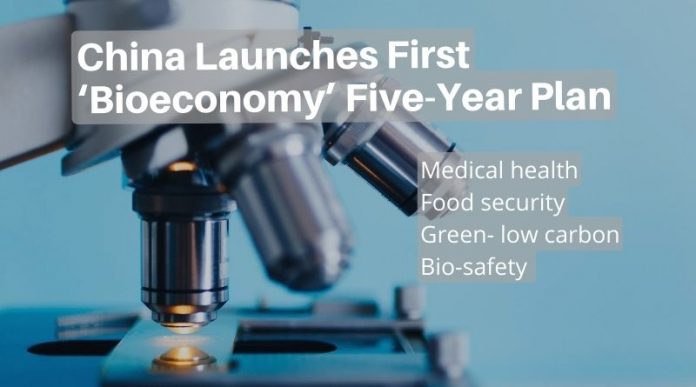
China Launches First ‘Bioeconomy’ Five-Year Plan

The four key development areas of the bioeconomy are medical health, food security, green and low-carbon and biosafety.

China has launched its first five-year plan for the development of the biotechnology economy, vowing to raise the value of the sector to 22 trillion yuan ($3.3 trillion) and nurture more companies with revenues upward of 10 million yuan.

The plan, published by the National Development and Reform Commission (NDRC), aims to grow the contribution of what is dubbed the ‘bioeconomy’ to China’s GDP.

According to the plan the “bioeconomy” is driven by the development and progress of life sciences and biotechnology, based on the protection, development and utilisation of biological resources, and is based on extensive integration of medicine, health, agriculture, forestry, energy, environmental protection, materials as well as other industries.

Why should the “bioeconomy” be planned separately?

On May 10th, Wang Xiang, deputy director of the High Technology Department of the National Development and Reform Commission, explained at a press conference the considerations for releasing the first five-year bioeconomy plan.

Wang said that at present, the development of the bioeconomy and the global bio-tech revolution and industrial transformation are at a major intersection.

As an important part of China’s science and technology economic strategy, the bioeconomy will provide new opportunities for addressing major challenges such as life and health, climate change, resource and energy security, and food security solutions.

Wang Xiang, deputy director of the High Technology Department

What are the four key industries of China’s Bioeconomy Five-Year Plan?

According to Wang, the four key development areas of the bioeconomy are medical health, food security, green and low-carbon and biosafety.

Related: A Biotech Revolution is coming, is the Hainan FTP ready?

The new document, released by the National Development and Reform Commission, said it is important to boost the bioeconomy during the next five years, to help meet the rising domestic demand for healthcare and better lives, foster high-quality economic development, prevent and control biosecurity risks and modernise China’s system and capacity for governance.

NDRC said the new plan is in line with the requirements of the 14th Five-Year Plan, which pledged to promote the integration and innovation of biotechnology and information technology, as well as accelerate the development of biomedicine, biological breeding, biomaterials, bioenergy and other industries to enhance the bioeconomy in both scope and strength.

Under the plan, a model focusing on protecting and using biological resources and integrating medicine, healthcare, agriculture, forestry, energy, environmental protection, materials and other sectors will become a key driving force to boost high-quality development by 2025.

The Hainan FTP and deepening cooperation in bio-economy innovation

The Plan encourages domestic biological scientific research institutions to take the initiative to initiate and participate in international major scientific projects and participate in the protection and utilisation of biological resources, medicine and health, bio-manufacturing and other fields for international rule and standard setting.

Under the plan it is also important to promote innovative drugs, high-end medical devices, genetic testing, products and services such as pharmaceutical research and development services, traditional Chinese medicine, and Internet diagnosis and treatment are encouraged to go global.

Bio-enterprises are encouraged to establish overseas R&D centres, production bases, sales networks and service bodies.

Departments are to accelerate integration into the international market, accelerate the construction of foreign cooperation bio-industrial parks. International cooperation will focus on the field of medical and health care in the Hainan Free Trade Port to explore the development and application of advanced biotherapeutic and diagnostic technologies.

Related article: June 1st! Haikou to give 5 million in subsidies to newly established state-level key laboratories

LEAVE A REPLY

Please enter your comment!
Please enter your name here

- Follow Us on WeChat -

spot_img

Related articles:

Lost Your Passport in China: The Emergency Document You Should Know About

Lost your passport in China? If your embassy, consulate, or relevant home-country institution in China cannot reissue a travel document, China has an Exit-Entry Permit for Foreigners …

Hainan’s Free Trade Port Is Moving From Incentives to Usability

Hainan’s new services plan points to a shift in how foreign operators may use the FTP: banking, permits, policy access and talent recognition …

How Hainan’s 30% Rule Is Beginning to Shape Business Decisions

How Hainan’s 30% rule is beginning to shape business decisions for companies using the FTP’s customs route into mainland China ...

Typhoon Season 2026, What Hainan Residents Can Expect in the Coming Months

Typhoon Season 2026 in Hainan: What residents need to know about storm forecasts, El Niño impacts, ferry suspensions, airport disruptions, warning levels, and how to prepare for typhoons from July to October ...

Get weekly email updates for new articles published!

Follow Us on WeChat

spot_img

Latest Articles ...

How international graduates can stay in China after graduation through Hainan’s startup residence route, and why it does not allow paid work ...
What spouses on S visas in China can and cannot legally do, including work, tutoring, remote work, volunteering, tax, and permit risks ...
A complete guide, how to apply online for a provisional driving permit in Hainan as a foreign national, including the application steps, required documents, and the online learning module you must complete ...
Foreign employees in China may have a Housing Provident Fund account they have never checked. The balance, employer contributions included, can be withdrawn in full when you leave. Here is how to claim it before you go …
spot_img

China’s Green Card: How Rare Is It, and What It Takes to Get One

Between 2004 and 2017, China issued just over 10,000 permanent residency permits to foreign nationals. This guide explains the four eligibility routes, the real criteria, and your honest odds of qualifying …

Why Your Passport Doesn’t Work: A Foreigner’s Guide to China’s ID-Only Systems

Your passport is legally valid for trains, hotels, SIM cards and payment accounts in China. The problem isn't the rules, it's the systems built on top of them …

China’s 2026 Work Permit Salary Rules: Who Actually Needs to Worry?

China’s work permit salary thresholds have raised concerns among foreign professionals. This explainer clarifies the 6× and 4× rules, why the figures appear high, and who is actually affected ...

Change Jobs in China Without Losing Your Legal Status

A practical guide to changing employers in China without losing your work permit or residence status, with timelines, documents, and common risks explained ...
spot_img

Looking for an international pre-school in Haikou?

Flora's International Preschool has three preschools in the Haikou area. Our schools follow a European curriculum

Continue Reading ...

Lost Your Passport in China: The Emergency Document You Should Know About

Lost your passport in China? If your embassy, consulate, or relevant home-country institution in China cannot reissue a travel document, China has an Exit-Entry Permit for Foreigners …

Hainan’s Free Trade Port Is Moving From Incentives to Usability

Hainan’s new services plan points to a shift in how foreign operators may use the FTP: banking, permits, policy access and talent recognition …

How Hainan’s 30% Rule Is Beginning to Shape Business Decisions

How Hainan’s 30% rule is beginning to shape business decisions for companies using the FTP’s customs route into mainland China ...

Get weekly email updates for new articles published!

Never miss another important notice or event. Be informed of what you need to know, when you need to know it.