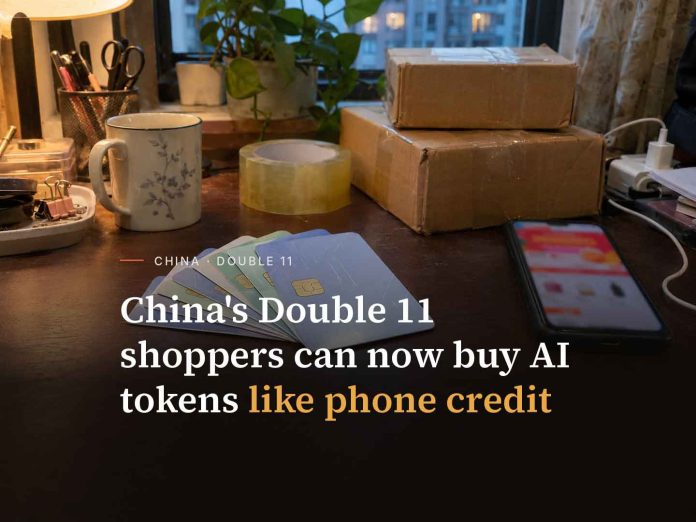
On the evening of 2 November, the Taobao livestream host Li Jiaqi listed a kind of product his channel had never sold before: AI computing, packaged as a one-month personal membership card for Qwen Office (千问办公). It was the first time a leading Chinese shopping livestream had sold AI tokens, 21st Century Business Herald reported.
According to the paper’s 21jingji news site the card normally costs 28 yuan, in Li’s livestream it cost one fen, or 0.01 yuan. Only buyers with no previous subscription could redeem it. It covers office work such as documents, data and slides. Within half an hour 100,000 had sold, equal to about 2 trillion tokens.
Tokens (词元, ciyuan) are the units in which AI language models measure use and charge for it. In the past, that usage was settled by volume inside each AI model company’s systems. This year, it reported, tokens went on sale as a separate category on several shopping platforms for the first time during Double 11 (双十一), China’s annual online shopping festival, which culminates on 11 November.
A top-up counter for AI
Alibaba’s Tmall opened a token top-up centre on 3 September. By 1 November it carried DeepSeek, Alibaba Cloud, Zhipu and Kimi, according to Xinhua; MiniMax, Qwen Office and StepFun (阶跃星辰) had opened stores there too. Shoppers find it by searching “Token” on Taobao.
JD.com opened an “AI software top-up hall” in September with Zhipu’s GLM, DeepSeek, Doubao and others, alongside AI books and app memberships such as WPS, China Youth Daily reported on 3 November.
Buyers have two main options, Pay-as-you-go vouchers work like mobile phone credit: use them up, then buy more. Subscriptions give a fixed monthly or yearly allowance: buy too much and some goes unused, too little and it runs out. To top up, buyers give the phone number linked to their AI account.
A Qwen AI Lite monthly card listed at 60 yuan on the official website sold for 39 yuan in the festival, 35% less. Wang Daoxing, executive director of an AI company in Chongqing, told Xinhua his firm spends over 2,000 yuan a month on tokens. He bought twelve months of Qwen AI’s standard card, well below the official website price.
On 20 October, the first day of the Double 11 sales, the transaction value of Tmall’s token category rose 450% on the previous month, a Tmall executive told Xinhua. Neither Tmall nor Xinhua gave amounts in yuan. Tmall says the buyers are mainly individuals and small businesses with a clear need for AI: households, students and researchers, and one-person companies.
Small numbers behind the percentage
Despite a reported 450% rise in sales, demand remained modest. By 23 October, Yicai reported just 300 token sales at Zhipu’s Tmall store and slightly over 100 at MiniMax. Li Jiaqi’s 100,000 cards were an exception, but at one fen each, they would have generated only about 1,000 yuan.
Comparing offers remains difficult. The same text can consume 20% to 50% more tokens on one model than another, while subscriptions come with different allowances and billing rules. Providers also face limits on computing capacity, making it difficult to guarantee access if demand exceeds what their systems can handle.
Related article: Bitten at home, a non-coder used AI to build a hotel bed bug map