Hainan’s Technology Push Is Moving from Plans to Implementation
Between 31 July and 18 August, four developments suggested that Hainan’s long-running technology ambitions were entering a new phase.
A new provincial deep-sea industry group was established in Sanya. Hainan Daily reported that more than 40 domestic semiconductor companies had established a presence in the province, with several already in production. Wenchang officials said two commercial launch pads were now in routine operation and its satellite manufacturing facility had entered trial production. A day later, the National Data Administration named Hainan among ten locations taking part in a new national pilot for international data cooperation.
Individually, these developments are modest. Together, they suggest Hainan’s technology strategy is beginning to move beyond policy documents and into something more tangible: operating infrastructure, new companies and institutions built around sectors the province has been promoting for years.
Commercial aerospace, deep-sea technology and the digital economy already sit within Hainan’s 2026–2030 industrial strategy. The province groups these alongside seed industries and green development under its five-part “Five Directions Strengthening” (五向图强) framework: seeds (向种图强), sea (向海图强), sky (向天图强), green development (向绿图强) and digital development (向数图强).
Wenchang moves beyond proving it can launch rockets
Wenchang has already crossed the clearest operational threshold.
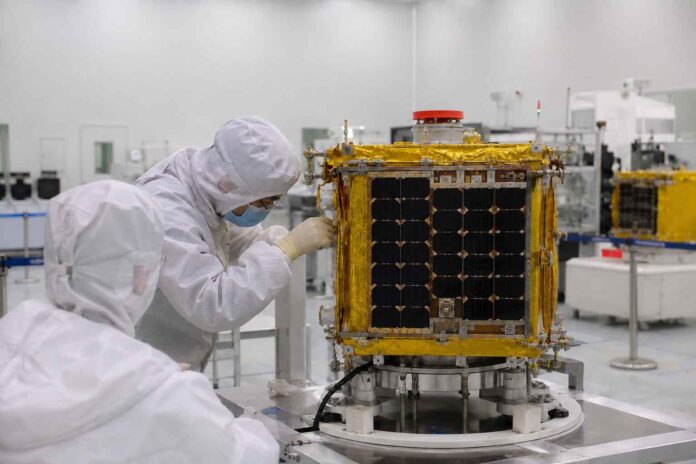
At a provincial press conference on 17 August, Wenchang officials said launch pads 1 and 2 at the Hainan Commercial Aerospace Launch Site had entered routine operation. The production line at the satellite “super factory” had entered trial production, while offshore rocket-recovery infrastructure and tracking and control systems were being developed.
Officials also said launch pads 3 and 4 were under construction, with the aim of having them capable of launches by the end of 2026. The first satellite from the new manufacturing facility is targeted to come off the production line before year-end, while several rocket-related projects are also under construction in Wenchang.
Things have changed considerably since late 2024, when the immediate story was whether China’s first commercial aerospace launch site could operate successfully. Its first mission took place on 30 November 2024, when a Long March 12 carrier rocket placed two technology test satellites into orbit. The China National Space Administration said the site had been built and brought to first launch in 878 days.
Wenchang hosts both China’s national Wenchang Space Launch Site (文昌航天发射场) and the separate Hainan Commercial Aerospace Launch Site (海南商业航天发射场). The commercial project is intended to support a wider system involving launch services, rocket and satellite manufacturing, satellite applications and related aerospace businesses.
Hainan joins a national pilot for international data cooperation
The most immediate new development for international companies came on 18 August.
At a National Data Administration press conference in Beijing, Hainan was named as one of ten locations in the first group of pilots for international cooperation in the data sector. Hainan Free Trade Port’s pilot work will focus on cross-border data flows and international data services.
The 《海南自由贸易港国际数据中心发展规定》 (Provisions on the Development of International Data Centers in Hainan Free Trade Port) was adopted on 29 November 2024 and took effect on 1 December that year. It supports both domestic and overseas enterprises developing international data-centre businesses in Hainan and defines international data-centre business around data storage, processing, trading and related services provided to overseas recipients through dedicated cross-border channels.
Companies registered in Hainan with service facilities in the Free Trade Port can apply through a licensed basic telecommunications operator for access to dedicated cross-border communications channels, giving eligible businesses a formal route for providing international data services.
The rules identify potential international data-service applications including gaming, film and television processing, commercial aerospace, BeiDou applications, cross-border e-commerce, cross-border livestreaming, tourism, telemedicine, distance education, international academic cooperation and multinational production and manufacturing.
They also address the technology used to provide those services. International data-service providers may choose trusted and secure domestic or overseas cloud services, computing chips and AI large models. The provisions also set out circumstances in which qualifying data activities may be exempt from standard cross-border data security assessment, personal-information standard contract or personal-information protection certification procedures.
The August pilot announcement does not itself create a new set of operating rules. Its importance is that Hainan’s existing regulatory framework is now being placed inside a national pilot specifically focused on cross-border data movement and international data services.
Among the four sectors examined here, this currently gives international data services the clearest link between policy and potential business application. There is already legislation, an application route, defined service scenarios and explicit provision for overseas enterprises.
More than 40 semiconductor companies reported in Hainan
While Hainan’s semiconductor sector is less developed, there is now more evidence of an industry beginning to form.
On 10 August, Hainan Daily reported that more than 40 domestic semiconductor companies had established a presence in Hainan and that several had already entered production. The report described a preliminary four-part chain covering chip design, packaging and testing, finished-product manufacturing, and bonded repair and remanufacturing, giving a clearer picture of the semiconductor sector beginning to take shape in Hainan.
Hainan’s current industrial planning does not centre on large-scale wafer fabrication. Instead, it emphasises chip design, advanced packaging and testing, and downstream repair and manufacturing activities, including semiconductor equipment, storage products and mobile terminals.
Bonded repair and remanufacturing are particularly relevant to the Free Trade Port model because they connect semiconductor activity with Hainan’s trade, customs and processing policies. Packaging, testing and design also require a different industrial base from leading-edge wafer fabrication.
There is still a large gap between these 40 companies establishing a presence and Hainan becoming a significant semiconductor centre. Hainan Daily itself describes the four-part chain as preliminary. But the August report provides something previous industry plans did not: evidence of companies entering the province and some production beginning.
That makes the semiconductor story worth watching for a different reason from Wenchang. The question is not whether Hainan can build a complete semiconductor industry. It is whether it can establish a commercially viable niche around selected parts of the supply chain where Free Trade Port policies provide a practical advantage.
Yazhou Bay creates a vehicle to commercialise deep-sea technology
A similar transition is being attempted in Sanya, although from a very different starting point.
On 31 July, the Yazhou Bay (Hainan) Deep-Sea Group Co., Ltd. (崖州湾(海南)深海集团有限公司) was formally unveiled at Sanya Yazhou Bay Science and Technology City. It is intended to serve as a provincial deep-sea industry platform, bringing together marine assets and helping move research and technology towards industrial application.
According to reports, the group incorporates existing assets including deep-sea research and testing infrastructure and is intended to integrate deep-sea resources, develop an industrial chain and promote the commercialisation of research results. Cooperation agreements with marine research and technology organisations were also signed when the group was established.
This gives the new organisation something substantial to work with.
Yazhou Bay already contains the Institute of Deep-Sea Science and Engineering of the Chinese Academy of Sciences and major marine research and testing infrastructure. Xinhua reported in March that more than 1,000 marine-related enterprises had gathered in Yazhou Bay Science and Technology City, while the National Marine Comprehensive Test Site provides deep-water conditions for equipment testing and verification.
Hainan’s 15th Five-Year Plan points towards deep-sea intelligent equipment manufacturing, underwater robots, subsea production systems, key components and maintenance and repair services. It also identifies technologies associated with marine mineral resources, including zirconium-hafnium and cobalt-nickel resources, as future development areas.
The establishment of the Deep-Sea Group gives Hainan a new organisation specifically intended to help bridge the gap between scientific capability and industry.
While Wenchang is already operating commercial launch infrastructure, Yazhou Bay is at an earlier stage, with the emphasis on turning its deep-sea research base into commercial technology, equipment and services.
Four industries, four different stages
The four sectors are at very different stages. Wenchang already has operating commercial launch infrastructure and is beginning to add manufacturing capacity around it. International data services have both a regulatory framework and a national pilot designation. Hainan’s semiconductor industry remains small and specialised, while Yazhou Bay is still largely research-led, with a new provincial platform intended to push more of that capability towards commercial use.
For overseas companies, international data services currently offer the clearest route into the market because the legislation explicitly provides for foreign enterprises. Opportunities in aerospace, semiconductors and deep-sea technology are less developed and will depend more heavily on the industries and supply chains forming around the infrastructure already in place.
Hainan has promoted these sectors for years.
What changed in July and August 2026 was not the strategy, but implementation: operating infrastructure, companies entering production, a national pilot and a new commercialisation platform. The question now is whether those pieces can develop into viable industries and whether the Free Trade Port gives companies enough reason to build them in Hainan rather than elsewhere in China.
Related article: Hainan Is Planning an Entirely New Transport Layer Between the Roads and Conventional Aviation