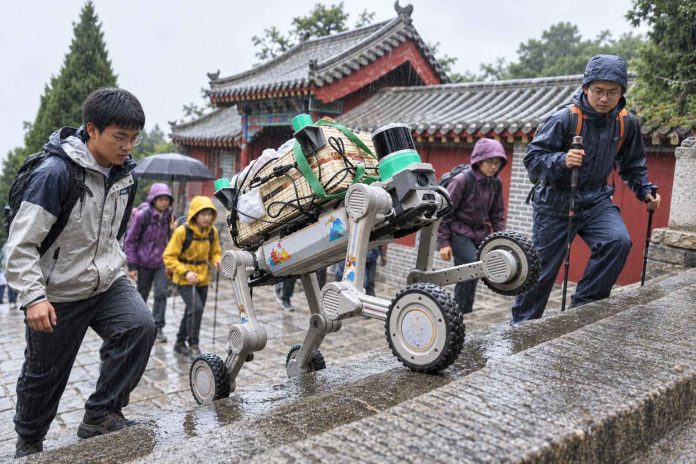
At China’s first robot-climbing competition on Mount Tai, a four-legged machine covered more than 3,100 stone steps in about an hour, comfortably beating the time taken by most hikers. But the achievement also reveals how much these robots still depend on careful preparation and advance knowledge of the terrain.
On 26 October, in pouring rain, a four-legged robot developed by Zhishen Technology (智身科技) climbed a section of China’s Mount Tai in about an hour. Starting at Hongmen (红门), the gate at the mountain’s foot, it reached Zhongtianmen (中天门), or the Middle Gate of Heaven, in roughly half the time many hikers would need, walkers typically take between 90 minutes and two hours to complete the same climb.
The performance put Zhishen’s robot first in qualifying for the inaugural CMG World Robot Mount Tai Climbing Competition (首届CMG世界机器人登泰山大赛). The competition is jointly organised by two divisions of China Media Group (CMG), China’s state broadcaster, and the Tai’an municipal government.
This is not a purpose-built obstacle course. The robots must negotiate a historic stone pathway that remains in everyday use by tourists. The 3.8-kilometre route from Hongmen to Zhongtianmen includes more than 3,100 stone steps and rises approximately 600 metres. CCTV describes it as a “thousand-year” stone way.
While the qualifying runs demonstrated that a four-legged robot can climb this demanding route faster than an ordinary hiker, it also highlighted an important qualification: unlike human walkers, the machines depend heavily on detailed reconnaissance and advance mapping of the terrain.
When the referees couldn’t keep up
One of the more unexpected problems during qualifying was that the robots proved too fast for the people supervising them.
Initially, each machine was followed up the mountain by a referee on foot. That arrangement quickly became impractical.
“Robots run on electricity, and our referees run on food,” chief referee Su Qingwei (苏庆伟) told CCTV News. “It can change its battery and keep accelerating, but our referees’ stamina is limited.”
The organisers responded by abandoning the idea of having referees follow individual robots. Instead, officials were stationed at fixed points along the route, each responsible for a section of approximately 50 to 60 metres. At blind bends, neighbouring referees must remain within sight of one another, Su explained.
Speed, however, is only part of the contest. The robots climb alongside ordinary visitors, making safety and adherence to the course essential.
Under the rules Su outlined to the Taishan Evening News, in a report reproduced by The Paper, team members are forbidden from lifting or carrying their machines up the steps. A robot that strays from the designated course and risks obstructing tourists also incurs a penalty.
Infractions add either 50 or 100 seconds to a competitor’s time. As a result, the first machine to reach the finish line is not necessarily the winner.
The advantage of knowing the route
Although the robots must negotiate an irregular mountain path, they are not being asked to find their way through entirely unfamiliar surroundings.
According to CCTV, both four-legged robots and two-legged humanoids first traverse the entire course to construct a detailed map. This gives them a substantial advantage when they return to race.
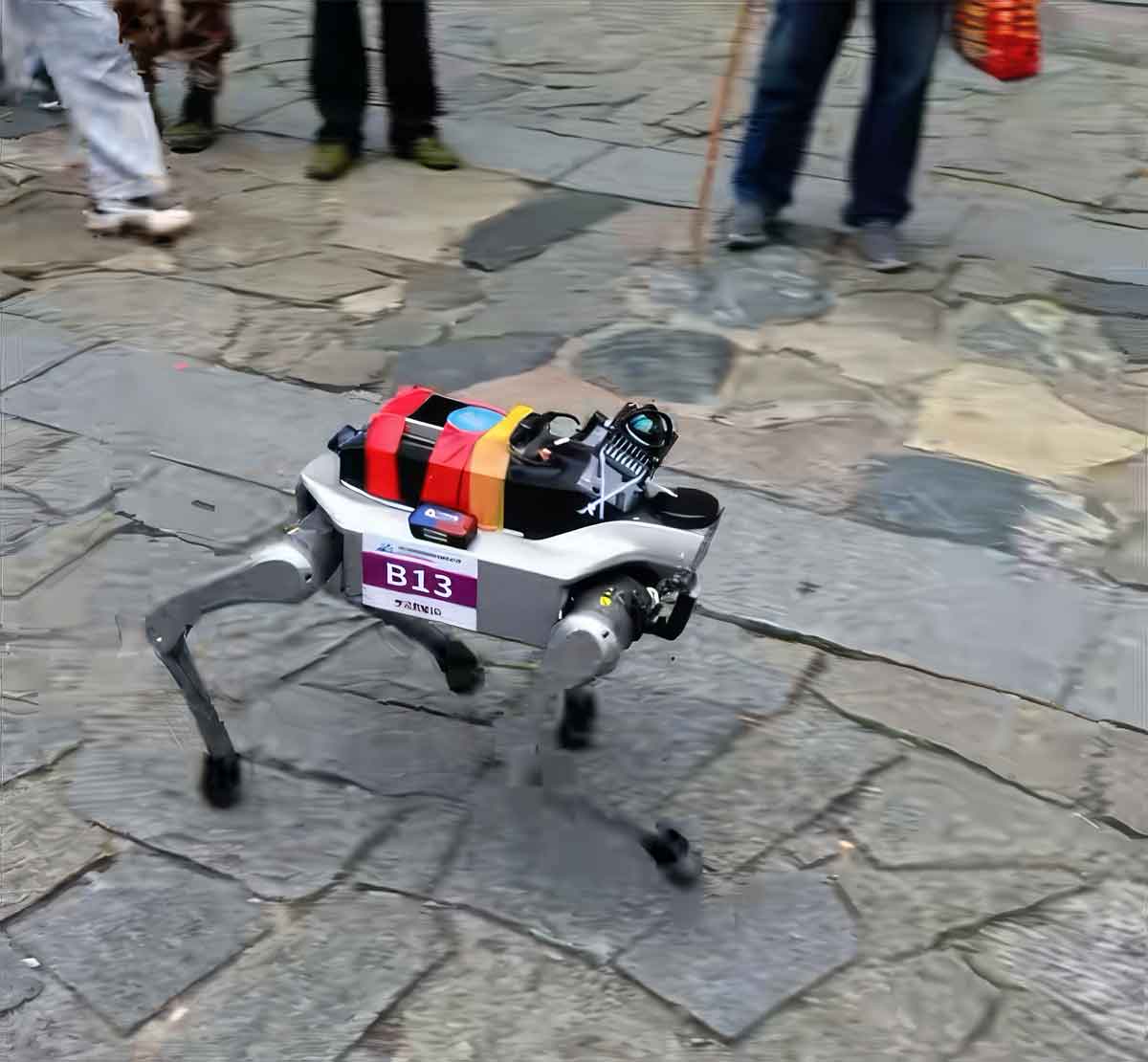
“The robot dog carries a lidar that scans the terrain with infrared laser and judges whether something is a step, a rock, a roadside obstacle or a tree,” explained Chen Lin (晨霖), a navigation engineer with the Yufan Lingmao team.
The information is used to create a three-dimensional map that helps the robot determine its route.
For humanoid robots, the challenge is considerably greater. Their taller bodies make balance and control of the centre of gravity more difficult, CCTV reported. Some teams have responded by relocating cameras from the robots’ heads to their chests, giving them a better view of the steps immediately ahead.
Beyond racing: robots built for real work
The competition is intended to test more than climbing speed. It includes four formal events: a humanoid speed race, a legged-robot speed race, a legged-robot load race and an exoskeleton event. There is also an all-terrain route-finding challenge.
The race coincided with the 2026 China (Taishan) Embodied Intelligence Industry Exhibition, which rans from 1 to 3 November at the Taishan International Convention and Exhibition Centre in Tai’an.
A different kind of finish line
At the time of writing, the finals results have not been published.
Whatever the outcome, the contest has already demonstrated both the remarkable climbing ability of modern legged robots and the limitations that remain. They can tackle thousands of irregular stone steps at speeds that challenge human endurance, but only after carefully mapping the route ahead.
Related article: Using Chinese Apps? China Signals Stronger Protection for Your Personal Data