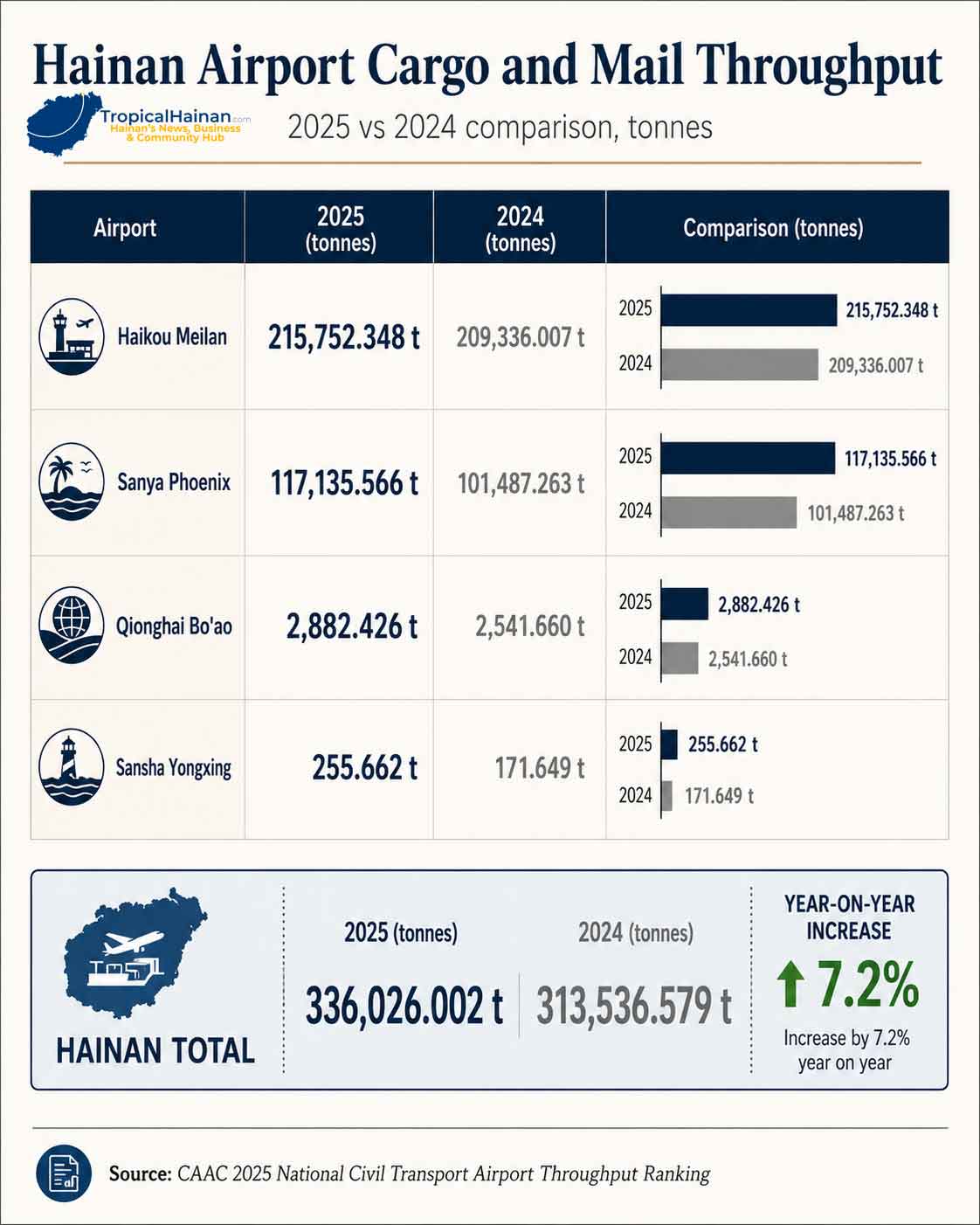
Hainan’s airports handled 336,026 tonnes of cargo and mail in 2025, an increase of 7.2% from the previous year. Under the province’s new 2026–2030 service-sector plan, the target is at least 480,000 tonnes by 2030.
On the surface, the target looks ambitious: it requires an increase of almost 43% in five years. But the annual growth rate needed is about 7.4%, almost exactly the pace Hainan recorded in 2025. In other words, the challenge is not a sudden acceleration in air-cargo growth, but sustaining the recent rate for another five years.
Air cargo is only one part of a much wider logistics push. The same plan targets 100 container-liner routes, around 100 stable international and regional air routes, 140 million tonnes of cargo through Yangpu Port, and a much broader expansion of cold-chain, bonded, multimodal and smart-logistics services.
Hainan already has much of the basic maritime and aviation connectivity on which those targets depend. The bigger question is whether Hainan can turn its existing logistics-services base into a broader, higher-value industry around the freight moving through its ports and airports.
The shipping network is already more than three-quarters of the way to 100 routes
Hainan is starting relatively close to its headline shipping target.
At the end of 2025, the province operated 75 container-liner routes, including 36 foreign-trade routes, according to the 2026 Provincial Government Work Report. By June 2026, the provincial transport department was reporting 77 routes, including 38 foreign-trade routes, following further additions during the first half of the year. The operating target for 2026 is 80.
The service-sector plan says the total number of container-liner routes should reach 100 by 2030. A separate Hainan Province 15th Five-Year Comprehensive Transport (Highway and Waterway) Development Plan, issued in July, provides more detail: it calls for 100 stably operating container-liner routes province-wide, including 46 foreign-trade routes.
The 100-route target is a province-wide target, not a Yangpu-only figure.
Yangpu nevertheless accounts for much of Hainan’s container-liner network. Xinhua reported 65 container-liner routes at Yangpu in early January 2026, comprising 30 domestic and 35 foreign-trade services.
The 100-air-route target is closer to maintenance than expansion
By the end of June 2026, Hainan had 90 overseas passenger-and-cargo routes, serving 28 countries and 50 cities. The provincial transport department said it was aiming to push that number above 100 during 2026.
That makes the service-sector plan’s 2030 target of around 100 international and regional routes more stable operation and less an expansion target. The plan also calls for around 500 domestic air routes by 2030.
Cargo gives a clearer measure of what Hainan is trying to build
Air-cargo volumes provide a more straightforward benchmark.
Civil Aviation Administration of China data show that Meilan handled 215,752 tonnes of cargo and mail in 2025, Phoenix handled 117,136 tonnes, Bo’ao handled 2,882 tonnes and Yongxing handled 256 tonnes.
Together, those figures give Hainan a 2025 total of 336,026 tonnes. Reaching the 2030 target of 480,000 tonnes means adding roughly another 144,000 tonnes of annual throughput.
The plan is also specific about the types of freight it wants Hainan to attract. It identifies cross-border e-commerce, fresh and cold-chain products and high-value manufacturing components. To support those flows, it calls for dedicated freighters, greater use of passenger-aircraft belly capacity, aviation cold-chain services, bonded aviation logistics, airport distribution centres and airport-to-port connections.
It also proposes an “inland China–Hainan–Southeast Asia” transit corridor, explicitly seeking cargo originating outside the island for consolidation and onward movement through Hainan.
More routes do not automatically mean more logistics business. A route can exist without carrying much freight. What matters commercially is whether Hainan can attract regular cargo volumes, distribution centres, bonded and cold-chain operations, and customers that use the network consistently.
Yangpu’s target is 140 million tonnes
The scale of the maritime growth target is clearer at Yangpu.
The port handled 85.948 million tonnes of cargo in 2025, up 29.64%, while container throughput reached 3.311 million TEU, an increase of 65.39%. Foreign-trade container throughput alone reached 1.086 million TEU, up 113.66%.
The service-sector plan targets 140 million tonnes of cargo throughput at Yangpu by 2030. That is about 63% above the 2025 level and would require compound annual growth of roughly 10.3%.
That is considerably slower than Yangpu’s 29.6% cargo growth in 2025. If growth were evenly distributed across the five years, an annual rate of about 10.3% would be enough to reach the target.
The plan’s ambitions extend well beyond moving more cargo.
Its higher-value shipping agenda covers international vessel registration, bonded marine fuel, maritime arbitration, shipping finance, insurance and reinsurance, ship supply and repair, seafarer services and an offshore shipping settlement centre.
Vessel registration is one area where there is already a measurable base. Hainan’s transport department reported 95 vessels registered under “China Yangpu Port” by the end of June 2026, representing more than 8.6 million deadweight tonnes. That meant Hainan had passed its full-year goal of 8 million deadweight tonnes early. The 2026 target is 100 or more registered vessels.
Registering more ships in Yangpu however does not necessarily mean more shipping business is being done in Hainan. The plan wants to expand the services around those ships and cargo flows, including finance, insurance, legal services and settlement.
Infrastructure projects are at very different stages
The infrastructure intended to support that strategy ranges from projects already under construction to proposals that remain at much earlier stages.
The Xinhai Land-Island Logistics Park start-up area is under construction in 2026. Seven buildings had topped out by March, and cumulative fixed-asset investment was reported at RMB1.266 billion by early May. Authorities are targeting completion and acceptance around the end of 2026.
The Hainan International Smart Trade and Logistics Cloud Port, in Haikou’s Jiangdong New Area, is likewise a construction project rather than an operating logistics facility.
Work began in January 2025. By the end of that year, the project had moved into secondary-structure with completion and acceptance targeted for August 2026. At the time of writing, no source reviewed for this article confirms that final acceptance has taken place.
Other projects remain much earlier in the development process.
At the end of 2025, Hainan’s Development and Reform Commission was still selecting appraisal agencies for the proposal, feasibility study and preliminary design of the Sanya suburban large-warehouse cold-chain logistics park. The project’s estimated investment was RMB598.13 million.
That figure is an estimated project cost. It is not money already invested, nor is it evidence that construction has started.
Digital infrastructure has progressed further.
The first phase of the Hainan Free Trade Port Smart Logistics Big Data Platform went online in June 2025. The project has reported total investment of RMB159 million and is planned around three main modules and 18 subsystems. Its first two live systems cover provincial cold-chain public services and non-staple-food procurement and distribution.
The 2030 plan sets a broader objective, calling for a province-wide logistics “one network” that integrates public and market data.
Low-altitude freight is operating, but only at one end of the scale
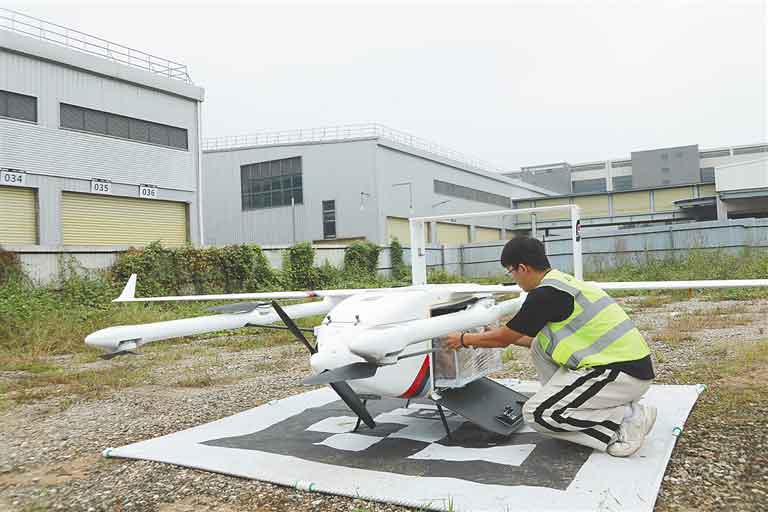
On 1 December 2025, SF Express’s Hainan unit and its drone subsidiary Fengyi Technology opened a route between Haikou’s Xiuying district and Xuwen in Guangdong. Official reporting described it as a 常态化物流航线, a regular or normalised logistics route.
The inaugural flight carried simulated emergency supplies across the Qiongzhou Strait in 19 minutes. The Fengzhou 90 drone has a stated payload of 20 kilograms.
A much larger aircraft crossed the strait at the end of the same month, but that flight was at a different stage of development.
On 31 December, AutoFlight’s unmanned CarryAll eVTOL flew 23 kilometres from Haikou’s Mingzhu Island to Xuwen Port in nine minutes. The aircraft has a maximum take-off weight of two tonnes and a maximum commercial payload of 400 kilograms.
AutoFlight described the flight as a 运输场景验证, or transport-scenario verification, intended to lay the groundwork for future regular operation. It was not an existing scheduled heavy-freight service.
The service-sector plan goes further still. It names a Chengmai–Xuwen cross-sea low-altitude freight corridor and proposes cargo eVTOL and heavy-lift drone operations.
No approval, test, launch or regular commercial operation for that specific corridor was independently established in the research for this article. The Chengmai–Xuwen route therefore remains a plan proposal, not evidence of an operating freight link.
Types of companies Hainan wants to attract
The service-sector plan is not only a list of infrastructure and throughput targets. During 2026–2030, it calls for the recruitment each year of 10 freight-forwarding companies, one or two comprehensive shipping-service companies or large-company transshipment operations, one or two leading international air-cargo companies, one or two cold-chain logistics companies, and further supply-chain, pharmaceutical, green-logistics, digital-freight and drone-logistics operators.
For companies assessing Hainan, the plan therefore points to two different types of market.
Freight forwarding, port operations, air cargo, warehousing and some digital logistics already have measurable activity and infrastructure behind them. Other areas, including shipping finance, marine insurance and reinsurance, maritime arbitration, offshore settlement, bonded aviation logistics and high-capacity low-altitude freight, are better understood as policy-backed markets that Hainan wants to deepen rather than mature industries whose scale can already be demonstrated.
Hainan’s transport network is already close to several of the plan’s headline route targets, while freight volumes at Yangpu and the airports are rising.
The next layer of the strategy is different. It asks banks, insurers, law firms, freight consolidators, logistics technology companies and specialist operators to use that network as a place to do business.
Whether those services develop at the same pace as the ships, aircraft and cargo will be the more revealing test of Hainan’s logistics ambitions through 2030.
Related article: Hainan’s 2030 Service-Sector Plan Sets Targets for Trade, Finance, Logistics and International Services