Hainan expects services to account for roughly 61% of its economy in 2030. The headline share will change little. The planned changes are within the sector, as the province seeks to expand modern services, cross-border trade and specialised industries around Haikou, Sanya and Danzhou–Yangpu.
Hainan’s service sector accounted for 61.7% of provincial GDP in 2025. The province expects the figure to remain at around 61% in 2030.
The more substantial target concerns modern services. Their share of GDP is expected to rise from 27.5% to about 31%, with trade, logistics, finance, data services and professional industries more closely tied to the Free Trade Port’s international role.
The Hainan Provincial Government General Office issued the plan on 20 July 2026 as 琼府办〔2026〕39号. The document describes itself as an 行动指引, or “action guide”, for city and county governments, sector authorities and business entities during 2026–2030. A separate implementation opinion was published on 3 August, setting out more detailed measures.
A structural change, not simply faster growth
Most of the comparable growth targets are more cautious than Hainan’s reported performance during the previous five-year period.
The plan sets annual service-sector growth of at least 6% from 2026 to 2030, compared with an average of 6.9% over the previous five years. Modern services are expected to grow by at least 9% a year, against 11.4% previously.
The target for finance is 7%, compared with 8.4% during the previous period. Information transmission, software and IT services are set a 6% target, against 9.9%.
The plan is less a promise of faster growth than an attempt to change the composition of an economy already dominated by services. It gives greater weight to internationally traded and business-facing activities, including shipping, aviation, data processing, finance, offshore trade, testing, research and professional services.
Main 2030 indicative targets
| Indicator | 2025 plan baseline | 2030 indicative target |
| Services as a share of GDP | 61.7% | Around 61% |
| Modern services as a share of GDP | 27.5% | Around 31% |
| Goods imports and exports | RMB 276.0bn | RMB 444.5bn |
| Trade in services | RMB 69.26bn | RMB 172.3bn |
| Wholesale and retail value added | RMB 91.59bn | RMB 134.6bn |
| Transport, storage and postal value added | RMB 34.98bn | RMB 51.4bn |
| Financial-sector value added | RMB 54.1bn | RMB 76.6bn |
| Information transmission, software and IT services value added | RMB 45.85bn | RMB 61.4bn |
| Real-estate value added | RMB 87.18bn | RMB 106.1bn |
All nine indicators are marked 预期性, meaning “indicative” or “anticipated”. They set out the results the provincial government wants policy, investment and market activity to produce. They are not binding quotas or guarantees that the targets will be achieved.
Trade carries the fastest headline target
Among the nine headline indicators, trade in services carries the fastest annual growth target. Trade in services covers cross-border transactions in areas such as transport, tourism, finance, software, data processing and professional services, while goods trade covers physical products moving into and out of Hainan.
Hainan wants the annual value of services imports and exports to rise from RMB 69.26 billion in 2025 to RMB 172.3 billion in 2030. Reaching that figure would require average annual growth of approximately 20%.
Goods trade is expected to rise from RMB 276 billion to RMB 444.5 billion, equivalent to about 10% growth a year.
Haikou Customs said Hainan’s goods trade grew by an average of 24.1% a year during the 2021–2025 planning period, although the annual total fell by 0.7% in 2025. The plan’s 2030 target implies average annual growth of about 10% from that baseline. The year-on-year increase was already far above that pace in the first half of 2026, when Hainan’s goods trade reached RMB 194.93 billion, up 59.9%. The figures show that goods trade entered the new planning period with considerable momentum.
Services trade grew by 22.1% in 2025, close to the annual pace required under the plan. Hainan will need to maintain similar growth for five years and convert those cross-border transactions into sustained demand for businesses based in the province.
Part of a national services strategy
Hainan’s plan forms part of a wider national effort to improve China’s service industries.
China’s national 15th Five-Year Plan Outline for Economic and Social Development, covering 2026–2030, calls for 生产性服务业, or productive services, to become more specialised and move towards the higher end of the value chain. These services include logistics, research, software, finance, testing and other activities used by manufacturers and agricultural businesses.
The national plan also calls for consumer-facing services to become more varied, convenient and higher quality.
The State Council followed in April with an opinion setting a 2030 target of more than RMB 100 trillion for the total scale of the service sector.
It identified weaknesses in research and technical services, logistics, software, data, supply-chain finance, testing, environmental services and business support.
Hainan’s implementation opinion explicitly states that it was issued to carry out the State Council policy. It applies the national priorities to Free Trade Port industries, including international data services, offshore trade, cross-border finance, foreign medical institutions and international education.
The opinion confirms a target of RMB 660 billion in service-sector value added by 2030. It also targets average annual growth of at least 10% in the service sector’s actual use of foreign investment.
Haikou: aviation, digital trade and professional services
The plan gives Haikou’s economic circle four main priorities: airport-linked industries, digital trade, exhibitions and professional services.
The circle covers Haikou, Chengmai, Wenchang, Ding’an and Tunchang. It includes Meilan International Airport, Haikou Jiangdong New Area, the Haikou Comprehensive Bonded Zone, Fullsing Internet Information Industrial Park and technology parks in Chengmai.
By the end of the previous five-year period, Jiangdong New Area’s annual revenue had exceeded RMB 500 billion. Fullsing reported more than 7,000 companies and revenue above RMB 160 billion in 2024, with a focus on digital industries, international headquarters and cross-border data.
Those revenue figures measure business turnover within the parks. They do not measure the parks’ direct contribution to provincial GDP.
Haikou already has operating airport, bonded-zone, business-park and digital infrastructure. The commercial test is whether those assets attract enough companies and cross-border activity to sustain the professional and digital services the plan prioritises.
Sanya: premium consumption and research services
Sanya’s economic circle is assigned high-end tourism and culture, medical and wellness services, headquarters-related finance and science and technology services.
The circle includes Sanya, Wuzhishan, Lingshui, Ledong and Baoting. Its commercial base combines Sanya Central Business District with the research facilities and companies concentrated in Yazhou Bay Science and Technology City.
Sanya Central Business District reported 10,989 companies by the end of May 2026. Since its establishment, the park had added 239 foreign-invested enterprises and cumulatively introduced 31 headquarters companies.
The district’s industries include headquarters operations, finance, trade, cruise and yacht services. Newer activities include digital services and advanced manufacturing.
Yazhou Bay supports a different type of service economy. Its work in seed research and deep-sea science creates demand for laboratories, intellectual-property services, testing, technology transfer and specialist research contractors.
Several additional platforms named in the plan are presented as projects to be built or advanced, rather than as existing operating businesses.
Sanya is expected to combine high-value consumer services with research and corporate activity. Its ability to move beyond tourism will depend on the growth of those non-tourism clients.
Danzhou–Yangpu: ports, logistics and offshore trade
Danzhou–Yangpu receives the plan’s clearest trade assignment: international logistics, offshore trade and port-related industries.
Yangpu already has a working port, bonded operations, petrochemical industries, bulk-commodity trading and the “China Yangpu Port” international ship registry.
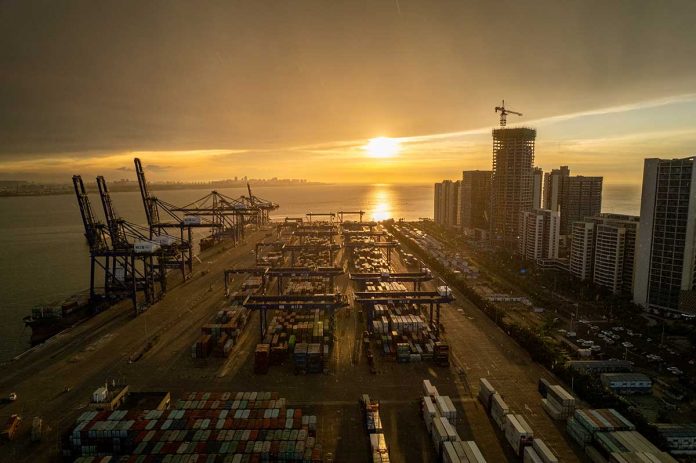
Yangpu Port handled 3.31 million twenty-foot equivalent units in 2025, an increase of 65.4%. Foreign-trade containers reached 1.09 million units, more than double the previous year’s level.
The plan seeks to develop higher-value services around those cargo flows. These include shipping finance and insurance, bonded marine-fuel supply, ship repairs, maritime arbitration and offshore settlement.
Expanding those industries is different from simply increasing port capacity. Banks, insurers, shipowners, cargo owners and professional-service firms must conduct real transactions through Yangpu. Policy can encourage that market, but it cannot create it by itself.
A guide to priorities, not automatic market access
Haikou, Sanya and Danzhou–Yangpu are Hainan’s three economic circles. They overlap with two wider regional groupings used in provincial statistics: the coastal city belt and the central mountain ecological conservation area. They are not exclusive development zones, and industries cannot be neatly confined within their assigned circles.
The assignments however, still offer a useful commercial map. In the plan, Haikou is directed towards aviation-linked, digital and professional services. Sanya combines premium consumption with finance and scientific research. Danzhou–Yangpu is built around trade, shipping and industrial logistics.
Neither the development plan nor the implementation opinion changes the licensing rules governing those industries. Foreign banks, telecommunications operators, hospitals, universities, airlines and data companies remain subject to national laws, negative lists and sector approvals. The documents identify where Hainan wants companies to invest and operate, but market entry still depends on the relevant national licensing and approval processes.
Full-year 2026 data will provide a broader test of the strategy: whether the rebound in goods trade is sustained, whether services trade remains near the planned 20% pace and whether modern services increase their share of the provincial economy.
Related article: Hainan-Registered Companies Nearly Triple Exports to Ten ASEAN Markets