Nov 11th, the State Council’s Joint Prevention and Control Mechanism announced 20 adjusted COVID-19 control measures which strictly forbid imposing arbitrary COVID-19 restrictions such as locking down schools, halting production, suspending transportation without approval and prolonging lockdowns unnecessarily.
Since the announcement, a series of laws, regulations and guidelines have been released to clarify the requirements.
Q: So, are COVID-19 restrictions in Hainan going to be lifted?
A: Not yet.
On November 30, Lu Ying, deputy director of the Emergency Response Center of the Hainan Provincial Center for Disease Control and Prevention, said that “it must be (made) clear, the “Twenty Points” are not about relaxing prevention and control, but adapting to the new situation of epidemic prevention and control and the new characteristics of the new coronavirus mutation.
According to the Emergency Response Center, the following points should be noted:
Requirements for close contacts have been adjusted from the original “7+3” to “5-day centralised isolation + 3-day home isolation” and the province will continue to implement centralised isolation measures for those who do not have the conditions for home isolation.
The “Twenty Articles” canceled the requirement to determine “second” close contacts. The “closeness” judgment must be accurately determined, and risk groups should be isolated and controlled as much as possible.
Requirements for people coming from high-risk areas have been adjusted from the original “7-day centralized isolation” to “7-day home isolation”. During this period, they are assigned codes and are not allowed to go out.
Risk areas are divided into “high-risk areas” and “low-risk areas”, “medium risk areas” are no longer designated.
The requirement for two negative nucleic acid test results taken within 48 hours before boarding has been adjusted to one negative nucleic acid test result within 48 hours before boarding.
According to the People’s Daily Health APP, the following Q&A on implementing the 20 measures should be clarified.
Q: Who has the power to implement lockdowns?
A: Only local governments at and above the county level can enforce lockdowns, according to China’s Law on the Prevention and Treatment of Infectious Diseases.
The law stipulates that governments at and above the county level should organize resources to cut transmission of contagious diseases when an outbreak occurs. If necessary, they should report to higher-level authorities to determine if emergency measures, such as suspending markets, art performances or other public gatherings; halting production; and closing down schools and venues that might cause further spread of the virus.
Q: Where can lockdown measures be applied during a COVID-19 outbreak?
A: High-risk areas, mostly confined to residential units or buildings, can be locked down, according to a protocol released by the State Council’s Joint Prevention and Control Mechanism on Nov 19th.
Areas where infected people live and areas deemed to be at high risk of virus transmission due to frequent visits by those high risk people can be categorized as high risk. The scope of high-risk areas can be expanded moderately when transmission chains are unclear.
It said high-risk areas should be locked down, and a round-the-clock patrol or electric door seals can be deployed to prevent population movement. Designated vehicles and personnel should be on hand to transport residents who need medical treatment.
Q: When should lockdown measures be lifted?
A: According to the protocol, a high-risk area can be downgraded to a low-risk area when no new infections are found for five consecutive days and all residents test negative on the fifth day. When these conditions are met, lockdown measures should be lifted promptly.
A low-risk area refers to all remaining areas in a county-level region where the high-risk area is located. Residents there are required to take precautions and avoid gathering, and present negative test results taken within 48 hours before leaving.
Q: Can fire exits at residential complexes or buildings be sealed?
A: It is strictly forbidden to block or seal off safety exits, or misappropriate access for fire brigade vehicles for virus control reasons.
According to the Law on Fire Protection, no institutions or individuals may damage, misappropriate, dismantle or deactivate firefighting equipment without authorization. Evacuation passages, safety exits and fire truck access shall not be occupied, blocked or closed off. Doors and windows in crowded places shall not be equipped with barriers that could affect escape and firefighting rescue efforts.
Q: How can COVID-19 control malpractices be addressed?
A: According to the announcement on Nov 11, rectification efforts will be stepped up to curb the one-size-fits-all approach and casual adoption of extra COVID-19 restrictions and violators whose actions result in serious consequences will be held accountable. In addition, task forces for rectification have been set up across different government levels.
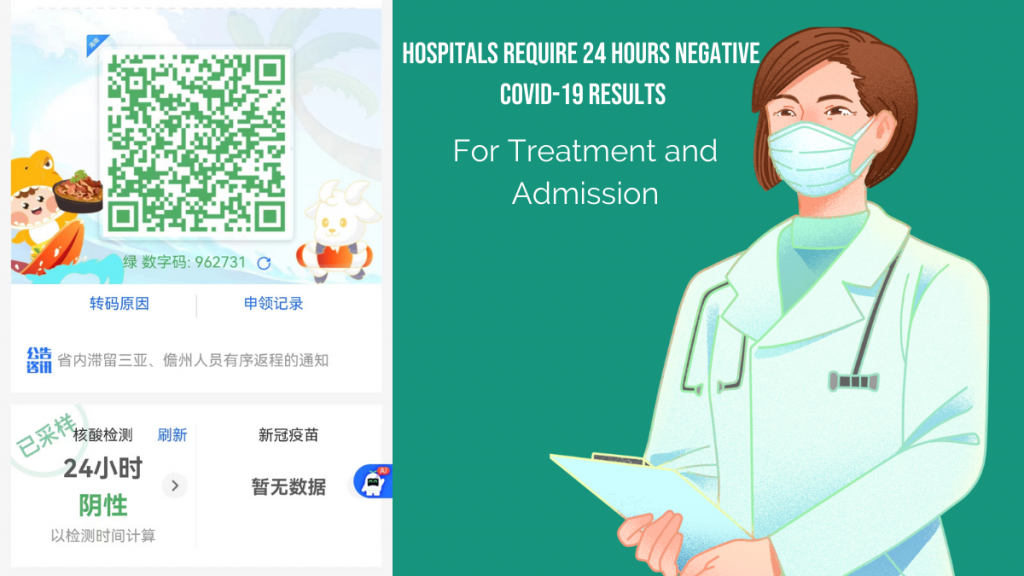
Related article: 24 hours negative nucleic acid results for hospital treatment and admission